
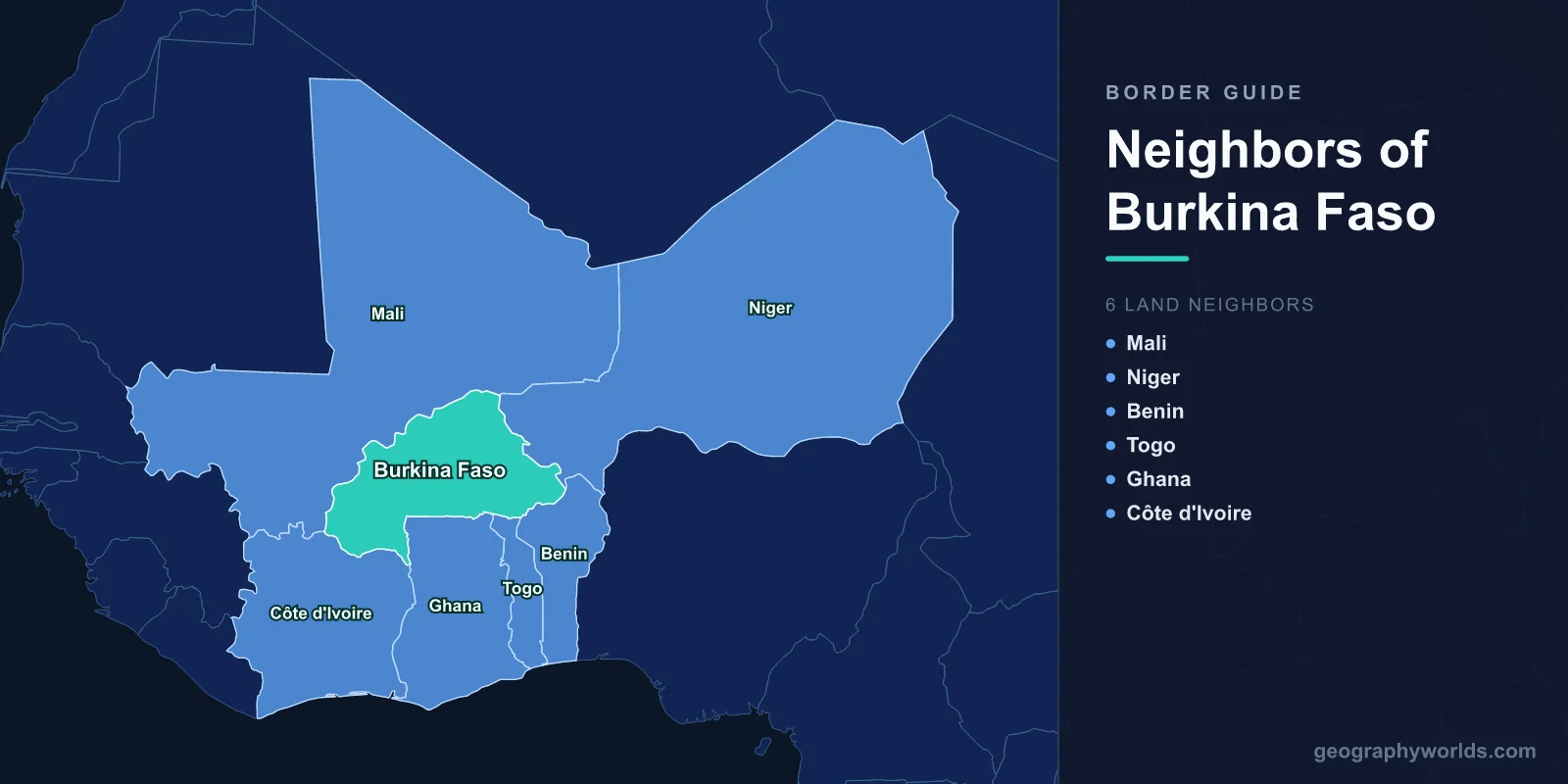
Burkina Faso shares land borders with six countries: Mali to the north and west, Niger to the east, and Benin, Togo, Ghana and Ivory Coast to the south. It has no coastline. Four of those six neighbours have ports, and the country's trade routes, colonial history and current security crisis are all organised around that single fact.
A Country That Was Abolished for Fifteen Years
Burkina Faso, then Upper Volta, was dissolved as a colony in 1932 and its territory parcelled out among Ivory Coast, French Sudan and Niger. The motive was labour: the densely settled Mossi plateau was a reservoir of workers for Ivorian plantations and construction, and removing the internal boundary made recruitment easier.
It was reconstituted in 1947 after sustained lobbying by Mossi traditional authorities and French-educated Voltaic elites. Independence came in 1960, and the name changed in 1984 when Thomas Sankara replaced the colonial hydronym with Burkina Faso, land of upright people, combining words from Mooré and Dioula.
The fifteen-year abolition left a permanent mark: a migration corridor south that still runs, and a diaspora in Ivory Coast numbering in the millions.
The Mossi Plateau Is Older Than Any of the Lines
The centre of the country is the Mossi plateau, and the Mossi kingdoms based at Ouagadougou, Yatenga and Tenkodogo were among the most durable states in West Africa, resisting Songhai and later Islamic conquest for centuries.
The Mogho Naba, the Mossi emperor in Ouagadougou, still holds substantial moral authority and has intervened publicly in national crises, mediating during the 2015 coup attempt. Mossi territory and related peoples extend across the modern borders into northern Ghana and Ivory Coast, so the frontier cuts a political community that predates France by several hundred years.
Four Ports, None of Them Its Own
Burkina Faso's imports and exports reach the sea through Abidjan in Ivory Coast, Tema in Ghana, Lomé in Togo and Cotonou in Benin. Each corridor is a road, and in one case a railway, running several hundred kilometres to a coast the country does not touch.
The choice between them is made on cost, congestion and politics. Abidjan has historically been dominant because of the railway and the colonial-era relationship, but Ivorian instability in the 2000s pushed traffic toward Lomé and Tema, and the diplomatic ruptures of the 2020s have moved it again.
Each of those four governments therefore holds a lever over Ouagadougou, and each has used it. Landlocked states do not have trading partners so much as gatekeepers.
The Railway That Still Runs
The Abidjan-Ouagadougou railway, begun under colonial rule and reaching the capital in 1954, was built to move cotton and people. It has been run under concession for decades, its service has been intermittent, and extending it north to Kaya and eventually toward Niger has been promised repeatedly.
It remains the only rail link Burkina Faso has, and its condition is a fair proxy for the state of relations with Ivory Coast — which have deteriorated sharply since 2022, with Ouagadougou accusing Abidjan of hosting destabilising elements and Abidjan objecting to the detention of its nationals.
The Agacher Strip, Seen From This Side
The border with Mali produced West Africa's most-cited territorial case. A band of land in the north-east, the Agacher Strip, was disputed from independence, and fighting broke out in 1974 and again over five days in December 1985.
Thomas Sankara was in power for the second war, and the episode sits awkwardly in his legacy: a revolutionary government that positioned itself against the artificiality of colonial borders went to war over one. The International Court of Justice divided the strip almost equally in 1986, and both states accepted and demarcated.
Gold Along the Frontiers
Burkina Faso has become one of Africa's leading gold producers, and gold has overtaken cotton as its principal export. Alongside the industrial mines are thousands of artisanal sites, many of them in the northern and eastern border zones.
These sites have become a war economy. Armed groups tax them, control access to them and use them to recruit, and gold moves across borders into Togo, Niger and further afield with little documentation. The sector that was supposed to fund the state has partly ended up funding its opponents.
Liptako-Gourma, Where Three States Meet
Where Burkina Faso meets Mali and Niger — the Liptako-Gourma region — is the most violent place in the Sahel. Groups affiliated with al-Qaeda and Islamic State operate across all three jurisdictions, and the border is an operational advantage rather than an obstacle to them.
Attacks on military positions, massacres of civilians in villages such as Solhan and Seytenga, and the blockading of towns have become routine. Djibo, in the northern Soum province, has been effectively besieged for long periods, supplied by military convoy and air drop.
Territory the State No Longer Enters
By most independent estimates, something approaching half of Burkina Faso's territory lies outside effective government control, concentrated along the northern and eastern borders. Schools have closed in their thousands, health posts have shut, and administrators have withdrawn to regional capitals.
Two coups in 2022 were justified by the failure to reverse this. The military government subsequently ended the French military presence, turned to Russian support, and mobilised a large volunteer auxiliary force, the VDP, whose deployment has itself been implicated in communal violence.
Displacement, and Who Absorbs It
More than two million people have been displaced inside the country, one of the largest internal displacement crises anywhere. Hundreds of thousands more have crossed the borders, principally into Ivory Coast, Ghana, Togo, Benin and Mali.
The coastal states have found themselves hosting Burkinabè refugees in their northern regions, which are typically their poorest and least served, and the arrivals have arrived alongside the armed groups themselves. The borders that used to carry seasonal labour now carry displacement in the same direction.
The Coastal States Look North
Since 2021, Benin, Togo, Ghana and Ivory Coast have all recorded attacks in their northern districts, close to the Burkinabè line. Benin's Alibori and Atakora departments and Togo's Savanes region have been worst affected, with Togo declaring a state of emergency in the north.
The response has been the Accra Initiative, a cooperation framework among coastal and Sahel states for intelligence sharing and joint operations. Its weakness is political: the Sahel states that most need to participate have been leaving the region's institutions rather than joining new ones.
Leaving ECOWAS
In 2023 Burkina Faso joined Mali and Niger in the Alliance of Sahel States, and the three subsequently announced their withdrawal from the Economic Community of West African States, which had suspended and sanctioned them after their coups.
For a landlocked country whose entire trade depends on ECOWAS free movement and transit rules, the decision was striking. The practical consequences — customs procedures, residence rights for millions of Burkinabè in Ivory Coast and Ghana, tariff treatment — are still being worked out, and both sides have reason to avoid the harshest version.
Cotton, and What the Borders Carry South
Before gold, Burkina Faso's export economy was cotton, and it remains among the largest producers in Africa. The crop is grown in the west and south-west, ginned locally and trucked to Abidjan, Lomé or Tema — which means the cotton economy is a border economy, and its margins are set by transport costs across other countries' roads.
The sector has been through a turbulent period. Burkina Faso adopted genetically modified cotton in 2008 and became one of the largest adopters in Africa before abandoning it in 2016, on the grounds that fibre length and therefore quality had fallen. The reversal was watched closely across the continent.
Cross-border smuggling shapes the trade in both directions. Subsidised fertiliser intended for Burkinabè cotton growers has consistently leaked into neighbouring countries, and seed cotton moves across to whichever national marketing board is paying more in a given season — the same arbitrage that moves cocoa between Ivory Coast and Ghana, operating one ecological zone to the north. For a landlocked country, the border is not where trade stops; it is where the price is decided.
Burkinabè Abroad
Emigration is one of the defining features of Burkinabè life, and it runs south across the borders. Estimates of the Burkinabè-descended population in Ivory Coast run to several million, and there are substantial communities in Ghana, Mali and Ivory Coast's plantation belt.
Remittances from them are a meaningful share of the rural economy in the Mossi plateau, and the political status of those migrants has repeatedly become a diplomatic issue, most sharply during the ivoirité years when Burkinabè farmers were expelled from land they had cleared. For Ouagadougou, the southern borders are not only trade routes but the frontier of a diaspora larger than the population of several of its provinces.
Six Neighbours and the W
At the south-eastern corner, Burkina Faso, Niger and Benin meet in the W-Arly-Pendjari protected area, named after a bend in the Niger river. It is a UNESCO World Heritage site and the largest intact block of savanna ecosystem in West Africa, holding the region's remaining elephants and most of its surviving lions.
It has also been infiltrated by armed groups, which use its emptiness the way they use the rest of the border zone, and rangers have been killed. The park is the clearest single illustration of Burkina Faso's predicament: a shared frontier asset that only works if three states can cooperate across it, in a region where cooperation is collapsing. Burkina Faso in wider terms is our Burkina Faso country guide, and the belt its northern borders run through is described in the geography of the Sahel.
