
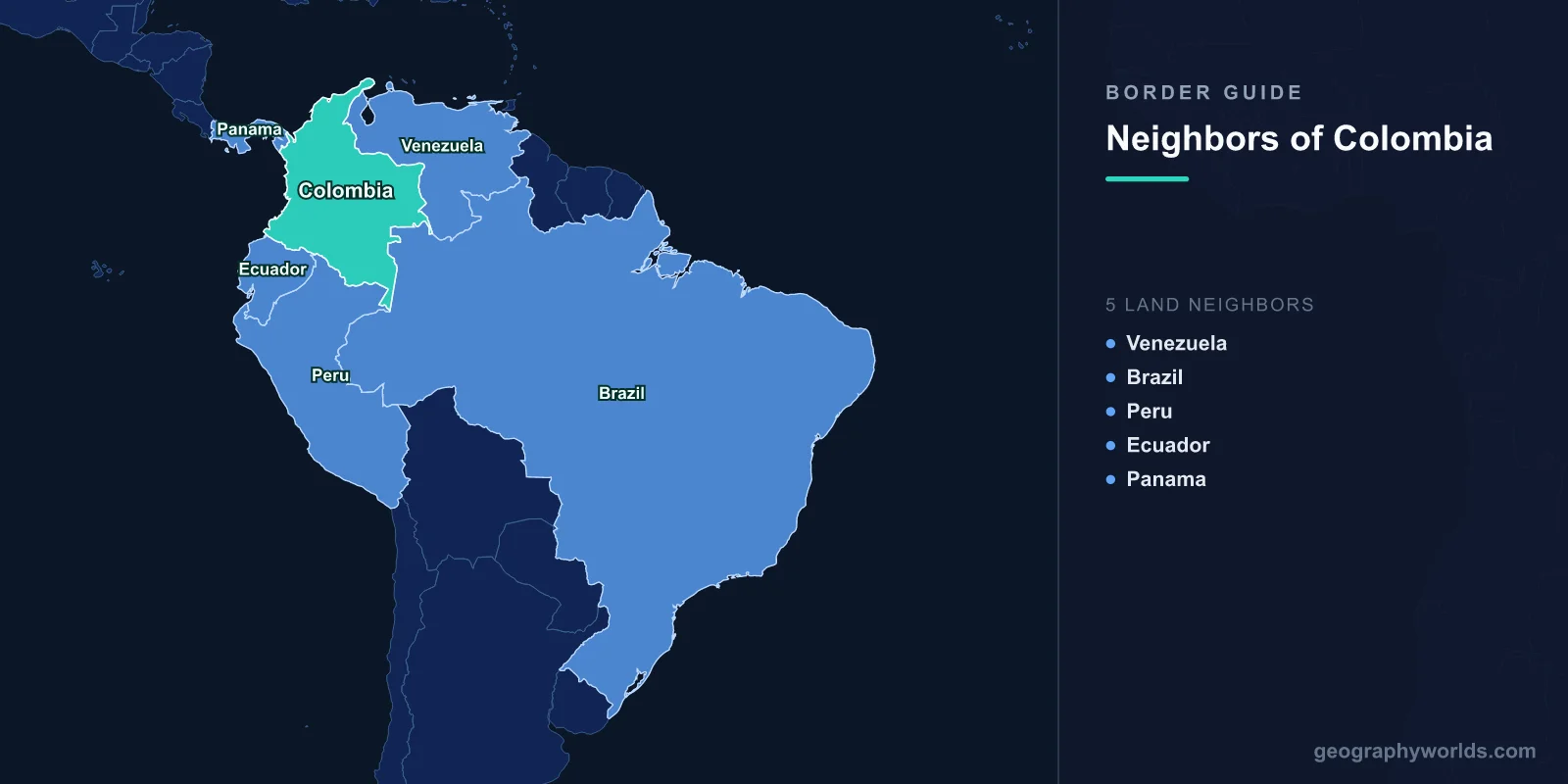
Colombia shares land borders with five countries: Venezuela to the east, Brazil to the southeast, Peru to the south, Ecuador to the southwest, and Panama to the northwest. Colombia is the only South American country with coastlines on both the Pacific Ocean and the Caribbean Sea.
Introduction
Colombia's borders traverse an astonishing range of landscapes, from the snow-capped peaks of the Andes to the dense Amazon rainforest, the vast Llanos grasslands, and the tropical Darien jungle. As the gateway between Central and South America, Colombia occupies one of the most strategically important positions on the continent, with borders that reflect centuries of colonial history and post-independence diplomacy.

Overview of Colombia's Borders
- Total Land Borders: 6,672 km
- Number of Neighbors: 5 countries
- Longest Border: Venezuela (2,341 km)
- Shortest Border: Panama (339 km)
Colombia's borders reflect its position at the intersection of the Andes, the Amazon, the Caribbean, and Central America. The Venezuelan and Brazilian borders cross the vast Llanos grasslands and Amazon rainforest, while the Ecuadorian and Peruvian borders traverse the Andes and Pacific lowlands. The Panama border crosses the impenetrable Darien Gap, one of the most challenging terrains on Earth.
The current borders were largely established in the 19th and early 20th centuries through a combination of treaties and, in some cases, armed conflict. Colombia's most traumatic border change was the loss of Panama in 1903, when the province declared independence with US support to facilitate construction of the Panama Canal.
Eastern Neighbor: Venezuela
- Border Length: 2,341 km
- Key Features: Llanos grasslands, Andes, Catatumbo region
- Major Crossing: Cucuta-San Antonio del Tachira
- Border Rivers: Arauca, Meta, Orinoco tributaries
The Venezuelan border is Colombia's longest at 2,341 km, running from the Caribbean coast through the northern Andes, across the Llanos grasslands, and into the Amazon basin. The main crossing point at Cucuta-San Antonio del Tachira handles massive daily traffic. The Catatumbo region near Lake Maracaibo is famous for the Catatumbo Lightning, a unique meteorological phenomenon producing nearly continuous lightning.
Relations between Colombia and Venezuela have been volatile, especially since Venezuela's political crisis beginning in the 2010s. Millions of Venezuelan migrants have crossed into Colombia, making it the largest recipient of Venezuelan refugees. The border has been periodically closed and reopened, disrupting communities and commerce. Despite political tensions, the two countries share deep cultural ties rooted in their common history as part of Simon Bolivar's Gran Colombia.
Southern Neighbors: Brazil and Peru
- Brazil Border: 1,644 km
- Peru Border: 1,494 km
- Key Features: Amazon rainforest, Putumayo River, Leticia-Tabatinga tripoint
- Biodiversity: Among the most biodiverse border regions on Earth
The Brazilian border runs 1,644 km through some of the most remote and densely forested terrain in the Amazon basin. The tripoint city of Leticia (Colombia)-Tabatinga (Brazil) on the Amazon River is the most notable point, where Colombia touches the Amazon River for just a short stretch. This border region is home to dozens of indigenous communities and extraordinary biodiversity, but is also affected by illegal mining and deforestation.
The Peruvian border at 1,494 km follows the Putumayo River for much of its length through dense Amazon jungle. This region was the site of horrific rubber boom-era atrocities against indigenous peoples in the early 1900s. A brief war between Colombia and Peru over Leticia in 1932-1933 established the current border. Today, the border remains sparsely populated and largely accessible only by river or air.
Western Neighbors: Ecuador and Panama
- Ecuador Border: 708 km
- Panama Border: 339 km
- Key Features: Andes Mountains, Pacific lowlands, Darien Gap
- Darien Gap: Only break in the Pan-American Highway
The Ecuadorian border runs 708 km from the Pacific coast through the Andes and into the Amazon foothills. This is one of Colombia's most active borders, with significant cross-border trade and cultural exchange. The border city of Ipiales, near the stunning Las Lajas Sanctuary built into a gorge, is the main crossing point. The two countries share Andean culture, similar dialects of Spanish, and close economic ties.
The Panama border at 339 km crosses the notorious Darien Gap, a roadless expanse of dense tropical jungle and swampland that is the only break in the Pan-American Highway from Alaska to Argentina. The Darien is so impenetrable that no road has ever been built through it, despite decades of proposals. In recent years, the Darien Gap has become a dangerous migration route for people from around the world seeking to reach North America.
Cross-Border Relations and Trade
- Andean Community: Member with Peru, Ecuador, Bolivia
- Venezuelan Refugees: Over 2 million in Colombia
- Pacific Alliance: Member with Mexico, Peru, Chile
- Maritime Borders: Caribbean and Pacific maritime boundaries
Colombia is a member of both the Andean Community and the Pacific Alliance, giving it trade frameworks with most of its neighbors. Ecuador is one of Colombia's most important regional trade partners, while the historically vital trade with Venezuela has been severely disrupted by political tensions. Colombia's dual-ocean position gives it strategic importance for both Atlantic and Pacific trade routes.
Security cooperation along Colombia's borders has been a major issue for decades. The long internal conflict with FARC guerrillas often spilled across borders into Venezuela, Ecuador, and Panama. The 2016 peace agreement has improved border security, though illegal armed groups and drug trafficking continue to challenge border regions. Cross-border cooperation on Amazon conservation is growing through multilateral frameworks.
Key Facts
- Colombia borders 5 countries: Venezuela, Brazil, Peru, Ecuador, and Panama.
- The Venezuelan border at 2,341 km is Colombia's longest.
- Colombia is the only South American country with both Pacific and Caribbean coastlines.
- The Darien Gap on the Panama border is the only break in the Pan-American Highway.
- Colombia touches the Amazon River at Leticia, its tripoint with Brazil and Peru.
Fun Facts
- Colombia lost Panama in 1903 when the US supported Panamanian independence to build the canal.
- The Catatumbo Lightning near the Venezuela border produces lightning up to 160 nights per year.
- The Darien Gap is so dense that even with modern technology, no road has been built through it.
- Leticia, Colombia's Amazon port, has no road connection to the rest of the country and is accessible only by air or river.
Final Thoughts
Colombia's five land borders place it at the geographic crossroads of the Americas. From the politically charged Venezuelan frontier to the impenetrable Darien Gap and the remote Amazon borders with Brazil and Peru, Colombia's boundaries reflect the extraordinary geographic diversity and complex geopolitical dynamics of a nation that bridges two continents and two oceans.
Test Your Knowledge!
Think you know which countries share borders? Try our geography games!
Play Geography Games →