
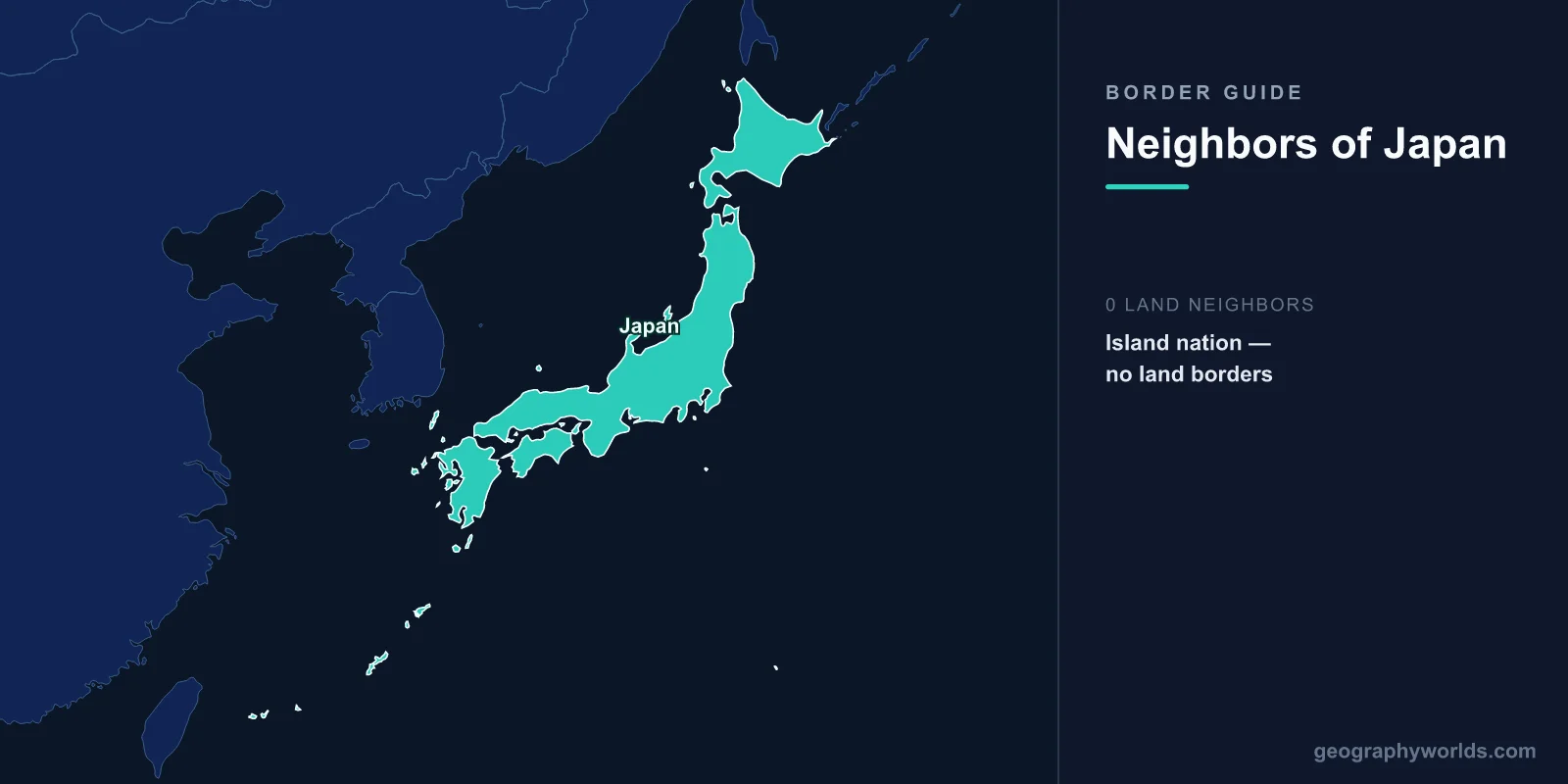
Japan has no land borders, as it is an archipelago of 6,852 islands. However, Japan has maritime boundaries with six countries and territories: Russia to the north, South Korea and North Korea to the west, China to the southwest, Taiwan to the south, and the Philippines to the far south.
Introduction
Japan's maritime geography defines its national identity and security. Surrounded by the Pacific Ocean, the Sea of Japan (East Sea), the East China Sea, and the Philippine Sea, Japan has the sixth-largest exclusive economic zone in the world. Multiple territorial disputes with its maritime neighbors make Japan's sea borders among the most strategically contested in the Pacific.

Overview of Japan's Maritime Borders
- Land Borders: None (island nation)
- Number of Islands: 6,852
- EEZ: 4.47 million km² (6th largest in the world)
- Maritime Neighbors: 6 (Russia, South Korea, North Korea, China, Taiwan, Philippines)
Japan's four main islands (Honshu, Hokkaido, Kyushu, and Shikoku) stretch approximately 3,000 km from northeast to southwest. The Ryukyu island chain extends further southwest toward Taiwan, while the Kuril island chain extends northeast toward Russia. Japan's vast exclusive economic zone (EEZ) is more than 10 times the country's land area.
Japan has active territorial disputes with three of its maritime neighbors: with Russia over the Southern Kuril Islands (Northern Territories), with South Korea over Dokdo/Takeshima, and with China over the Senkaku/Diaoyu Islands. These disputes affect diplomatic relations and are tied to historical grievances from World War II and the colonial era.
Northern Maritime Neighbor: Russia
- Disputed Territory: Southern Kuril Islands (Northern Territories)
- Distance: Hokkaido to Kunashir: 16 km
- Status: No peace treaty since WWII
Russia controls the Southern Kuril Islands (called the Northern Territories by Japan) off the northeast coast of Hokkaido. Japan claims these four islands (Kunashir, Iturup, Shikotan, and the Habomai group) were illegally occupied by the Soviet Union in August 1945. This dispute has prevented the signing of a formal peace treaty between Russia and Japan since World War II.
The strait between Hokkaido and Kunashir is only about 16 km wide, making these some of the closest Russian-controlled territories to Japan. Approximately 17,000 Russians live on the disputed islands. Visa-free exchanges allowed former Japanese residents to visit ancestral graves, but these were suspended after Japan's sanctions on Russia following the 2022 Ukraine conflict.
Western Maritime Neighbors: South Korea and North Korea
- Korea Strait Width: ~200 km to South Korea
- Disputed Territory: Dokdo/Takeshima (with South Korea)
- Tsushima Island: Closest Japanese territory to Korean Peninsula
The Korea Strait separates Japan from the Korean Peninsula, with Tsushima Island lying roughly halfway between. South Korea is one of Japan's most important economic and cultural partners, though historical grievances from colonial rule (1910-1945) continue to strain relations. The Dokdo/Takeshima islands remain a perennial source of diplomatic friction.
North Korea poses a direct military threat to Japan through its ballistic missile program. Multiple North Korean missiles have overflown Japanese territory or landed in Japan's exclusive economic zone. Japan's missile defense system and its alliance with the United States are central to its security posture vis-a-vis North Korea. Historical issues, including abductions of Japanese citizens by North Korean agents, remain unresolved.
Southwestern Maritime Neighbors: China and Taiwan
- Disputed Territory: Senkaku/Diaoyu Islands (with China)
- East China Sea: Median line dispute
- Taiwan Strait: Japan's southwest islands near Taiwan
The Senkaku/Diaoyu Islands dispute is one of the most dangerous flashpoints in the Pacific. Japan administers these uninhabited islands in the East China Sea, but China and Taiwan also claim them. Chinese coast guard vessels regularly enter waters around the islands, and both countries have scrambled fighter jets in the area. The islands sit near significant shipping lanes and potentially rich energy resources.
Taiwan (which Japan does not formally recognize as a separate country) lies approximately 110 km from Japan's westernmost inhabited island, Yonaguni. Japan's Ryukyu island chain extends along the edge of the East China Sea, creating a strategic maritime boundary with China. Japan has been increasing military deployments to its southwestern islands in response to Chinese naval expansion.
Strategic Significance of Japan's Maritime Position
- US Alliance: 70+ US military bases in Japan
- Maritime Trade: 99% of trade by sea
- Self-Defense Forces: One of the most capable militaries in Asia
Japan's island geography makes maritime security existential. The country imports virtually all its energy and most of its food by sea, making freedom of navigation in surrounding waters a core national interest. The US-Japan Security Alliance, with over 70 US military bases in Japan (including Okinawa's massive complex), is the cornerstone of Pacific security.
Japan has been gradually expanding its military capabilities in response to China's naval buildup and North Korea's missile threats. The Self-Defense Forces are being reconfigured for island defense, with new bases in the Ryukyu chain. Japan's 2022 National Security Strategy marked a significant shift toward a more assertive defense posture, including the acquisition of counterstrike capabilities.
Key Facts
- Japan has no land borders, being an archipelago of 6,852 islands.
- Japan has maritime boundaries with 6 countries: Russia, South Korea, North Korea, China, Taiwan, and the Philippines.
- Japan's EEZ of 4.47 million km² is the 6th largest in the world.
- The Southern Kuril Islands dispute with Russia has prevented a peace treaty since 1945.
- The Senkaku/Diaoyu Islands dispute with China is one of the most dangerous flashpoints in the Pacific.
Fun Facts
- Japan's island of Yonaguni is only 110 km from Taiwan.
- The Korea Strait between Japan and South Korea was where the Japanese Navy won a decisive victory in 1905.
- Japan has more coastline per unit of land area than almost any country in the world.
- 99% of Japan's international trade moves by sea.
Final Thoughts
Japan's maritime geography makes it unique among major powers, with no land borders but some of the world's most consequential maritime boundaries. Multiple territorial disputes with Russia, South Korea, and China keep Japan's sea borders at the forefront of Pacific geopolitics, while its alliance with the United States anchors the security architecture of the entire Indo-Pacific region.
Test Your Knowledge!
Think you know which countries share borders? Try our geography games!
Play Geography Games →