
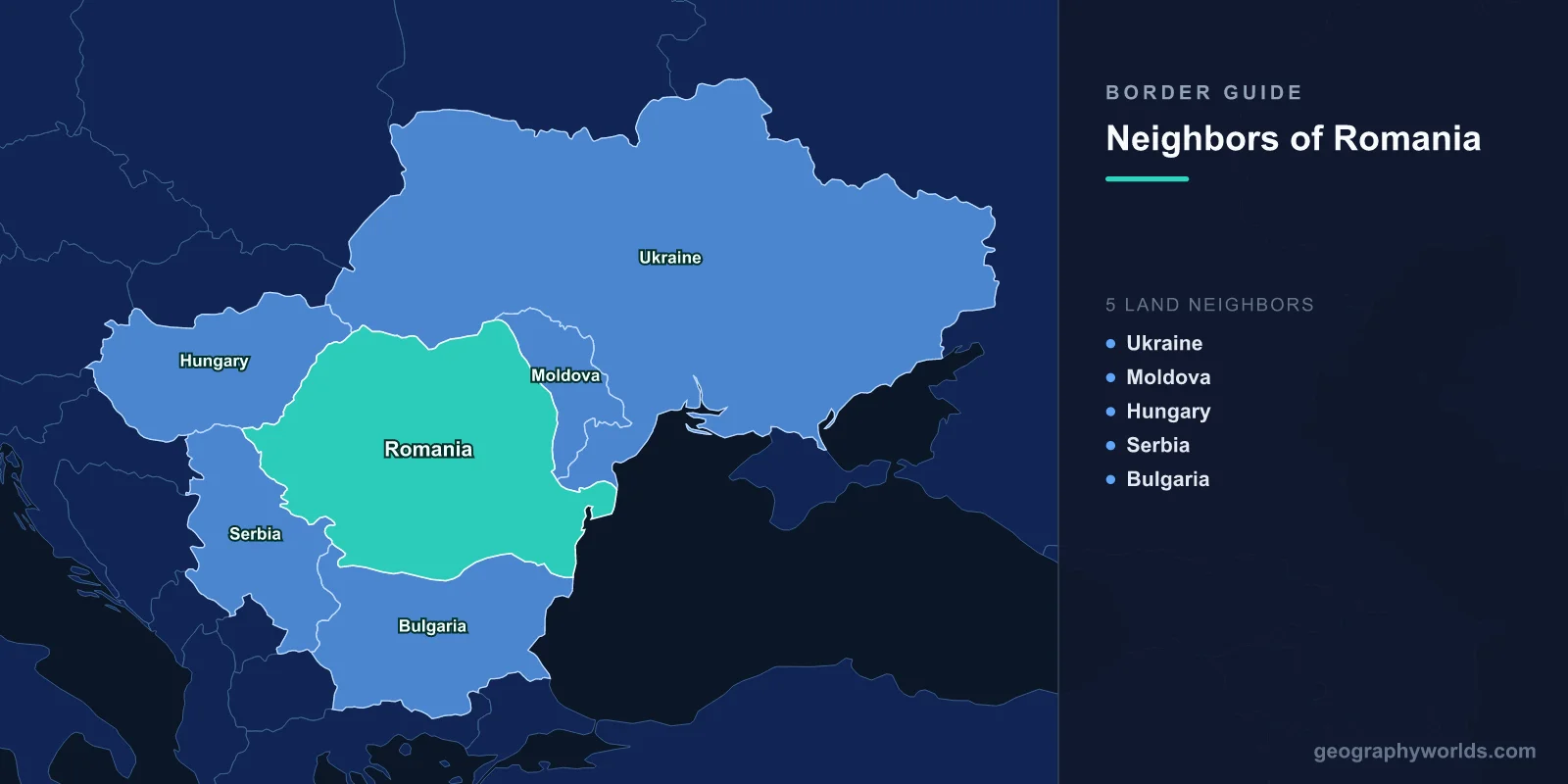
Romania shares land borders with five countries: Ukraine and Moldova to the north and east, Hungary to the west, Serbia to the southwest, and Bulgaria to the south, with the Danube River forming much of the southern frontier.
Introduction
Romania's borders encompass a remarkably diverse geography, from the Carpathian Mountain arc that curves through the center of the country to the Danube Delta on the Black Sea coast. The Danube itself forms one of Europe's great natural borders, separating Romania from Bulgaria and Serbia for hundreds of kilometers before emptying into the Black Sea.

Overview of Romania's Borders
- Total Land Borders: 2,508 km
- Number of Neighbors: 5 countries
- Longest Border: Ukraine (601 km)
- Key River Border: Danube (forms much of Bulgaria and Serbia borders)
Romania's borders combine natural features with lines drawn by 20th-century treaties. The Danube River defines most of the southern border with Bulgaria and part of the border with Serbia. The Carpathian Mountains influence the western border alignment, while the eastern borders with Moldova and Ukraine cross the flat Moldavian Plateau and the Danube Delta.
Romania's current borders were largely established after World War I through the Treaty of Trianon (1920), which doubled Romania's territory by adding Transylvania, Bukovina, and Bessarabia. The loss of Bessarabia (now Moldova) to the Soviet Union in 1940 and Northern Bukovina to Ukraine significantly altered the eastern borders.
Northern and Eastern Neighbors: Ukraine and Moldova
- Ukraine Border: 601 km
- Moldova Border: 450 km
- Key Features: Danube Delta, Bukovina, Maramures
Romania's longest border is with Ukraine at 601 km, running from the Maramures Mountains in the north through northern Bukovina (where Ukraine absorbed historically Romanian territory in 1940) to the Danube Delta in the south. The Danube Delta, shared between Romania and Ukraine, is Europe's largest wetland and a UNESCO World Heritage Site.
The Moldovan border at 450 km follows the Prut River for most of its length. Moldova was historically the eastern half of the Romanian principality of Moldavia and shares the same language and culture. Many Romanians consider Moldova a historically Romanian territory, and over a million Moldovans hold Romanian citizenship. The border is part of the EU's external frontier.
Western Neighbor: Hungary
- Border Length: 424 km
- Key Features: Great Hungarian Plain, Mures River
- Cultural Significance: 1.2 million ethnic Hungarians in Transylvania
The Hungarian border runs 424 km across relatively flat terrain, from the Maramures region in the north through the Great Hungarian Plain to the Danube tripoint with Serbia. This border was drawn by the Treaty of Trianon in 1920, which transferred Transylvania from Hungary to Romania. The loss of Transylvania remains a sensitive issue in Hungarian national memory.
Approximately 1.2 million ethnic Hungarians live in Romanian Transylvania, particularly in the Szeklerland region (Harghita and Covasna counties). This large minority maintains Hungarian-language schools, media, and cultural institutions. While the border is now open under Schengen (Romania joined in 2024), the Hungarian minority question continues to influence bilateral relations.
Southern and Southwestern Neighbors: Bulgaria and Serbia
- Bulgaria Border: 608 km
- Serbia Border: 476 km
- Key Feature: Danube River forms most of both borders
The Bulgarian border at 608 km is defined almost entirely by the Danube River, one of Europe's mightiest waterways. The Friendship Bridge at Ruse-Giurgiu (opened 1954) was the only bridge connecting the two countries until the New Europe Bridge opened in 2013 at Vidin-Calafat. The Danube here is up to 2 km wide and serves as a major shipping corridor.
The Serbian border runs 476 km, also partly along the Danube, particularly through the spectacular Iron Gates gorge, where the river cuts through the Carpathian-Balkan mountain chain. The Iron Gates hydroelectric dam, jointly operated by Romania and Serbia, is one of the largest in Europe. The border continues through the Banat region, a historically multiethnic area.
Cross-Border Relations and Trade
- EU Member: Since 2007; Schengen since 2024
- EU External Border: Moldova and Ukraine borders
- Trade Partners: Germany is Romania's top trade partner, followed by Italy
Romania joined the EU in 2007 and the Schengen Area in 2024, making its borders with Hungary, Bulgaria, and (indirectly) Serbia easier to cross. The borders with Ukraine and Moldova remain EU external frontiers with full controls. Romania has been a strong advocate for Moldova's EU integration.
Economic ties with western neighbors are strong. Germany and Italy are Romania's top trade partners, with automotive and IT sectors driving exports. Cross-border cooperation with Hungary includes joint infrastructure projects, while the Danube serves as a vital waterway connecting Romania to Serbia, Bulgaria, and the wider European inland navigation network.
Key Facts
- Romania borders 5 countries: Ukraine, Moldova, Hungary, Serbia, and Bulgaria.
- The Danube River forms most of Romania's borders with Bulgaria and Serbia.
- The Iron Gates gorge on the Serbian border features one of Europe's largest hydroelectric dams.
- The Danube Delta on the Ukrainian border is Europe's largest wetland.
- Approximately 1.2 million ethnic Hungarians live in Romanian Transylvania.
Fun Facts
- The Treaty of Trianon (1920) doubled Romania's territory overnight by adding Transylvania.
- The Danube Delta is home to over 300 species of birds and is Europe's most biodiverse region.
- The Iron Gates of the Danube were considered so dangerous for shipping that the Romans built a canal to bypass them.
- Romania's border with Moldova is one of the few in Europe where the same ethnic group and language exist on both sides.
Final Thoughts
Romania's five borders tell a story of empires, treaties, and the complex ethnic geography of southeastern Europe. From the Carpathian-defined western frontier to the Danube's sweeping course along the south, Romania's borders connect it to both the European Union's integrated west and the still-evolving east, making it a pivotal country in Europe's ongoing geographic and political evolution.
Test Your Knowledge!
Think you know which countries share borders? Try our geography games!
Play Geography Games →