
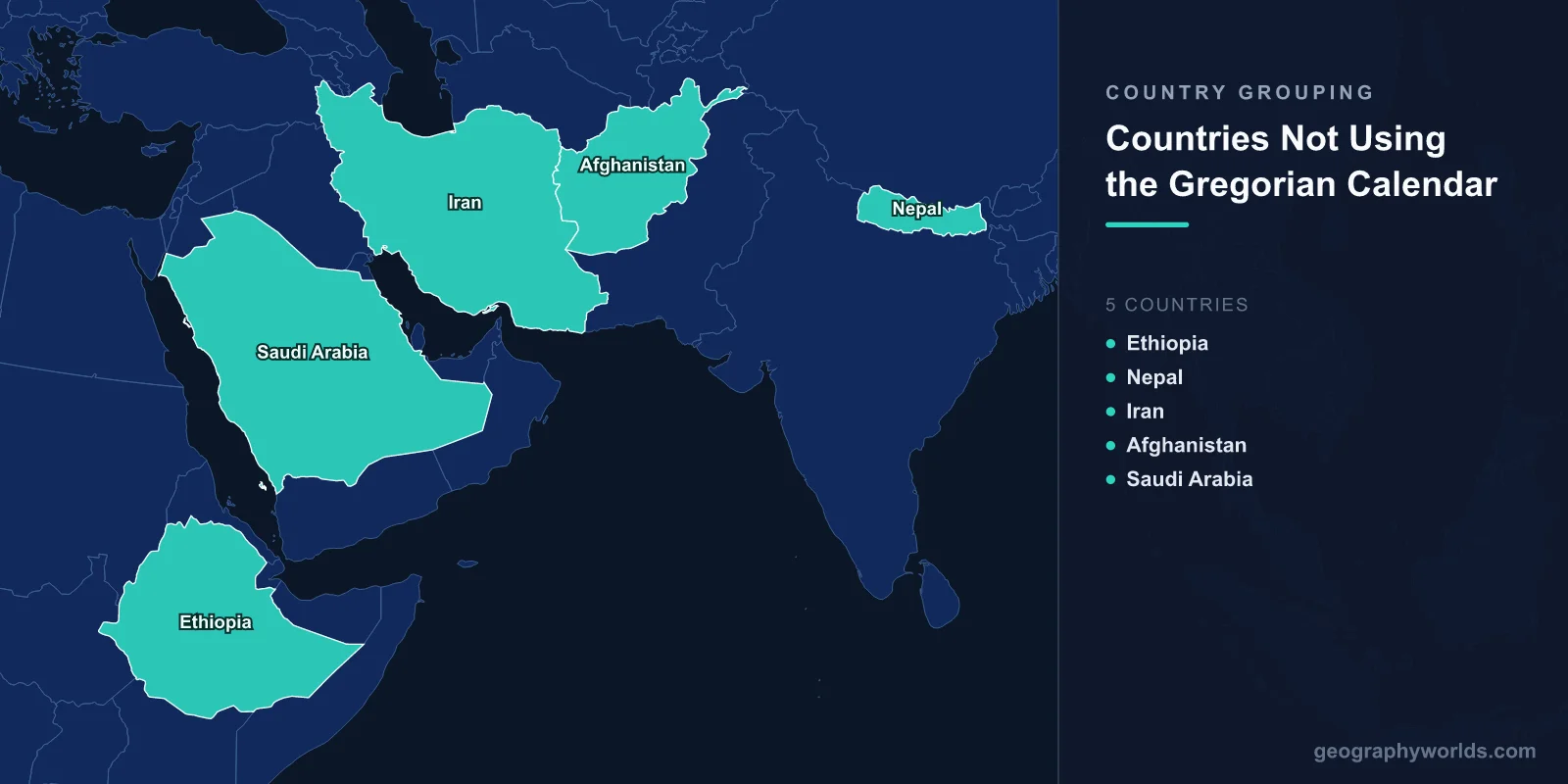
Five countries run an official calendar that is not the Gregorian one: Ethiopia, Nepal, Iran, Afghanistan and Saudi Arabia. In each case the year number differs from the Gregorian year — by seven or eight years in Ethiopia, by nearly fifty-seven in Nepal, by more than six hundred in Iran and Afghanistan, and by roughly five hundred and eighty in Saudi Arabia. Several other countries run a parallel era system alongside the Gregorian calendar without replacing it.
What Counts as Not Using It
Almost every country on earth uses the Gregorian calendar for international business, aviation and diplomacy, because the alternative is unworkable. The question is which calendar is official for domestic civil purposes — what appears on a government form, a newspaper masthead, a school term or a payslip.
By that test the list is short. It also shifts: Saudi Arabia moved its civil service pay to the Gregorian calendar in 2016 for budgetary reasons while keeping the Hijri calendar official, which puts it in a category of its own.
Ethiopia: Seven Years Behind, Thirteen Months Long
The Ethiopian calendar runs roughly seven to eight years behind the Gregorian one. When it is 2026 in most of the world, Ethiopia is in 2018 or 2019 depending on the month.
The gap comes from a disagreement about the date of the Annunciation. The Ethiopian Orthodox Tewahedo Church follows a calculation that places it in 9 AD rather than the 1 AD implied by the sixth-century reckoning of Dionysius Exiguus that the rest of Christendom adopted. Both are attempts to date the same event; the arithmetic differs.
The year has thirteen months: twelve of exactly thirty days, followed by Pagumē, a short month of five days, or six in a leap year. Ethiopia's tourist board has used the slogan thirteen months of sunshine for decades.
New Year, Enkutatash, falls on 11 September in most Gregorian years, at the end of the main rains. Christmas, Genna, is 7 January. The day is also counted differently: Ethiopian time starts at dawn, so six o'clock in the morning Gregorian is twelve o'clock in the Ethiopian reckoning, which catches out visitors arranging meetings.
Nepal: Fifty-Six Years Ahead
Nepal's official calendar is Bikram Sambat, a lunisolar Hindu calendar running about 56 years and 8 months ahead of the Gregorian one. A Gregorian year in the 2020s corresponds to a Bikram Sambat year in the 2080s.
It is the calendar of government, of newspapers, of school years and of legal documents. Nepali passports carry both. The new year, Nawa Barsha, falls in mid-April, usually on the 13th or 14th, and is a public holiday.
Month lengths are not fixed in advance in the traditional reckoning: they vary between 29 and 32 days, determined by the sun's movement through the zodiac, which means the calendar for a coming year is published rather than calculated by a simple rule. Nepal also uses Nepal Sambat, an older era associated with the Newar community of the Kathmandu valley, which was given national recognition in 2008.
Iran and Afghanistan: The Solar Hijri Calendar
Iran uses the Solar Hijri calendar, which counts years from the Hijra — the Prophet Muhammad's migration to Medina in 622 — but measures them by the sun rather than the moon. The result is a year number roughly 621 or 622 behind the Gregorian one, with a year of the same length.
It is among the most astronomically precise calendars in use anywhere. The year begins at the vernal equinox, determined by observation at the meridian of Tehran, so no leap-year rule is needed: Nowruz falls on the day the equinox falls, usually 20 or 21 March. The first six months have 31 days, the next five have 30, and the last has 29 or 30.
Afghanistan used the same calendar with different month names, mostly drawn from local and Pashto usage rather than the Persian zodiacal names. After 2021 the Taliban administration moved official usage toward the lunar Hijri calendar, which had been the practice during their earlier period in power, so Afghanistan's answer has changed within recent memory.
Saudi Arabia: The Lunar Hijri Calendar
Saudi Arabia's official calendar is the lunar Hijri calendar, counting from the same event as Iran's but with a year of twelve lunar months totalling about 354 days — roughly eleven days shorter than a solar year.
That shortfall is why the Hijri year number gains on the Gregorian one over time, and why Ramadan moves backwards through the seasons, completing a full cycle in roughly 33 years. It also means a person's age in Hijri years is slightly higher than in Gregorian years.
In October 2016 the Saudi government moved civil service salaries to the Gregorian calendar, a change reported at the time as a cost-saving measure — paying twelve lunar months a year means paying about eleven extra days of salary every three decades. The Hijri calendar remains the official calendar of the state and governs religious observance across the Muslim world.
The Countries That Run Two at Once
Several countries use the Gregorian calendar for dates but a separate system for the year, which is a different arrangement from the five above.
- Japan numbers years by imperial era. The Reiwa era began in 2019, so 2026 is Reiwa 8. Era years appear on official documents, coins and driving licences alongside Gregorian dates.
- Taiwan counts from the founding of the Republic of China in 1912, making the Gregorian 2026 into year 115.
- North Korea used a Juche calendar counting from Kim Il Sung's birth in 1912, with Juche 1 as that year. Its use in state media has been reported as scaled back in recent years.
- Thailand uses the Buddhist Era, 543 years ahead of the Gregorian year, on official documents and in everyday civil use.
- Israel uses the Hebrew calendar for religious observance and for state ceremonies, alongside the Gregorian calendar for civil purposes.
Ethiopia's Clock Runs on a Different Zero
Ethiopia's divergence is not only about the year. The country keeps a twelve-hour clock that starts counting at sunrise rather than at midnight, which near the equator is close enough to six in the morning year-round for the system to be stable.
So one o'clock Ethiopian time is seven in the morning by the international clock, and seven o'clock Ethiopian is one in the afternoon. Ethiopians refer to this as habesha se'at, Ethiopian time, as distinct from ferenj se'at, foreigner time, and both are in everyday use.
The practical consequence is that arranging anything requires specifying which system you mean. Airlines, hotels and international organisations use the international clock; buses, appointments and ordinary conversation frequently do not. Visitors who miss a morning departure by six hours have usually met this distinction for the first time.
Leap Years, and Why They Differ
Each of these calendars handles the awkward fact that a solar year is not a whole number of days, and each does it differently.
The Gregorian rule adds a day in years divisible by four, except centuries not divisible by 400 — which is why 1900 was not a leap year and 2000 was. That approximation leaves an error of about one day in 3,200 years.
The Ethiopian calendar adds a sixth day to Pagumē every fourth year without exception, matching the older Julian rule, which is why the gap between the Ethiopian and Gregorian calendars will slowly widen. The Solar Hijri calendar avoids the problem entirely by defining the year to begin at the observed equinox, making it more accurate than the Gregorian without needing a rule at all. The lunar Hijri calendar makes no attempt to track the sun, which is the whole point of it.
The Countries That Refused the Change Longest
The Gregorian calendar was promulgated by Pope Gregory XIII in 1582 to correct a drift in the Julian calendar of about eleven minutes a year, which had accumulated to ten days. Catholic states adopted it immediately; everyone else took their time.
Britain and its colonies waited until 1752, by which point the correction required was eleven days — 2 September was followed directly by 14 September. Russia changed only after the 1917 revolution, which is why the October Revolution is commemorated in November. Greece was the last European country to switch, in 1923.
The Eastern Orthodox churches are still divided. Several, including the Russian, Serbian, Georgian and Jerusalem patriarchates, continue to use the Julian calendar for fixed feasts, which is why Orthodox Christmas falls on 7 January — the Julian 25 December, now thirteen days behind.
Why Any of This Matters
Calendars look like a technicality until you need one to agree with another. Ethiopian birth certificates converted to Gregorian dates have produced ages that differ by a year depending on who did the arithmetic. Nepali contracts dated in Bikram Sambat require conversion for any international counterparty. Hijri-dated financial instruments accrue over a shorter year.
The deeper point is that a calendar is a claim about where history starts. Counting from the birth of Christ, from the migration to Medina, from the accession of an emperor or from the founding of a republic are all statements about what the society regards as the beginning of the reckoning — which is why the five countries here have kept theirs, and why the change is so rarely made. Our look at religion in Ethiopia covers the church whose calculation set the Ethiopian year, and our count of the world's time zones deals with the other way the world fails to agree about time.
