
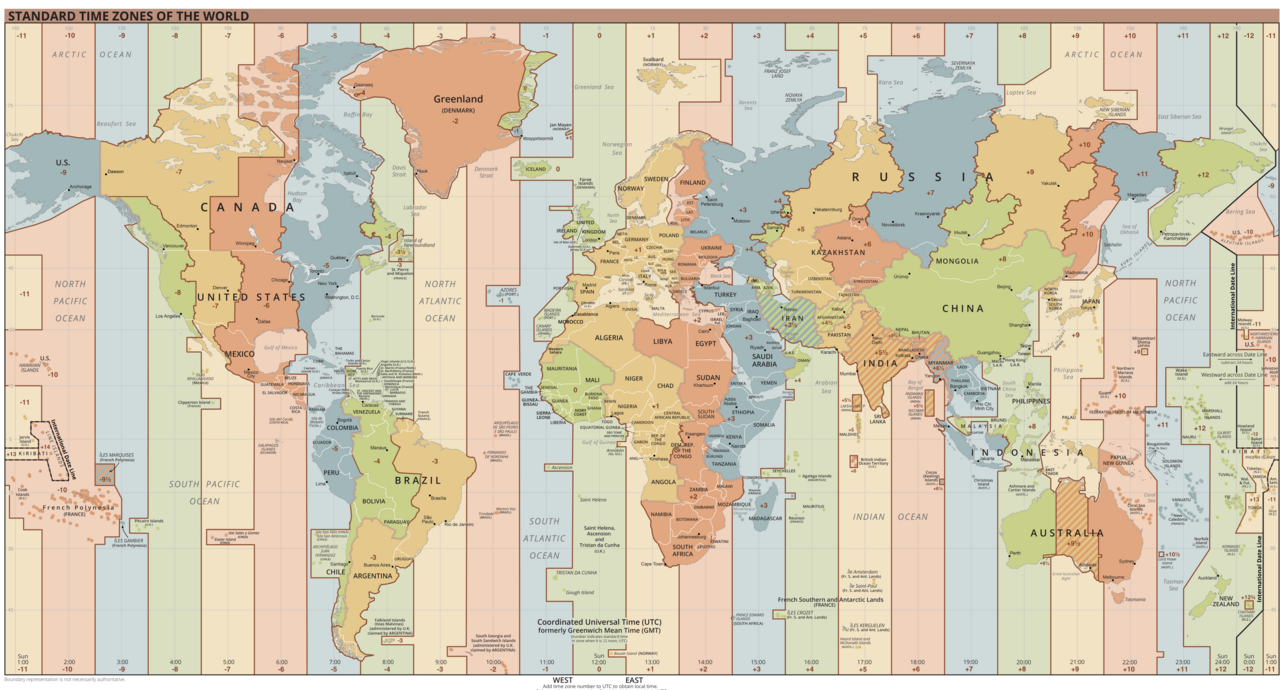
There are 24 time zones in the world in theory, one for each hour of the day and each 15 degrees wide, but about 38 different standard-time offsets are actually in use, because some countries set their clocks 30 or 45 minutes away from the hourly pattern. Those offsets run from UTC−12:00 on uninhabited Baker and Howland islands to UTC+14:00 in Kiribati’s Line Islands, a 26-hour spread. Daylight saving time adds more offsets for part of the year, and France, counting its overseas territories, uses more zones than any other country: 12, or 13 if its Antarctic claim is included. The clearest way to see why the tidy number 24 breaks down is to visit the places where it breaks.

Greenwich, 1884: Where the Count of 24 Begins
The idea of 24 zones starts with simple arithmetic. The Earth turns 360 degrees in 24 hours, so the Sun appears to move 15 degrees of longitude every hour, or one degree every four minutes. Before standard time, every town kept its own solar time: when it was noon in London it was about ten minutes earlier in Bristol, roughly 2.5 degrees to the west. That was harmless until railways and telegraphs needed timetables that worked across many towns at once.
Britain solved the problem first. The Great Western Railway began running on Greenwich Mean Time in November 1840, time signals went out by telegraph from the Royal Observatory from 1852, and by 1855 about 98% of public clocks in Great Britain showed GMT, although it did not become legal time until 2 August 1880. New Zealand went further on 2 November 1868, adopting a single national time 11 hours 30 minutes ahead of GMT and becoming the first country to observe one standard time nationwide, about fifteen years before any other.
The worldwide scheme came from the Scottish-born Canadian engineer Sir Sandford Fleming, who in 1876 proposed dividing the globe into 24 zones, each 15 degrees wide and lettered A to Y, skipping J. In October 1884 the International Meridian Conference in Washington, D.C., called at the request of President Chester A. Arthur, recommended the meridian through Greenwich as zero longitude. The United States had already moved its railways onto hourly zones on 18 November 1883, the “Day of Two Noons”, and Congress made them law in the Standard Time Act of 19 March 1918. Fleming’s neat lettered grid survives today almost unchanged in one place: the nautical time zones ships use on the high seas, in force since the 1920s, which are pure 15-degree strips with the 180th meridian splitting the last one in two.
Baker Island to Kiritimati: A 26-Hour Spread
If the world kept exactly 24 hourly zones, the earliest and latest clocks would differ by 24 hours. They actually differ by 26, and the reason lies in the middle of the Pacific. At the western end of the range sit Baker Island and Howland Island, two uninhabited United States atolls just north of the equator, about 3,090 km southwest of Honolulu. They keep UTC−12:00, which makes them among the last places on Earth to see any new year.
The other end belongs to Kiribati. When the republic became independent in 1979 it straddled the 180th meridian with three zones: UTC+12:00 in the Gilbert Islands, UTC−11:00 in the Phoenix Islands and UTC−10:00 in the Line Islands. The Gilbert Islands were therefore nearly a full day ahead of the eastern islands, which made running one government from Tarawa awkward. On 31 December 1994 Kiribati moved the Phoenix and Line Islands to UTC+13:00 and UTC+14:00, pushing the International Date Line far to the east around its territory. The offsets UTC+13:00 and UTC+14:00 did not exist before that change, and the Line Islands, including inhabited Kiritimati, started the year 2000 before anywhere else on Earth.
Samoa made a similar jump later. At the end of Thursday 29 December 2011 it skipped Friday 30 December entirely and went straight to Saturday 31 December, moving from UTC−11:00 to UTC+13:00. Prime Minister Tuilaepa Sailele Malielegaoi said the change was meant to improve business with New Zealand, Australia, China and other places in Asia. Neighbouring American Samoa stayed at UTC−11:00, so the two Samoas, part of the same island chain, now show the same clock time on dates a full day apart.
Kathmandu, Eucla and the Chatham Islands: The 45-Minute Zones
Most of the extra offsets beyond 24 are half-hour zones. India keeps UTC+05:30, a compromise adopted on 1 January 1906 because its standard meridian, 82°30′E near Mirzapur in Uttar Pradesh, sits halfway between local solar times of UTC+05:00 in the west and UTC+06:00 in the northeast. Iran keeps UTC+03:30, Afghanistan UTC+04:30, Myanmar UTC+06:30, Newfoundland in Canada UTC−03:30 and the Marquesas Islands of French Polynesia UTC−09:30.
Three zones go further, with a 45-minute offset. Nepal used Kathmandu solar time (UTC+05:41:16) until 1920, then adopted Indian time, and in 1986 moved its clocks forward 15 minutes to UTC+05:45, which makes it the last country to have adopted a standard offset. Its reference meridian runs through Gaurishankar, a peak about 100 km east of Kathmandu. New Zealand’s Chatham Islands, about 800 km east of the main islands, keep UTC+12:45, 45 minutes ahead of the rest of the country.

The third is unofficial. Along the Eyre Highway across the Nullarbor, the roadhouses from Border Village in South Australia westward through Eucla, Mundrabilla, Madura and Cocklebiddy to just short of Caiguna in Western Australia keep Central Western Time, UTC+08:45, halfway between Perth and Adelaide. No state or federal law defines it, yet the Shire of Dundas recognises its limits, road signs tell drivers to change their watches by 45 minutes, and it dates back at least to 1935, when the Commonwealth Railways timetable for the Trans-Australian line used it.
Ürümqi and Xinjiang: One Clock for All of China
Extra offsets push the count above 24, but large countries can pull it the other way. China stretches from about 73°E to 135°E, wide enough for five hourly zones, and the Republic of China proposed exactly that in 1918, from Kunlun Time (UTC+05:30) in the far west to Changpai Time (UTC+08:30) in the northeast. After 1949 the People’s Republic put the whole country on Beijing Time, UTC+08:00, and it has not observed daylight saving time since 1991. China is the largest country in the world that officially keeps a single time zone.
The cost falls on the west. Xinjiang lies far to the west of Beijing’s meridian, so people there usually schedule their days about two hours later than eastern China, and daily life runs on two times at once. Many Uyghur and Kazakh residents use the unofficial Xinjiang Time, UTC+06:00, shared with neighbouring Kyrgyzstan, while Beijing Time is used for official business. Xinjiang Television runs its Chinese channel on Beijing Time and its Uyghur and Kazakh channels on Xinjiang Time, and shops and offices in Ürümqi typically open from 10:00 to 19:00 Beijing Time, which is 08:00 to 17:00 local. The single clock also creates the largest time jump on any land border: crossing from Afghanistan (UTC+04:30) into China (UTC+08:00) moves the clock forward three and a half hours.
Paris, Papeete and Nouméa: Why France Has 12 Zones
The countries with the most time zones are not always the widest. Russia, which spans 11 zones from Kaliningrad (UTC+02:00) to Kamchatka and Chukotka (UTC+12:00), is the largest country by area. About 63% of Russians live on Moscow Time, UTC+03:00, and the country has not changed its clocks seasonally since 26 October 2014, after a three-year experiment with permanent summer time.
France beats it by spreading its territory across every ocean. Metropolitan France keeps Central European Time (UTC+01:00), but its overseas departments and collectivities need 11 more offsets: UTC−10:00 in Tahiti and the rest of the Society Islands, UTC−09:30 in the Marquesas, UTC−09:00 in the Gambier Islands, UTC−08:00 on Clipperton Island, UTC−04:00 in Guadeloupe and Martinique, UTC−03:00 in French Guiana and Saint Pierre and Miquelon, UTC+03:00 in Mayotte, UTC+04:00 in Réunion, UTC+05:00 in the Kerguelen Islands, UTC+11:00 in New Caledonia and UTC+12:00 in Wallis and Futuna. The United States also reaches 11 when Guam, Puerto Rico, American Samoa and its remote Pacific atolls are counted.
Australia and the United Kingdom reach nine each the same way. Australia’s include the Cocos (Keeling) Islands at UTC+06:30, Lord Howe Island at UTC+10:30 and Norfolk Island at UTC+11:00; the UK’s run from the Pitcairn Islands at UTC−08:00 to the British Indian Ocean Territory at UTC+06:00.
Vigo and Nome: Clocks Set Far From the Sun
Even where the offset is a whole hour, the boundaries rarely follow the 15-degree lines Fleming drew. Spain and France both lie on or across the Greenwich meridian, yet both keep Central European Time, based on 15°E. France had used GMT from 1911 but switched to German time during the occupation in 1940 and never switched back; the Netherlands, which kept “Amsterdam Time” 20 minutes ahead of GMT before the war, did the same. The result is that in summer, solar noon in Vigo, in Galicia, falls at 14:41 on the clock, and near the June solstice the sun sets after 22:00, as late as in Stockholm, 17 degrees farther north.
Nome, Alaska, is a sharper case. It sits at 165°24′W, close to the centre of the ideal UTC−11:00 strip, but keeps Alaska Time, based on 135°W, so its clocks run slightly more than two hours ahead of the sun in winter and over three hours ahead in summer. Indianapolis and Detroit ended up on Eastern Time for a commercial reason: people there wanted to share a clock with New York to simplify communications and business, which mattered more than the position of the sun.
So the honest answer to “how many time zones are there?” depends on what is being counted: 24 ideal hourly zones, about 38 standard offsets in use today, and more again in summer. The line where the calendar date changes is its own story, told in our guide to the International Date Line; China’s single clock gets fuller treatment in why China uses one time zone, and the full ranking sits in the countries with the most time zones.