
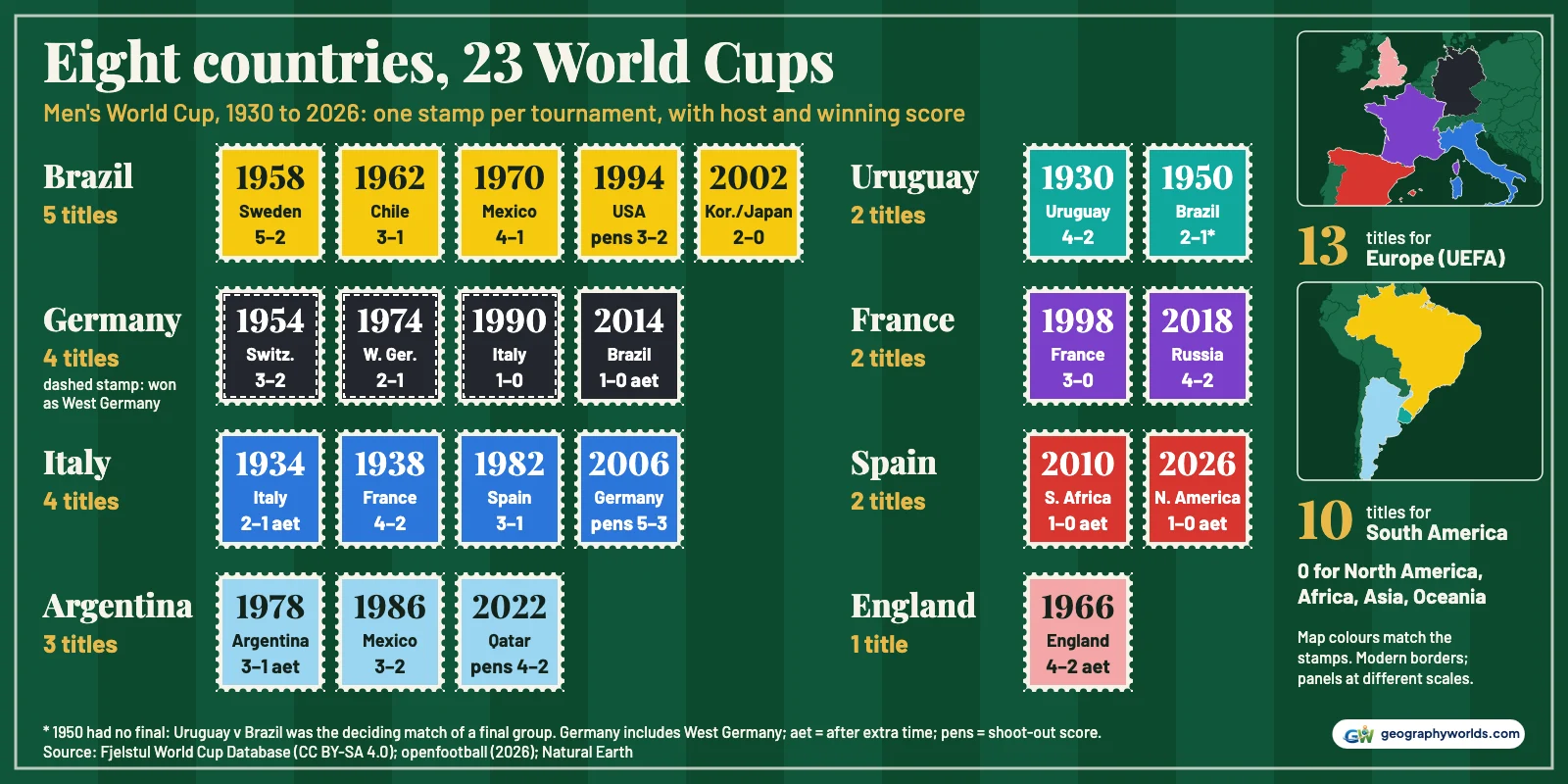
Eight countries have won the FIFA men's World Cup: Brazil 5 times (1958, 1962, 1970, 1994, 2002), Germany 4 (1954, 1974, 1990, 2014, the first three as West Germany), Italy 4 (1934, 1938, 1982, 2006), Argentina 3 (1978, 1986, 2022), Uruguay 2 (1930, 1950), France 2 (1998, 2018), Spain 2 (2010, 2026) and England once (1966). That accounts for all 23 tournaments from 1930 to 2026. Spain took the latest, beating Argentina 1–0 after extra time at MetLife Stadium in New Jersey on 19 July 2026, with a 106th-minute goal by Ferran Torres. Every champion comes from Europe or South America.
Three rules sit behind that count. West Germany and Germany are one team, because the same national association ran both, as explained below. The 1950 tournament had no final; a four-team final group decided it, and Uruguay against Brazil was its deciding match. And this list is men's only. The Women's World Cup has its own champions, which get a clearly separate section further down.
| Country | Titles | Years won | Runner-up | Confederation |
|---|---|---|---|---|
| Brazil | 5 | 1958, 1962, 1970, 1994, 2002 | 1950, 1998 | CONMEBOL |
| Italy | 4 | 1934, 1938, 1982, 2006 | 1970, 1994 | UEFA |
| Germany (incl. West Germany) | 4 | 1954, 1974, 1990, 2014 | 1966, 1982, 1986, 2002 | UEFA |
| Argentina | 3 | 1978, 1986, 2022 | 1930, 1990, 2014, 2026 | CONMEBOL |
| Uruguay | 2 | 1930, 1950 | never | CONMEBOL |
| France | 2 | 1998, 2018 | 2006, 2022 | UEFA |
| Spain | 2 | 2010, 2026 | never | UEFA |
| England | 1 | 1966 | never | UEFA |
Only two confederations have ever won it
FIFA has six continental confederations, and the title has gone to just two: UEFA in Europe with 13 and CONMEBOL in South America with 10. No other confederation appears in the results by confederation. Per member, South America is well ahead. CONMEBOL has 10 members, the fewest of any confederation, and three of them have been champions, or 30%. UEFA has 55, and five of those have won it, or 9%.
The two were level at 9–9 after 2006. Europe has led ever since, winning five of the last six tournaments; Argentina in 2022 is the only break in that run, and before that came Brazil in 2002.
South America: ten titles from three neighbours
The first final was a local derby. Uruguay hosted 13 teams in 1930 and beat Argentina, its neighbour across the Río de la Plata, 4–2 at the Estadio Centenario in Montevideo. The field at the 2026 tournament was 48.

Uruguay's second title came in Brazil in 1950, the 2–1 win at the Maracanã in the match that settled the final group. It has not won since, a gap of 76 years, the longest of any champion.
Brazil lost that day and went on to become the competition's most successful team. Its five titles span 1958 to 2002, and it is the only country to have played at all 23 tournaments. It has now gone 24 years without a title, matching its 24-year wait between 1970 and 1994. Argentina's three titles came on three different continents: at home in 1978, in Mexico in 1986 and in Qatar in 2022, the last one 4–2 on penalties after a 3–3 draw against France. It has also lost four finals, the latest in 2026.

Europe: thirteen titles from five countries
Italy was the first European champion, at home in 1934, and retained the title in France in 1938. Only Brazil, in 1958 and 1962, has matched that. Italy's other two came in Spain in 1982 and in Germany in 2006, the second 5–3 on penalties after a 1–1 draw against France. It has since missed three tournaments in a row, 2018, 2022 and 2026, so a four-time champion has not played at a World Cup since 2014.
England's one title came at Wembley in 1966, 4–2 after extra time against West Germany, 60 years ago. France won at home in 1998, 3–0 against Brazil, and in Russia in 2018, 4–2 against Croatia. It has reached two more finals and lost both. Spain's two titles are 16 years apart, in South Africa in 2010 and in North America in 2026, and it has never lost a final. Our guide to European football geography turns to the clubs, cities and rivalries behind those national sides.
How West Germany is counted
The German team that won in 1954, 1974, 1990 and 2014 is treated here as one continuous side, which is how the Germany's national team record runs: the Federal Republic, called West Germany in English, carried on the association's team from 1949 to 1990, and reunified Germany carried on from it. Wikipedia's list of finals totals them the same way. East Germany was a separate team with a separate association. It played at one World Cup, in 1974, and its record is not added to anyone's. That is the only merger on this page: Czechoslovakia, Yugoslavia and the Soviet Union appear under the names they played under.
On that count Germany has finished first or second eight times, more than anyone. Its 2014 run included the 7–1 semi-final win over Brazil in Belo Horizonte, before it beat Argentina 1–0 after extra time at the Maracanã.
Where the title was won
Geography has favoured whoever was closest to home. Europe has hosted 11 tournaments, and European teams won 10 of them; the exception was Brazil in 1958, who beat the hosts Sweden 5–2 in Solna. No European team won anywhere outside Europe until Spain in South Africa in 2010. Germany then became the only European side to win in South America, in 2014, and Spain in 2026 was the first to win in North America. The earlier three tournaments in North America went to Brazil, Argentina and Brazil, and both tournaments in Asia went to South American teams. Our guide to every World Cup host follows those tournaments one by one.
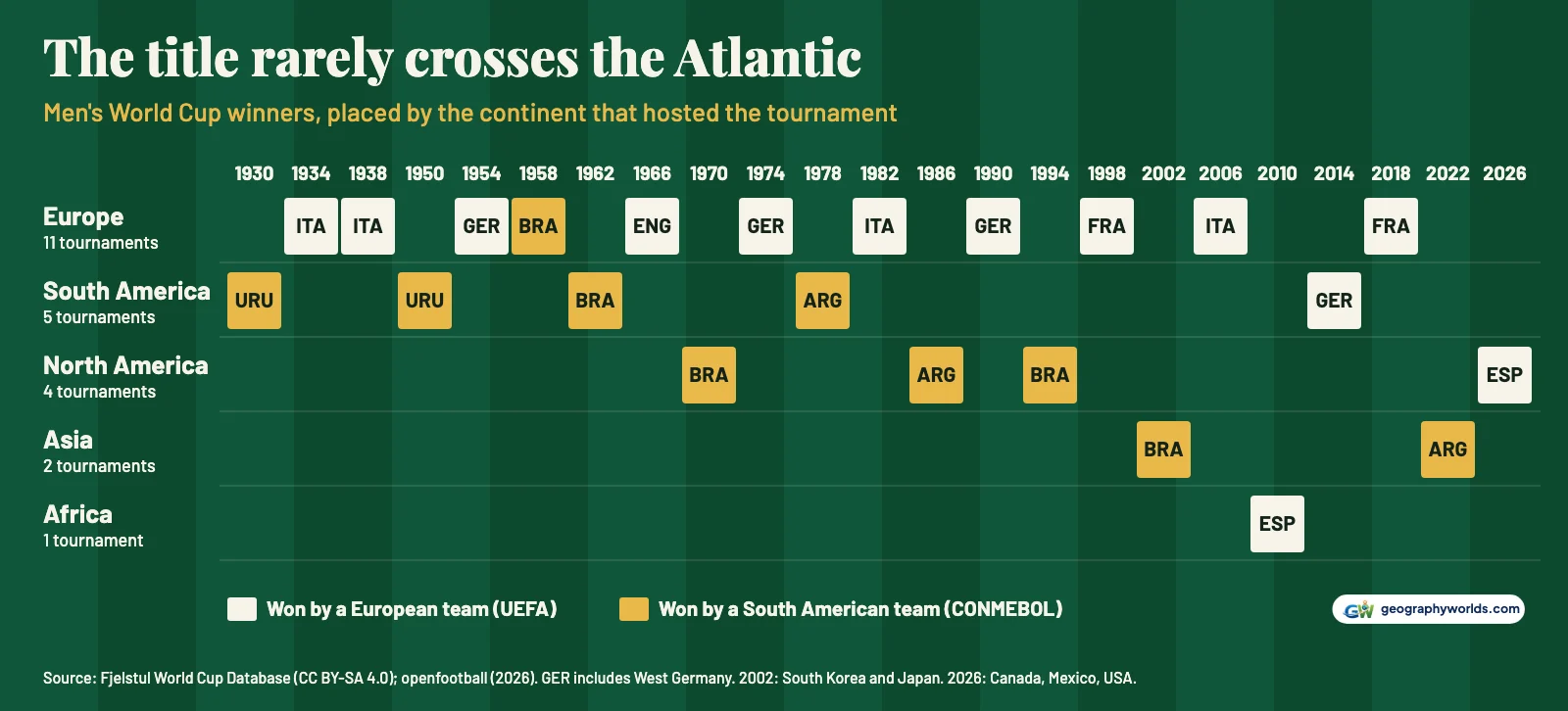
Hosts have won six times: Uruguay, Italy, England, West Germany, Argentina and France. None has done so since 1998, and none of the three 2026 hosts reached the semi-finals, whose four places all went to former champions.
The near-misses: five teams that lost finals and never won one
The Netherlands holds the record nobody wants: three finals, three defeats. It lost to the hosts in 1974 in Munich (2–1 to West Germany), to the hosts again in 1978 in Buenos Aires (3–1 after extra time for Argentina), and to Spain in Johannesburg in 2010, 1–0 after extra time. With two other top-four finishes, it has five, the most of any team without a title.
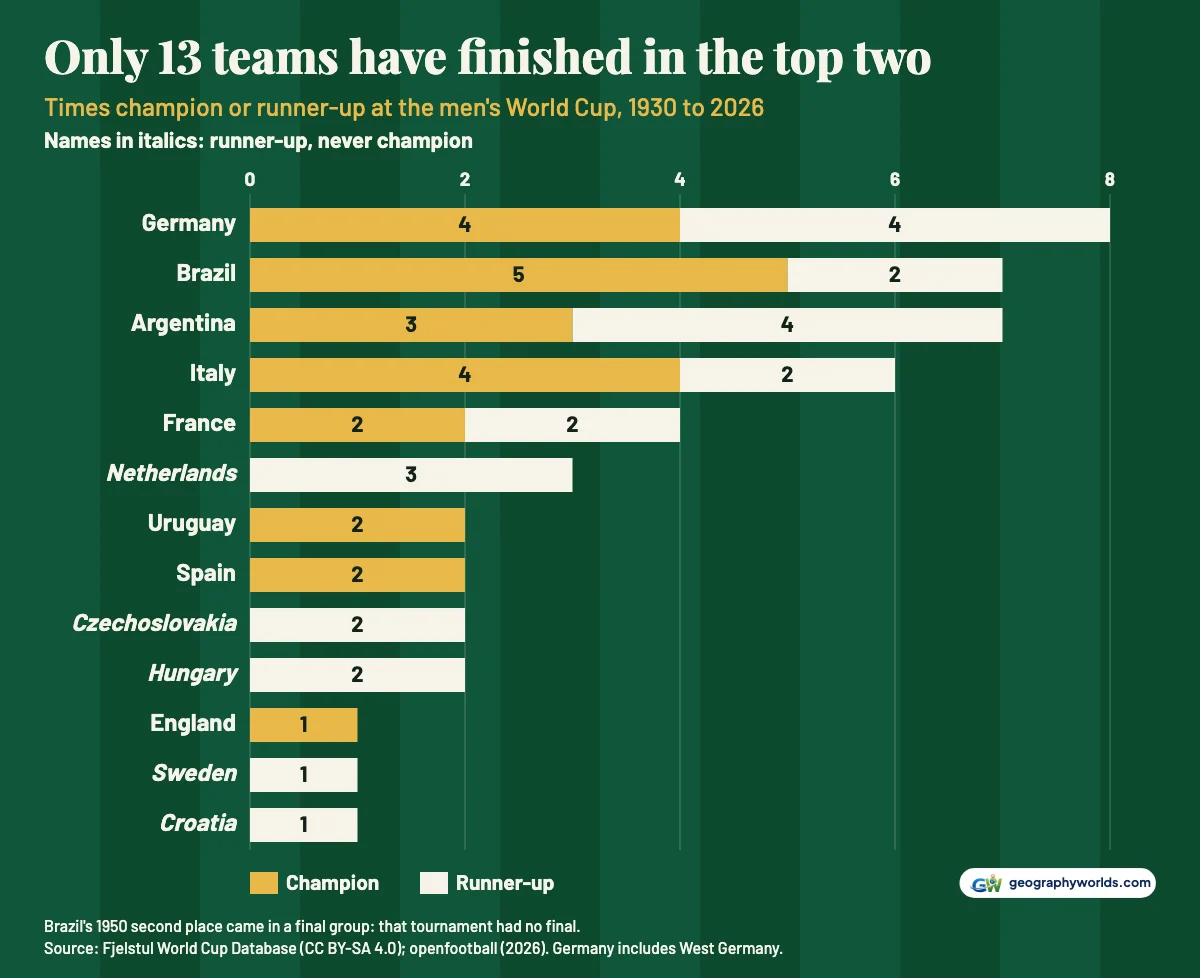
Hungary lost two finals. It went down 4–2 to Italy in 1938. In 1954 it had beaten West Germany 8–3 in the group stage, then lost the final to the same team 3–2 in Bern. Czechoslovakia also lost two, to hosts Italy in 1934 and to Brazil, 3–1, in Chile in 1962. It split into two countries at the end of 1992, so its record stands alone. Sweden lost the 1958 final at home and has four top-four finishes, and Croatia, runner-up in 2018, has three.
| Team (as named then) | Top-four finishes | Places | Confederation |
|---|---|---|---|
| Netherlands | 5 | 2nd 1974, 1978, 2010 · 3rd 2014 · 4th 1998 | UEFA |
| Czechoslovakia | 2 | 2nd 1934, 1962 | UEFA |
| Hungary | 2 | 2nd 1938, 1954 | UEFA |
| Sweden | 4 | 2nd 1958 · 3rd 1950, 1994 · 4th 1938 | UEFA |
| Croatia | 3 | 2nd 2018 · 3rd 1998, 2022 | UEFA |
| Austria | 2 | 3rd 1954 · 4th 1934 | UEFA |
| Belgium | 2 | 3rd 2018 · 4th 1986 | UEFA |
| Poland | 2 | 3rd 1974, 1982 | UEFA |
| Portugal | 2 | 3rd 1966 · 4th 2006 | UEFA |
| Yugoslavia | 2 | 4th 1930, 1962 | UEFA |
| Bulgaria | 1 | 4th 1994 | UEFA |
| Chile | 1 | 3rd 1962 | CONMEBOL |
| Morocco | 1 | 4th 2022 | CAF |
| South Korea | 1 | 4th 2002 | AFC |
| Soviet Union | 1 | 4th 1966 | UEFA |
| Turkey | 1 | 3rd 2002 | UEFA |
| United States | 1 | 3rd 1930 | CONCACAF |
How far the other four confederations have got
Only three teams from outside UEFA and CONMEBOL have ever finished in the top four. The United States did it first, in 1930, placed third in a tournament with no third-place match. South Korea reached fourth as co-host in 2002, a first for Asia, and Morocco became Africa's first semi-finalist in 2022, also finishing fourth. Morocco was the only such team in the 2026 quarter-finals, where it lost 2–0 to France.
Australia is the only team to get past the group stage after qualifying through Oceania: it came through the OFC route for 2006, joined the AFC on 1 January that year, and reached the round of 16. New Zealand, the only current OFC member to have qualified, went out in the group stage in 1982, 2010 and 2026. Australia's later knockout runs, the round of 16 in 2022 and the round of 32 in 2026, came as an AFC member.
The Women's World Cup is a separate list
The figures in this section are for the FIFA Women's World Cup, first held in 1991, and none of them is included above. Five countries have won its nine tournaments: the United States 4 times, Germany twice, and Norway, Japan and Spain once each. Three confederations have done so, which already breaks the men's pattern: CONCACAF and UEFA with four titles each and Asia's AFC with one.
Spain, champions in Sydney in 2023 after a 1–0 win over England, became the first country to hold both titles at once when its men won in July 2026. The tournament records agree: Germany is the only other country to have won both, and its titles never overlapped. Spain's women defend theirs in Brazil from 24 June 2027.
All 23 tournaments, and the data behind this page
| Year | Host | Champion | Result | Runner-up | Played at |
|---|---|---|---|---|---|
| 1930 | Uruguay | Uruguay | 4–2 | Argentina | Estadio Centenario, Montevideo |
| 1934 | Italy | Italy | 2–1 after extra time | Czechoslovakia | Stadio Nazionale PNF, Rome |
| 1938 | France | Italy | 4–2 | Hungary | Stade Olympique de Colombes, Paris |
| 1950 | Brazil | Uruguay | 2–1 (deciding match, no final) | Brazil | Estádio do Maracanã, Rio de Janeiro |
| 1954 | Switzerland | West Germany | 3–2 | Hungary | Wankdorf Stadium, Bern |
| 1958 | Sweden | Brazil | 5–2 | Sweden | Råsunda Stadium, Solna |
| 1962 | Chile | Brazil | 3–1 | Czechoslovakia | Estadio Nacional, Santiago |
| 1966 | England | England | 4–2 after extra time | West Germany | Wembley Stadium, London |
| 1970 | Mexico | Brazil | 4–1 | Italy | Estadio Azteca, Mexico City |
| 1974 | West Germany | West Germany | 2–1 | Netherlands | Olympiastadion, Munich |
| 1978 | Argentina | Argentina | 3–1 after extra time | Netherlands | Estadio Monumental, Buenos Aires |
| 1982 | Spain | Italy | 3–1 | West Germany | Estadio Santiago Bernabéu, Madrid |
| 1986 | Mexico | Argentina | 3–2 | West Germany | Estadio Azteca, Mexico City |
| 1990 | Italy | West Germany | 1–0 | Argentina | Stadio Olimpico, Rome |
| 1994 | United States | Brazil | 0–0, 3–2 on penalties | Italy | Rose Bowl, Pasadena |
| 1998 | France | France | 3–0 | Brazil | Stade de France, Saint-Denis |
| 2002 | Korea, Japan | Brazil | 2–0 | Germany | International Stadium Yokohama, Yokohama |
| 2006 | Germany | Italy | 1–1, 5–3 on penalties | France | Olympiastadion, Berlin |
| 2010 | South Africa | Spain | 1–0 after extra time | Netherlands | Soccer City, Johannesburg |
| 2014 | Brazil | Germany | 1–0 after extra time | Argentina | Estádio do Maracanã, Rio de Janeiro |
| 2018 | Russia | France | 4–2 | Croatia | Luzhniki Stadium, Moscow |
| 2022 | Qatar | Argentina | 3–3, 4–2 on penalties | France | Lusail Stadium, Lusail |
| 2026 | Canada, Mexico, United States | Spain | 1–0 after extra time | Argentina | MetLife Stadium, East Rutherford |
Results to 2022 come from the Fjelstul World Cup Database, read a second time from openfootball, which also supplies the 104 matches of 2026. The 2026 final also matches Wikipedia's page on the match, and the 2023 women's result comes from Wikipedia because the database stops at 2022. You can download the data as a CSV: all 32 tournaments, a competition column keeping men's and women's apart, shared under CC BY-SA 4.0 like the database it draws on. Drop the file into Parity to chart, say, runners-up by decade for yourself.
- Fjelstul World Cup Database (GitHub repository): © 2023 Joshua C. Fjelstul, Ph.D., licensed CC BY-SA 4.0 (https://creativecommons.org/licenses/by-sa/4.0/legalcode). Men's tournaments 1930–2022, women's 1991–2019. Modified: West Germany merged into Germany for title counts, the 1999 final's city corrected to Pasadena, 2023 and 2026 rows added. Our CSV carries the same licence
- openfootball, worldcup.json: CC0 public domain. The 104 matches of the 2026 men's tournament; also a second reading of every earlier deciding match
- Wikipedia, 2026 FIFA World Cup final: CC BY-SA 4.0. Confirms the 2026 result
- Wikipedia, 2023 FIFA Women's World Cup final: CC BY-SA 4.0. The 2023 women's result, which the Fjelstul repository does not carry
- Natural Earth 1:50m admin-0 map units: public domain; present-day outlines, with England drawn separately from the rest of the UK
For the ranking told as a straight countdown, see the countries with the most World Cup wins.