
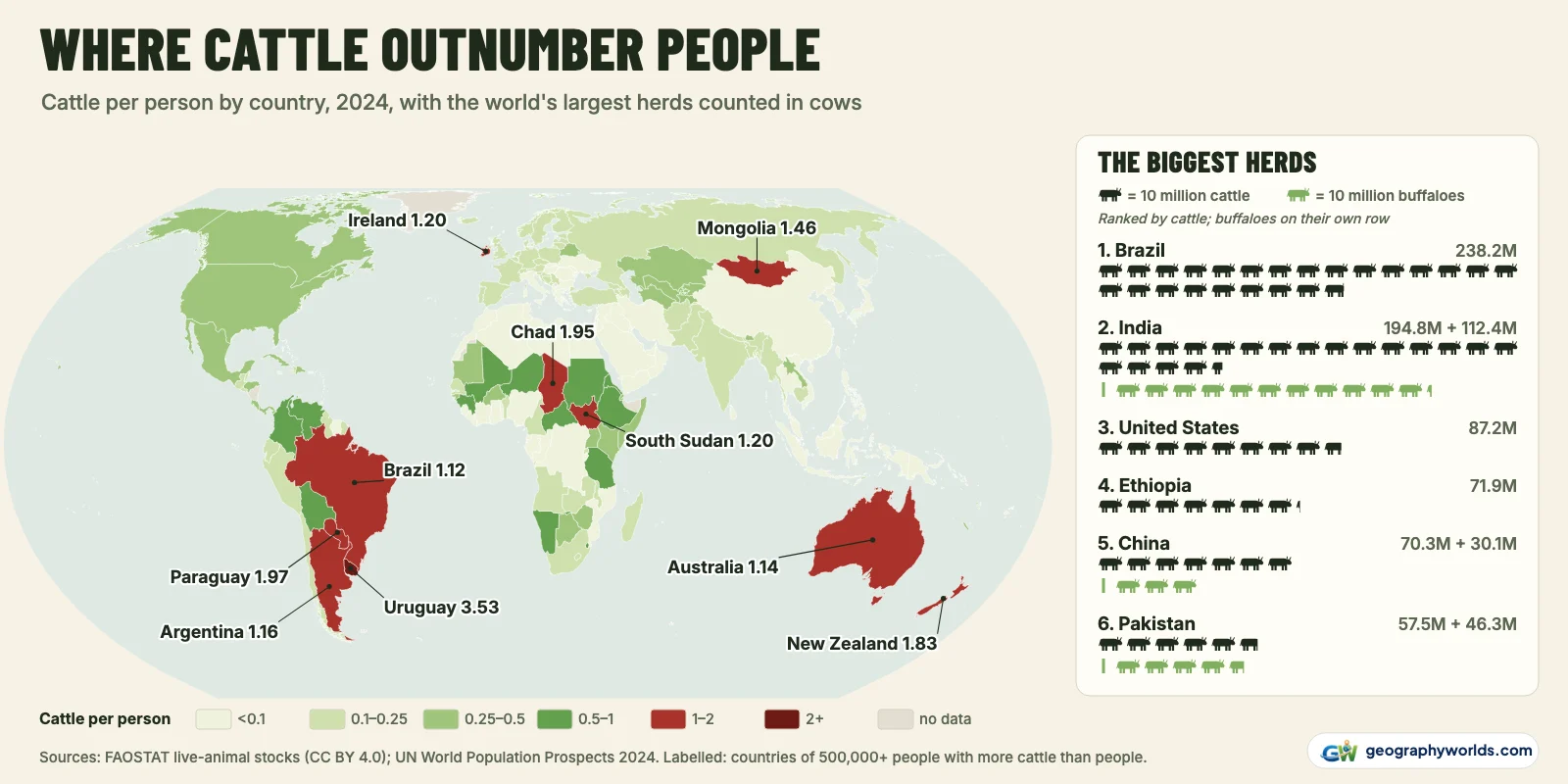
Brazil has the most cattle of any country: 238.2 million head in 2024, 15.1% of the world's 1.58 billion, according to the UN Food and Agriculture Organization (FAO). India is second with 194.8 million, then the United States (87.2 million), Ethiopia (71.9 million), China (70.3 million), Pakistan (57.5 million), Argentina (52.8 million), Chad (39.6 million), Tanzania (39.1 million) and Mexico (36.9 million). FAO counts buffaloes separately; add India's 112.4 million buffaloes and India is first, with 307.1 million bovines.
Those ten countries hold 56% of the world's cattle. FAO's figures are head counts of live animals at a reference date in each country's year, not slaughter numbers, and its series starts in 1961, when the world had 942.1 million cattle. The global herd has grown 68% since then, slower than the human population: there are now about 5.2 people for every head of cattle, or 0.19 cattle per person. In ten countries that ratio flips, and the leaderboard of cattle per person further down looks nothing like the ranking by herd size.
1. Brazil: first since it passed India in 2003
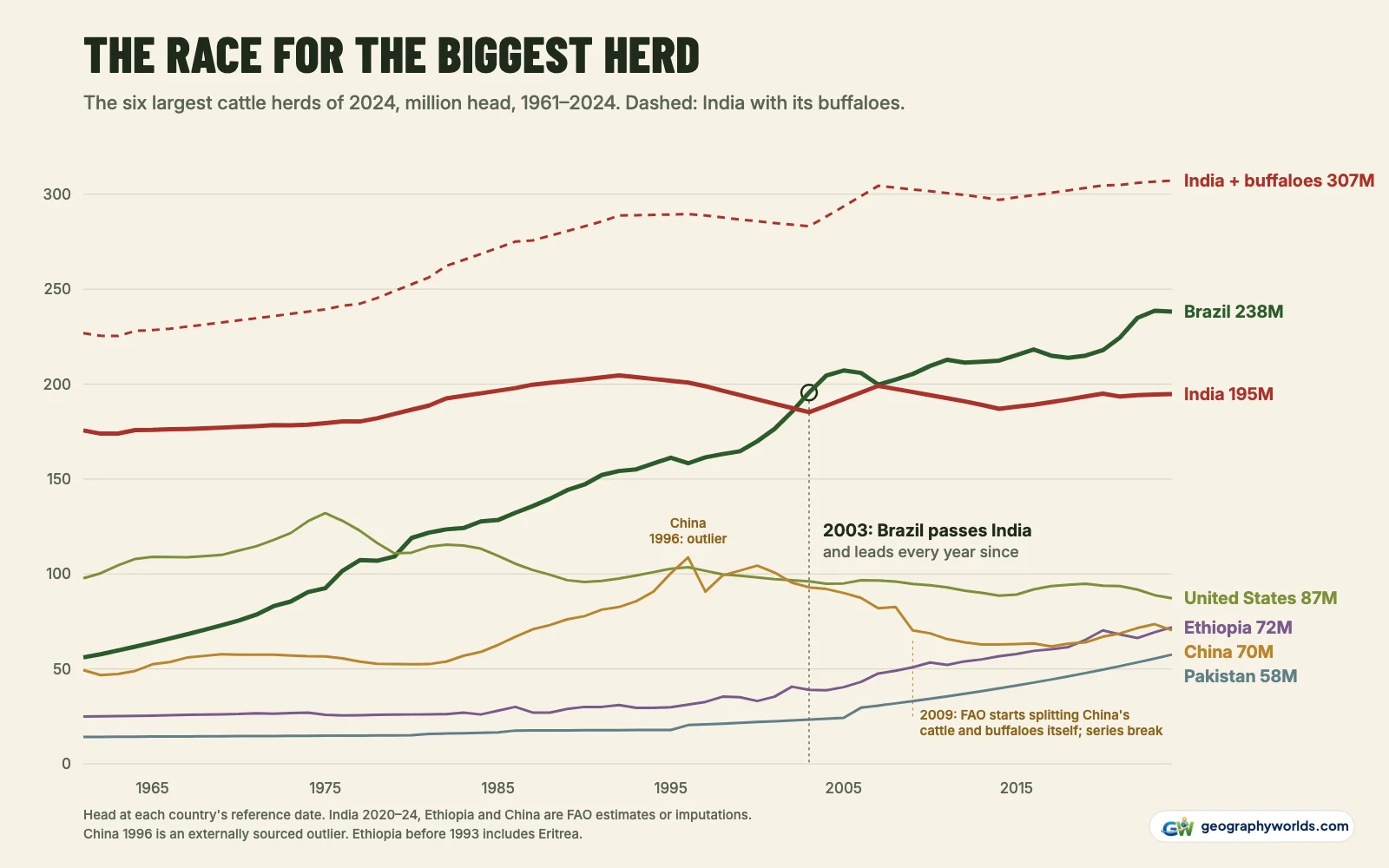
Brazil had 56.0 million cattle in 1961, less than a third of India's herd. It now has 4.3 times as many. FAO's series shows India first in every year until 2002; in 2003 Brazil's 195.6 million edged past India's 185.2 million, and Brazil has led every year from 2003 to 2024. Brazil's own statistics office agrees on the timing: the IBGE livestock survey (Pesquisa da Pecuária Municipal) recorded 195,551,576 head at the end of 2003.
FAO's 2024 figure for Brazil, 238,180,757, is IBGE's count to within a rounding error: IBGE's table 3939 gives 238,213,713 head on 31 December 2024. IBGE has also published a figure FAO has not yet caught up with: 234,251,041 head at the end of 2025, a fall of about four million that still leaves Brazil far ahead of India. Our guide to the geography of beef cattle ranching follows the herds from the Brazilian cerrado to the American plains.

2. India: second on cattle, first once buffaloes count
India's 194.8 million cattle in 2024 are an FAO imputation. The last measured figure is the 20th Livestock Census of 2019, which FAO carries as 193.46 million; the state-by-state table the government gave Parliament in December 2025 adds up to 193,500,987 cattle and 109,847,161 buffaloes. That answer still quoted the 2019 census, because the 21st census, which the ministry told the Lok Sabha was scheduled for 2024, had no national results we could find when we checked. FAO's numbers since 2019 are therefore its own estimate of a herd that has barely moved: India had 175.6 million cattle in 1961, and its peak in FAO's series was 204.6 million in 1992.
The buffalo herd is what puts India back on top. FAO lists 112.4 million Indian buffaloes in 2024, 53% of the world's 212.0 million. Count them with the cattle and India's 307.1 million bovines are well ahead of Brazil's 240.0 million, and India has been first on that measure in every year since 1961. Buffaloes also lift Pakistan above China and the United States.
3. United States: the smallest American herd in FAO's records
The United States had 87.2 million cattle in 2024, which is the USDA's count of 1 January 2024: "87.2 million head, 2 percent below" a year earlier. It is the lowest American figure anywhere in FAO's series. The herd peaked at 132.0 million in 1975 and was 97.7 million in 1961. The decline has continued since: the January 2026 Cattle report puts the herd at 86.2 million. At 0.25 cattle per person, the United States is above the world average of 0.19, but nowhere near the South American ranching countries.
4 and 5. Ethiopia and China, two estimates a whisker apart
Ethiopia is fourth with 71.9 million cattle, the largest herd in Africa, but FAO imputed that figure. Its last official value is 66.3 million for 2022, which matches the "over 66.2 million" in the Central Statistical Agency's 2023 livestock survey, as cited in a 2025 study. That survey leaves out the non-sedentary herds of parts of the Afar and Somali regions, so the true total is higher than the survey figure, but by how much is uncertain. FAO's 2024 number is 8.5% above its 2022 one.
China is fifth with 70.3 million cattle and another 30.1 million buffaloes. Both are FAO estimates. China's National Bureau of Statistics publishes a single figure for all bovines, 100.47 million at the end of 2024, down 4.4% in the year, and FAO's two items add up to exactly that. The split between cattle and buffaloes is FAO's. The series also has a break: in 2009, when FAO began estimating the split itself, its cattle figure for mainland China fell by 12.4 million while buffaloes rose by 6.8 million, so China's cattle line before and after 2009 is not comparable. Because Ethiopia's lead over China is less than two million head and both numbers are estimates, the order of fourth and fifth is the least certain part of the top ten.
6 and 7. Pakistan's fourfold growth, Argentina's recent fall
Pakistan has 57.5 million cattle, up from 14.2 million in 1961, 4.1 times as many; with 46.3 million buffaloes it has 103.9 million bovines, more than China. FAO marks Pakistan's figures as official.
Argentina is seventh with 52,783,892 cattle. That number is the national animal-health agency SENASA's count at the start of 2024, and Argentina's herd has shrunk since. The agriculture secretariat's report on stocks at the end of 2025 gives 50,920,790 head, down 1.36% (about 704,000 head) in the year, as the secretariat's report puts it. Argentina keeps its place either way, and still has 1.16 cattle per person.
8 to 10. Chad, Tanzania and Mexico
The last three places belong to herds that have grown a great deal since 1961 but are known less precisely. Chad's 39.6 million, up from 4.1 million in 1961, is about 10 times the 1961 figure; Tanzania's 39.1 million compares with 8.1 million in 1961; Mexico has 36.9 million, against 16.5 million in 1961. FAO imputed all three 2024 values. Chad's last reported figure, for 2023, was 37.6 million.
| Rank | Country | Cattle, 2024 (million head) | Share of world | Buffaloes (million) | Cattle per person | FAO flag |
|---|---|---|---|---|---|---|
| 1 | Brazil | 238.2 | 15.1% | 1.8 | 1.12 | official |
| 2 | India | 194.8 | 12.3% | 112.4 | 0.13 | imputed by FAO |
| 3 | United States | 87.2 | 5.5% | – | 0.25 | official |
| 4 | Ethiopia | 71.9 | 4.6% | – | 0.54 | imputed by FAO |
| 5 | China | 70.3 | 4.5% | 30.1 | 0.05 | FAO estimate |
| 6 | Pakistan | 57.5 | 3.6% | 46.3 | 0.23 | official |
| 7 | Argentina | 52.8 | 3.3% | – | 1.16 | official |
| 8 | Chad | 39.6 | 2.5% | – | 1.95 | imputed by FAO |
| 9 | Tanzania | 39.1 | 2.5% | – | 0.57 | imputed by FAO |
| 10 | Mexico | 36.9 | 2.3% | – | 0.28 | imputed by FAO |
| 11 | Sudan | 31.3 | 2.0% | – | 0.62 | imputed by FAO |
| 12 | Australia | 30.4 | 1.9% | – | 1.14 | official |
| 13 | Colombia | 30.3 | 1.9% | 0.5 | 0.57 | official |
| 14 | Bangladesh | 25.0 | 1.6% | 1.5 | 0.14 | official |
| 15 | Kenya | 22.4 | 1.4% | – | 0.40 | official |
The per-person leaderboard, 1 to 10
Divide each herd by the country's population and the ranking reorders completely. These are the ten countries of at least 500,000 people with more cattle than people in 2024:
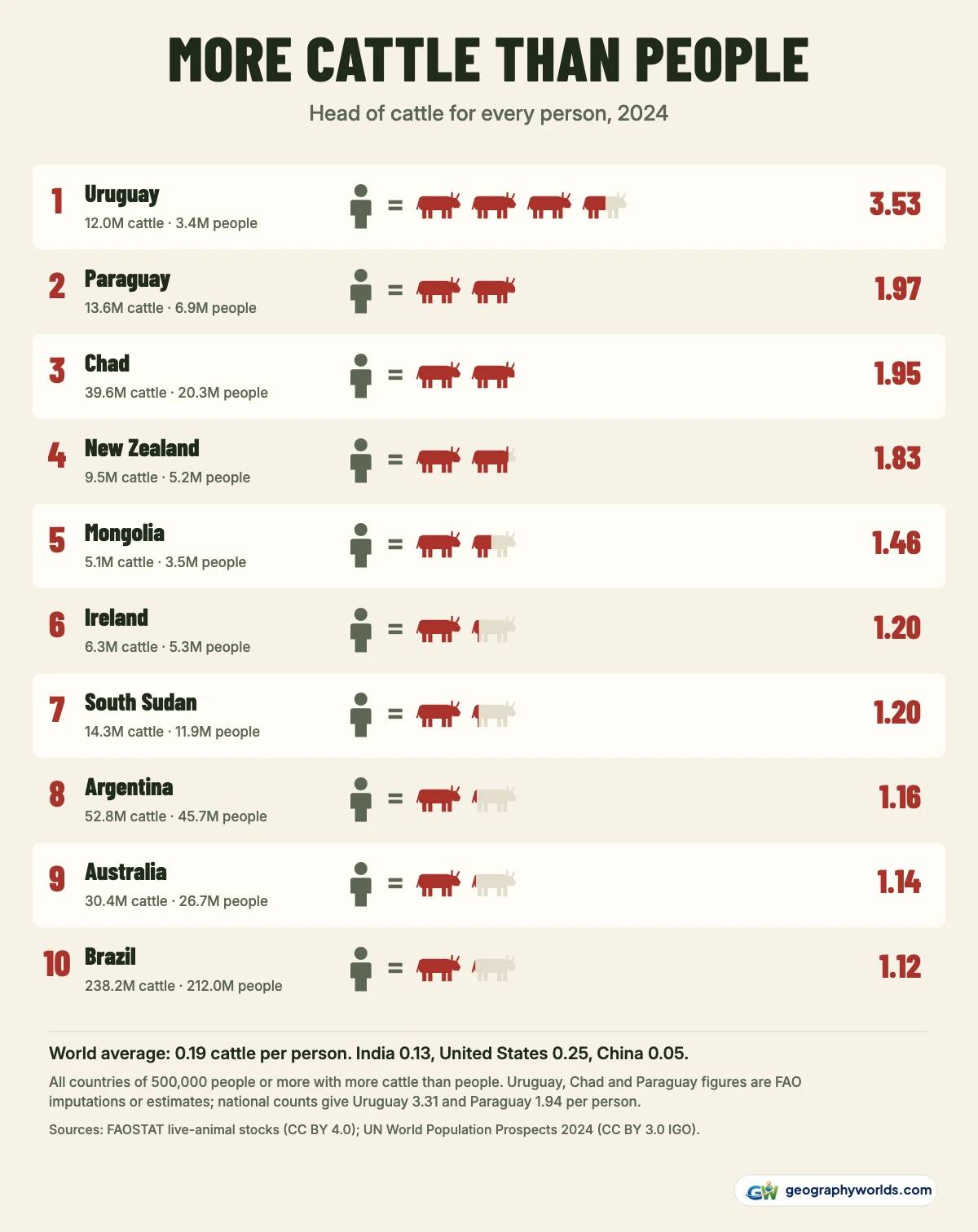
- Uruguay, 3.53. 12.0 million cattle for 3.4 million people, a ratio that was already 3.43 in 1961. FAO's 2024 figure is imputed. Uruguay's own sworn livestock declaration (DICOSE) for 2024/25 counted 11,583,321 head, El Observador reports, and the 2023 census found 3,499,451 residents, which gives 3.31 per person. On either count Uruguay is far ahead; our Uruguay country guide covers the grasslands that carry them.
- Paraguay, 1.97, on FAO's estimate of 13.6 million head. A herd figure of 13,470,055 for 2024, reported by ABC Color, gives 1.94.
- Chad, 1.95. Level with Paraguay within the margin of the estimates; on Paraguay's national figure Chad would be second.
- New Zealand, 1.83. 9.5 million cattle, which is Stats NZ's June 2024 count of 3,679,443 beef and 5,836,845 dairy cattle, as charted by Figure.NZ. Dairy cattle outnumber beef cattle there.
- Mongolia, 1.46.
- Ireland, 1.20, the only European country on the list.
- South Sudan, 1.20.
- Argentina, 1.16.
- Australia, 1.14, with 30.4 million head.
- Brazil, 1.12; with Argentina and Chad, it is one of three countries in both top tens.
The list was longer in 1961, when fourteen countries of that size had more cattle than people: Namibia, Uruguay, Botswana, New Zealand, Mauritania, Paraguay, Argentina, Mongolia, Australia, Madagascar, Ireland, Chad, Ethiopia and Somalia. Populations have outgrown herds almost everywhere since. India, with the second-largest herd, has 0.13 cattle per person; Ethiopia has 0.54; China 0.05.

Census dates, buffaloes and imputations: reading the counts
Three things make cattle rankings disagree from one source to the next. The first is the date. A stock is a count on a particular day: the USDA counts on 1 January, IBGE and SENASA on 31 December, Stats NZ on 30 June, and FAO files each under one calendar year. Argentina's "2024" figure in FAO is really the stock at the very start of that year.
The second is what counts as cattle. FAO's "Cattle" item excludes buffaloes, which matters most for India, Pakistan and China. China's statistics bureau reports cattle and buffaloes as one number, so any cattle-only figure for China is an estimate.
The third is how old the underlying count is. FAO flags each value: official, estimated, or imputed when a country has not reported. India's last census is from 2019, and the 2024 figures for India, Ethiopia, Chad, Tanzania, Mexico and Uruguay are all imputed. Where we could check the larger herds against national sources (Brazil, India's census, the United States, China's bovine total, Argentina and New Zealand), FAO matched them; Ethiopia's imputed figure runs above its last survey.
Where the numbers come from
All rankings use FAOSTAT's live-animal stocks for "Cattle" and "Buffalo" (bulk file of December 2025), with regional totals removed and FAO's combined China entry replaced by mainland China and Taiwan. Cattle per person divides by UN World Population Prospects 2024 mid-year estimates and leaves out countries under 500,000 people; for 1961, Ethiopia's figure covers the then Ethiopia including Eritrea. You can download the data as a CSV for all 202 countries and former countries, with every year since 1961, FAO's flag, buffaloes and population.
- FAO, FAOSTAT Crops and livestock products (QCL), items "Cattle" and "Buffalo", element Stocks: live animals (head) for every country, 1961–2024; bulk file dated December 2025; CC BY 4.0 (FAO statistical database terms)
- UN DESA, World Population Prospects 2024, demographic indicators (medium variant): mid-year population, used for cattle per person; CC BY 3.0 IGO
- IBGE, Pesquisa da Pecuária Municipal, table 3939 (Brazil's cattle herd at 31 December)
- Government of India, 20th Livestock Census figures as given to the Rajya Sabha, 17 December 2025
- USDA NASS, Cattle (January 2024 and January 2026 reports)
- Natural Earth country outlines (via world-atlas): public domain
Cattle are not the only grazing animals that outnumber people somewhere; New Zealand, Uruguay and Mongolia turn up again among the countries with more sheep than people.