
Introduction
Croatia 🇭🇷 and Serbia 🇷🇸 are close neighbours in the Balkans, two of the larger states to emerge from the former Yugoslavia. They share a long stretch of border and a tangled history, but their geography pulls them in different directions: one reaches out to the Adriatic Sea, the other sits landlocked at the crossroads of southeastern Europe. This comparison weighs them against each other on size, population, capitals, climate, and natural features.
Whether you are studying the region, planning a trip through the western Balkans, or simply curious about how these two nations differ, the tables and figures below cover the essentials.
Size & Geography
| Feature | Croatia 🇭🇷 | Serbia 🇷🇸 |
|---|---|---|
| Area | 56,594 km² | 77,474 km² |
| Continent | Europe | Europe |
| Region | Southern Europe | Southern Europe |
| Land Borders | Slovenia, Hungary, Serbia, Bosnia and Herzegovina, Montenegro | Hungary, Romania, Bulgaria, North Macedonia, Kosovo, Montenegro, Bosnia and Herzegovina, Croatia |
| Landscape | Adriatic coastline, interior plains, mountains | flat plains in north (Vojvodina); mountains in south |
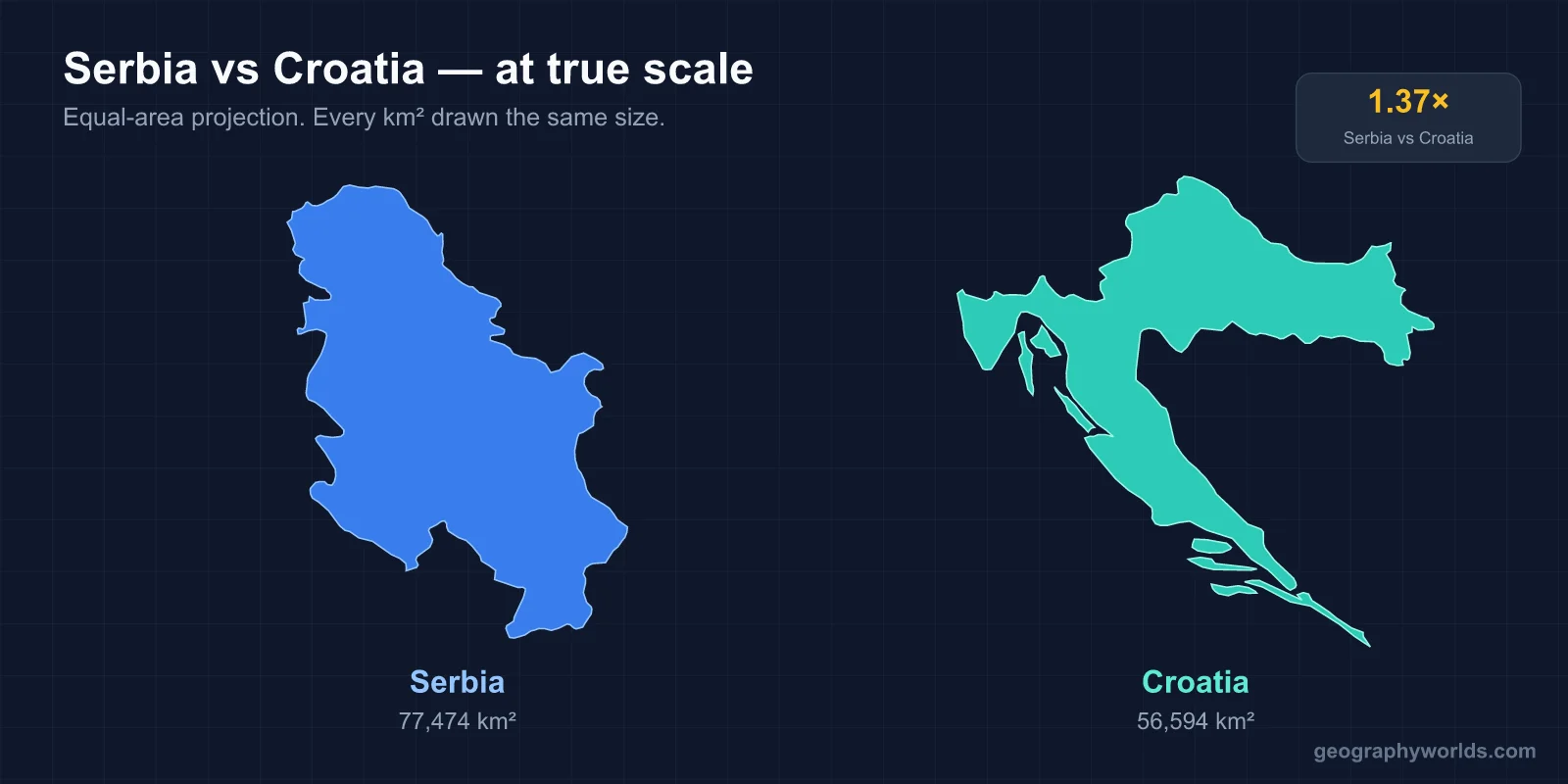
Serbia is the larger of the two, covering 77,474 km² to Croatia's 56,594 km², roughly 1.4 times the area. Their shapes and settings differ more than the numbers alone suggest. Croatia is famously crescent-shaped, wrapping from interior plains and mountains down to a long Adriatic coastline, while Serbia is landlocked, with the flat farmland of the Vojvodina plain in the north giving way to mountains in the south. Serbia's eight neighbours, against Croatia's five, reflect its central position in the Balkans; the two countries border each other directly.
Population & Demographics
| Metric | Croatia 🇭🇷 | Serbia 🇷🇸 |
|---|---|---|
| Population | 3.8 million | 6.6 million |
| Population Density | 67.5 per km² | 85.7 per km² |
Serbia leads on population as well as land. It is home to about 6.6 million people against Croatia's 3.8 million, roughly 1.7 times as many. With more people in a larger but still compact territory, Serbia is also the more crowded of the two, at 85.7 people per square kilometre versus Croatia's 67.5 — a gap of about 18.2 per km². Croatia's lower density partly reflects the way its population clusters along the coast and around Zagreb, leaving stretches of the mountainous interior thinly settled.
Capital Cities
Zagreb is the capital of Croatia, while Belgrade is the capital of Serbia. Both are Southern European cities, but their settings differ: Zagreb sits inland in the country's continental north, away from the coast that defines much of Croatia, while Belgrade commands a strategic perch where the Sava River meets the Danube.
Language, Currency & Culture
| Aspect | Croatia 🇭🇷 | Serbia 🇷🇸 |
|---|---|---|
| Languages | Croatian (official) | Serbian (official) |
| Currency | Euro (EUR) | Serbian Dinar (RSD) |
Croatian is the official language of Croatia and Serbian that of Serbia. The two are closely related South Slavic tongues, though they are written differently in practice, Croatian in the Latin alphabet and Serbian commonly in Cyrillic. Money draws a clearer line between them: Croatia adopted the Euro after joining the eurozone, while Serbia, outside the EU, keeps its own Serbian Dinar.
Climate & Natural Features
| Aspect | Croatia 🇭🇷 | Serbia 🇷🇸 |
|---|---|---|
| Climate | Mediterranean along coast; continental inland | continental in north; more Mediterranean in south |
| Key Features | Dalmatian Coast, Plitvice Lakes, Dinaric Alps, 1,000+ islands | Danube and Sava rivers, Đerdap Gorge, Dinaric Alps |
| Economy | tourism, shipbuilding, agriculture, food processing | automotive, agriculture, IT, mining |
Croatia's climate splits between a Mediterranean coast and a continental interior, a divide echoed in its landmarks: the Dalmatian Coast, the terraced waterfalls of Plitvice Lakes, the Dinaric Alps, and more than 1,000 islands. Serbia, without a coastline, runs continental in the north and shades toward Mediterranean influence in the south; its defining features are rivers and mountains, above all the Danube and Sava and the dramatic Đerdap Gorge, with the Dinaric Alps reaching into its territory as well. The economies follow these settings, with Croatia leaning heavily on tourism, shipbuilding, and food processing, and Serbia on automotive manufacturing, agriculture, IT, and mining.
What Makes Each Country Unique
Croatia is celebrated for the Dalmatian Coast, the walled city of Dubrovnik (a filming location for Game of Thrones), the Plitvice Lakes, and its scattering of more than 1,000 islands. A lesser-known claim to fame: the necktie, or cravat, traces its origins to Croatia, evolving from the scarves worn by Croatian mercenaries in 17th-century France.
Serbia is known for being the birthplace of Nikola Tesla, the lively nightlife of Belgrade, its medieval monasteries, and the Đerdap Gorge. Tesla, one of history's greatest inventors, was of Serbian origin, and the country honours him on its currency and through numerous monuments.
Key Differences at a Glance
- Area: Croatia (56,594 km²) vs Serbia (77,474 km²) — Serbia is 1.4x larger
- Population: Croatia (3.8 million) vs Serbia (6.6 million) — Serbia is 1.7x more populous
- Capitals: Zagreb vs Belgrade
- Currency: Euro (EUR) vs Serbian Dinar (RSD)
- Continents: Europe vs Europe
- Density: Serbia is more densely populated (difference of ~18.2 people per km²)
- Languages: Croatian (official) vs Serbian (official)
Verdict
Croatia and Serbia are neighbours shaped by the same region but defined by different relationships with the sea. Serbia is the larger country by about 1.4 times and the more populous by roughly 1.7 times, and it is also the more densely settled of the two. Croatia, smaller and more thinly populated, makes up for it with a long coastline that Serbia entirely lacks.
That coastline is the heart of Croatia's identity, from the Dalmatian shore to Plitvice Lakes and its thousand-plus islands, and it underpins a tourism-driven economy. Serbia's character is inland and riverine, built around the Danube and Sava, the Đerdap Gorge, and an economy weighted toward automotive manufacturing and agriculture.
Set side by side, the two countries illustrate how closely linked Balkan neighbours can still feel worlds apart. Whether you are travelling the region, studying it, or simply curious, comparing them brings the diversity of southeastern Europe into sharper focus.
Test Your Knowledge!
Think you know your countries? Try our interactive geography quiz!
Play Geography Games →