
Introduction
How do Democratic Republic of the Congo 🇨🇩 and Angola 🇦🇴 compare? Central-Southern African giants. In this geographic comparison, we examine how these two nations stack up across size, population, capitals, natural features, and more.
Whether you're studying geography, planning travel, or simply curious about how countries differ, this side-by-side comparison of Democratic Republic of the Congo and Angola provides the key facts and figures you need.
Size & Geography
| Feature | Democratic Republic of the Congo 🇨🇩 | Angola 🇦🇴 |
|---|---|---|
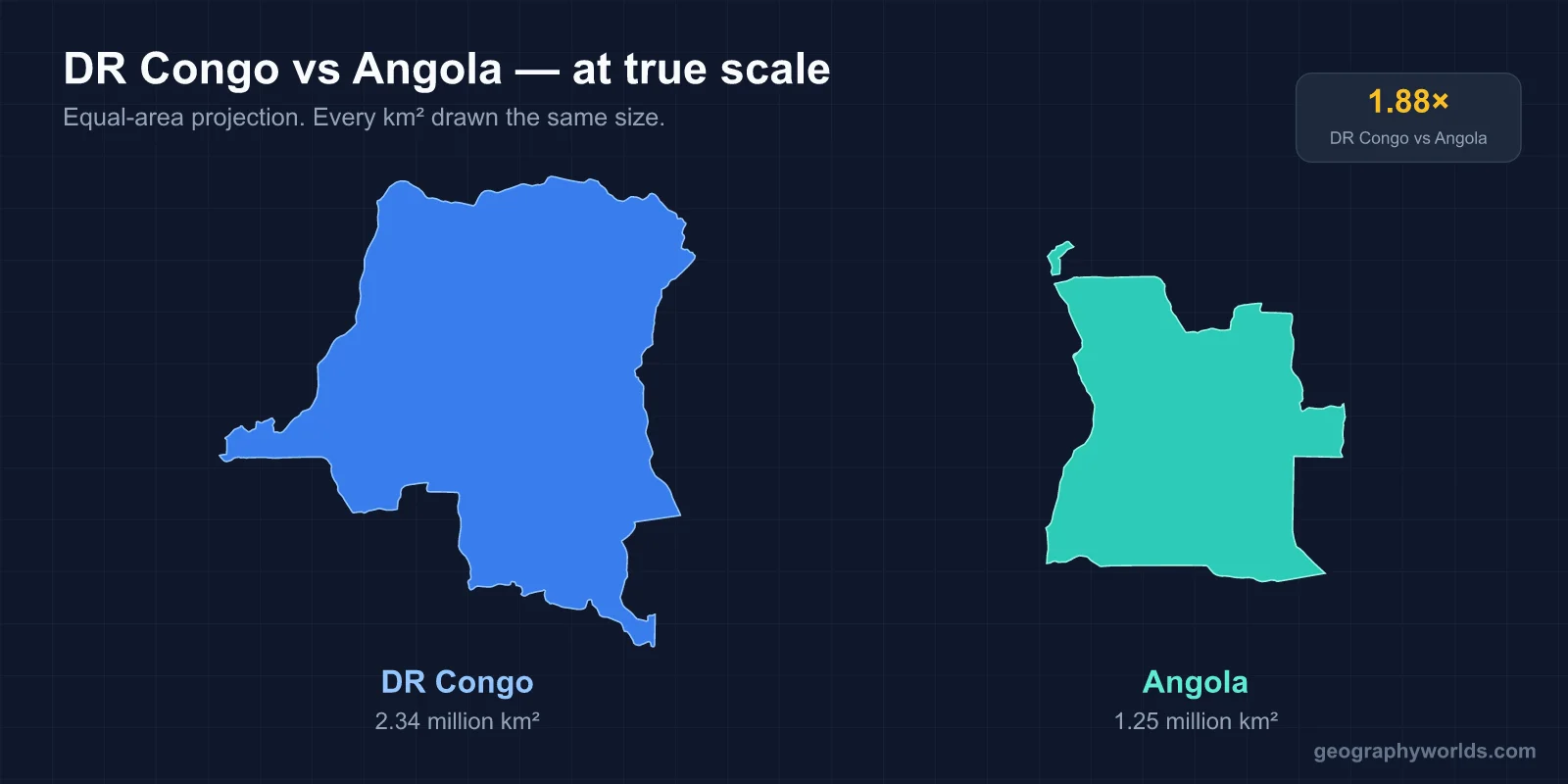
| Area | 2,344,858 km² | 1,246,700 km² |
| Continent | Africa | Africa |
| Region | Central Africa | Southern Africa |
| Land Borders | Republic of Congo, Central African Republic, South Sudan, Uganda, Rwanda, Burundi, Tanzania, Zambia, Angola | DRC, Republic of Congo, Zambia, Namibia |
| Landscape | vast central Congo Basin, mountains in the east | narrow coastal plain rising to vast interior plateau |
Democratic Republic of the Congo is approximately 1.9 times larger in area than Angola. Democratic Republic of the Congo features vast central Congo Basin, mountains in the east, while Angola is characterized by narrow coastal plain rising to vast interior plateau.
Population & Demographics
| Metric | Democratic Republic of the Congo 🇨🇩 | Angola 🇦🇴 |
|---|---|---|
| Population | 116.5 million | 40.2 million |
| Population Density | 49.7 per km² | 32.3 per km² |
Democratic Republic of the Congo has a larger population, approximately 2.9 times that of Angola. In terms of population density, Democratic Republic of the Congo is more densely populated, with a difference of about 17.4 people per km².
Capital Cities
Kinshasa serves as the capital of Democratic Republic of the Congo, while Luanda is the capital of Angola. Both capitals are located in Africa, with Kinshasa in Central Africa and Luanda in Southern Africa.
Language, Currency & Culture
| Aspect | Democratic Republic of the Congo 🇨🇩 | Angola 🇦🇴 |
|---|---|---|
| Languages | French (official), Lingala, Kikongo, Swahili, Tshiluba | Portuguese (official), Umbundu, Kimbundu, Kikongo |
| Currency | Congolese Franc (CDF) | Angolan Kwanza (AOA) |
In Democratic Republic of the Congo, French (official) is widely spoken, while Angola uses Portuguese (official). These linguistic differences reflect each country's unique colonial history, indigenous heritage, and cultural evolution over centuries.
Climate & Natural Features
| Aspect | Democratic Republic of the Congo 🇨🇩 | Angola 🇦🇴 |
|---|---|---|
| Climate | tropical; hot and humid in equatorial river basin | semiarid in south and along coast; tropical in north |
| Key Features | Congo River, Congo Rainforest, Virunga volcanoes | Kalandula Falls, Namib Desert extension, Congo Basin edge |
| Economy | mining (cobalt, copper, diamonds), agriculture | oil, diamonds, agriculture, fishing |
Democratic Republic of the Congo has a tropical; hot and humid in equatorial river basin climate, featuring notable landmarks such as Congo River, Congo Rainforest, Virunga volcanoes. Meanwhile, Angola experiences a semiarid in south and along coast; tropical in north climate and is known for Kalandula Falls, Namib Desert extension, Congo Basin edge.
What Makes Each Country Unique
Democratic Republic of the Congo is internationally renowned for the vast Congo Rainforest (second largest after Amazon), mountain gorillas, and extraordinary mineral wealth. The DRC produces roughly 70% of the world's cobalt, a critical element for rechargeable batteries.
Angola is best known for oil production, giant sable antelope (national symbol), and Kalandula Falls. Angola's Kalandula Falls are among the largest waterfalls in Africa by volume, plunging 105 meters.
Key Differences at a Glance
- Area: Democratic Republic of the Congo (2,344,858 km²) vs Angola (1,246,700 km²) — Democratic Republic of the Congo is 1.9x larger
- Population: Democratic Republic of the Congo (116.5 million) vs Angola (40.2 million) — Democratic Republic of the Congo is 2.9x more populous
- Capitals: Kinshasa vs Luanda
- Currency: Congolese Franc (CDF) vs Angolan Kwanza (AOA)
- Continents: Africa vs Africa
- Density: Democratic Republic of the Congo is more densely populated (difference of ~17.4 people per km²)
- Languages: French (official) vs Portuguese (official)
Verdict
Democratic Republic of the Congo and Angola — central-southern african giants — each offer unique geographic characteristics that make them fascinating to compare. While Democratic Republic of the Congo claims the larger land area (1.9x), Democratic Republic of the Congo leads in population (2.9x), showing how size and population don't always go hand in hand.
Democratic Republic of the Congo stands out for its tropical; hot and humid in equatorial river basin climate and landmarks like Congo River, whereas Angola is defined by its semiarid in south and along coast; tropical in north climate and features such as Kalandula Falls. Economically, Democratic Republic of the Congo focuses on mining (cobalt while Angola drives growth through oil.
Both nations contribute uniquely to our world's geographic tapestry. Whether you're planning a visit, studying world geography, or simply satisfying your curiosity, understanding these differences helps build a richer picture of our diverse planet.
Test Your Knowledge!
Think you know your countries? Try our interactive geography quiz!
Play Geography Games →