
Introduction
Denmark 🇩🇰 and Finland 🇫🇮 are often grouped together as Nordic countries, yet they sit at almost opposite ends of the region's geography. One is a compact, low-lying realm of peninsulas and islands reaching out from continental Europe; the other is a vast, forested expanse stretching deep toward the Arctic. This comparison sets the two side by side across size, population, capitals, climate, and the natural features that define each.
Whether you are revising for a geography class, sketching out a trip, or just curious how two neighbours in the same corner of the world can differ so sharply, the figures and tables below lay out what matters.
Size & Geography
| Feature | Denmark 🇩🇰 | Finland 🇫🇮 |
|---|---|---|
| Area | 43,094 km² | 338,424 km² |
| Continent | Europe | Europe |
| Region | Northern Europe | Northern Europe |
| Land Borders | Germany | Sweden, Norway, Russia |
| Landscape | low, flat; gently rolling plains | mostly low, flat to rolling plains with lakes |
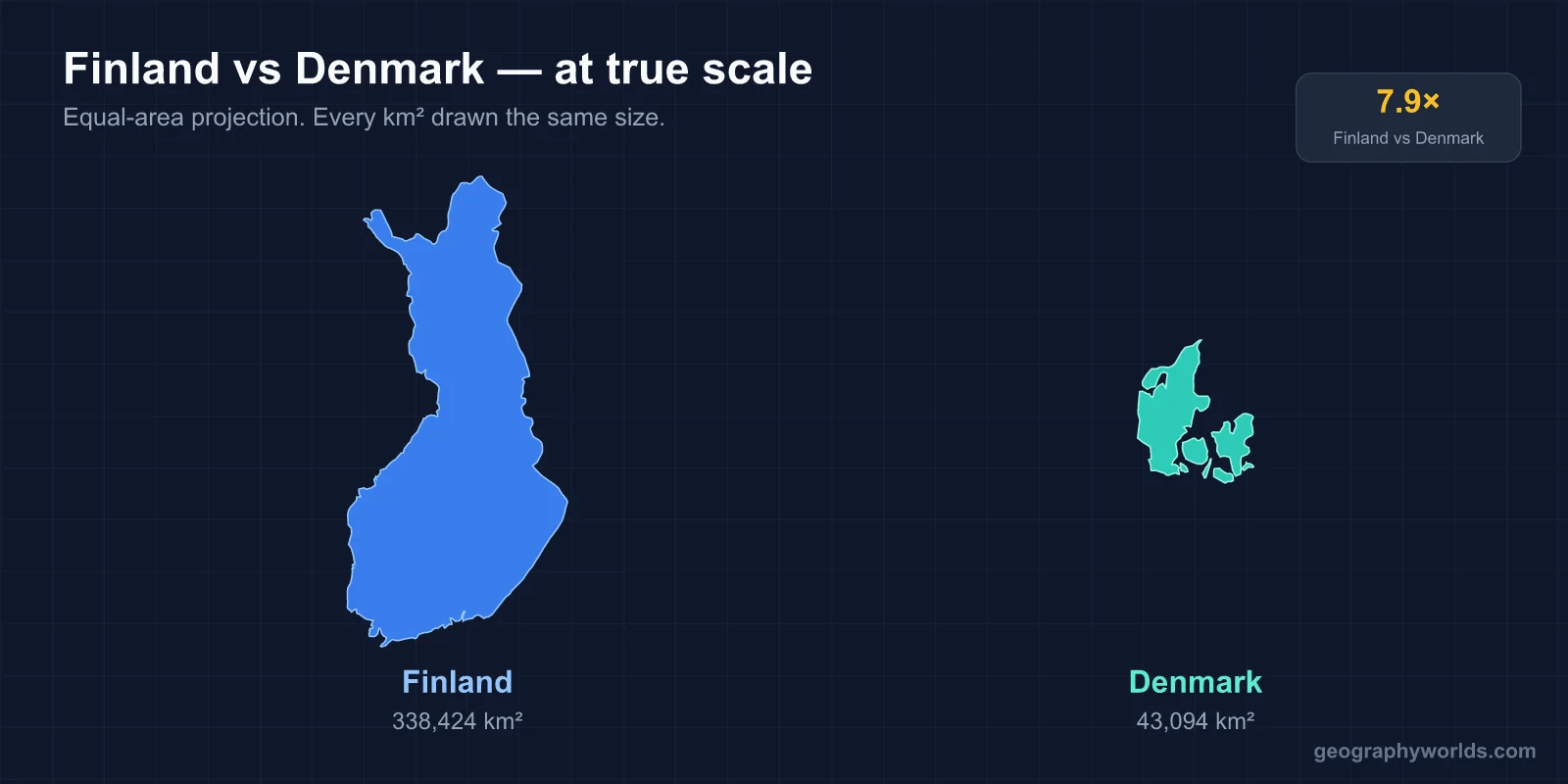
The contrast in scale is the first thing that stands out. Finland covers 338,424 km², roughly 7.9 times the 43,094 km² of Denmark. Their borders tell the same story of different positions on the map: Denmark shares just a single land frontier, with Germany to its south, while Finland's long eastern and northern boundaries touch Sweden, Norway, and Russia. Both are low-lying countries, Denmark made up of gently rolling plains and Finland of similarly flat to rolling terrain, but Finland's surface is laced with the lakes that give it much of its character.
Population & Demographics
| Metric | Denmark 🇩🇰 | Finland 🇫🇮 |
|---|---|---|
| Population | 6.0 million | 5.6 million |
| Population Density | 139.8 per km² | 16.6 per km² |
Here the two countries nearly meet in the middle. Denmark counts about 6.0 million people to Finland's 5.6 million, so their populations are close, with Denmark roughly 1.1 times larger. Density is where the geography reasserts itself: with similar headcounts spread across wildly different areas, Denmark packs 139.8 people into every square kilometre while Finland holds just 16.6 — a gap of about 123.2 per km². In short, a similar number of Finns live across an area nearly eight times the size of Denmark.
Capital Cities
Copenhagen is the capital of Denmark and Helsinki the capital of Finland. Both are Northern European cities and both face the Baltic Sea, yet each anchors its country's population, government, and economic life in a region otherwise defined by open space.
Language, Currency & Culture
| Aspect | Denmark 🇩🇰 | Finland 🇫🇮 |
|---|---|---|
| Languages | Danish (official) | Finnish and Swedish (both official) |
| Currency | Danish Krone (DKK) | Euro (EUR) |
Language marks one of the sharper cultural divides between the two. Danish is a North Germanic language, related to Swedish and Norwegian, and is the sole official tongue of Denmark. Finland, by contrast, recognises two official languages, Finnish and Swedish; Finnish belongs to the Finno-Ugric family and is unrelated to the Scandinavian languages around it. The countries also diverge on money: Finland adopted the Euro, while Denmark has kept its own Danish Krone.
Climate & Natural Features
| Aspect | Denmark 🇩🇰 | Finland 🇫🇮 |
|---|---|---|
| Climate | temperate; mild, windy winters and cool summers | cold temperate; harsh winters, mild summers |
| Key Features | Faroe Islands connection, Zealand, Jutland, coastal dunes | 188,000 lakes, Finnish Lapland, forests, midnight sun |
| Economy | wind energy, pharmaceuticals, shipping, agriculture | technology (Nokia), forestry, metals, engineering |
Denmark's maritime position gives it a temperate climate of mild, windy winters and cool summers, and its terrain is dominated by the sea: the islands of Zealand, the Jutland peninsula, coastal dunes, and a far-flung connection to the Faroe Islands. Finland reaches much farther north, so it endures a cold temperate climate of harsh winters and only mild summers, and its landscape is famously watery and wooded — some 188,000 lakes, the forests and fells of Finnish Lapland, and the long summer days of the midnight sun. Their economies lean in different directions too, Denmark toward wind energy, pharmaceuticals, shipping, and agriculture, Finland toward technology, forestry, metals, and engineering.
What Makes Each Country Unique
Denmark is known around the world for LEGO, the fairy tales of Hans Christian Andersen, the cosy ethos of hygge, and a strong social welfare tradition. Its Faroe Islands famously have more sheep than people, and the wider Kingdom of Denmark also includes Greenland, the largest island on Earth.
Finland draws visitors with Santa Claus Village in Lapland, its sauna culture, the Northern Lights, the Nokia name, and an education system that consistently ranks among the world's best. The country has more than 3 million saunas for a population of 5.5 million people — close to one sauna for every two residents.
Key Differences at a Glance
- Area: Denmark (43,094 km²) vs Finland (338,424 km²) — Finland is 7.9x larger
- Population: Denmark (6.0 million) vs Finland (5.6 million) — Denmark is 1.1x more populous
- Capitals: Copenhagen vs Helsinki
- Currency: Danish Krone (DKK) vs Euro (EUR)
- Continents: Europe vs Europe
- Density: Denmark is far more densely populated (difference of ~123.2 people per km²)
- Languages: Danish (official) vs Finnish and Swedish (both official)
Verdict
Denmark and Finland show how two Nordic neighbours with almost the same population can feel like entirely different places. Finland holds the far larger territory, nearly 7.9 times Denmark's, yet Denmark edges ahead in population by about 1.1 times and packs its people in far more tightly. It is a neat reminder that land area and headcount rarely track each other.
Denmark's appeal lies in its mild maritime climate and sea-shaped geography, from Zealand and Jutland to its coastal dunes, while Finland is defined by its colder northern setting and a landscape of lakes, forests, and the midnight sun. Even their economies pull in separate directions, with Denmark leaning on wind energy and Finland on technology.
Taken together, the two countries make a vivid pair to study. Whether you are heading north for a visit, working through world geography, or simply following your curiosity, holding them side by side sharpens the picture of just how varied the Nordic region really is.
Test Your Knowledge!
Think you know your countries? Try our interactive geography quiz!
Play Geography Games →