
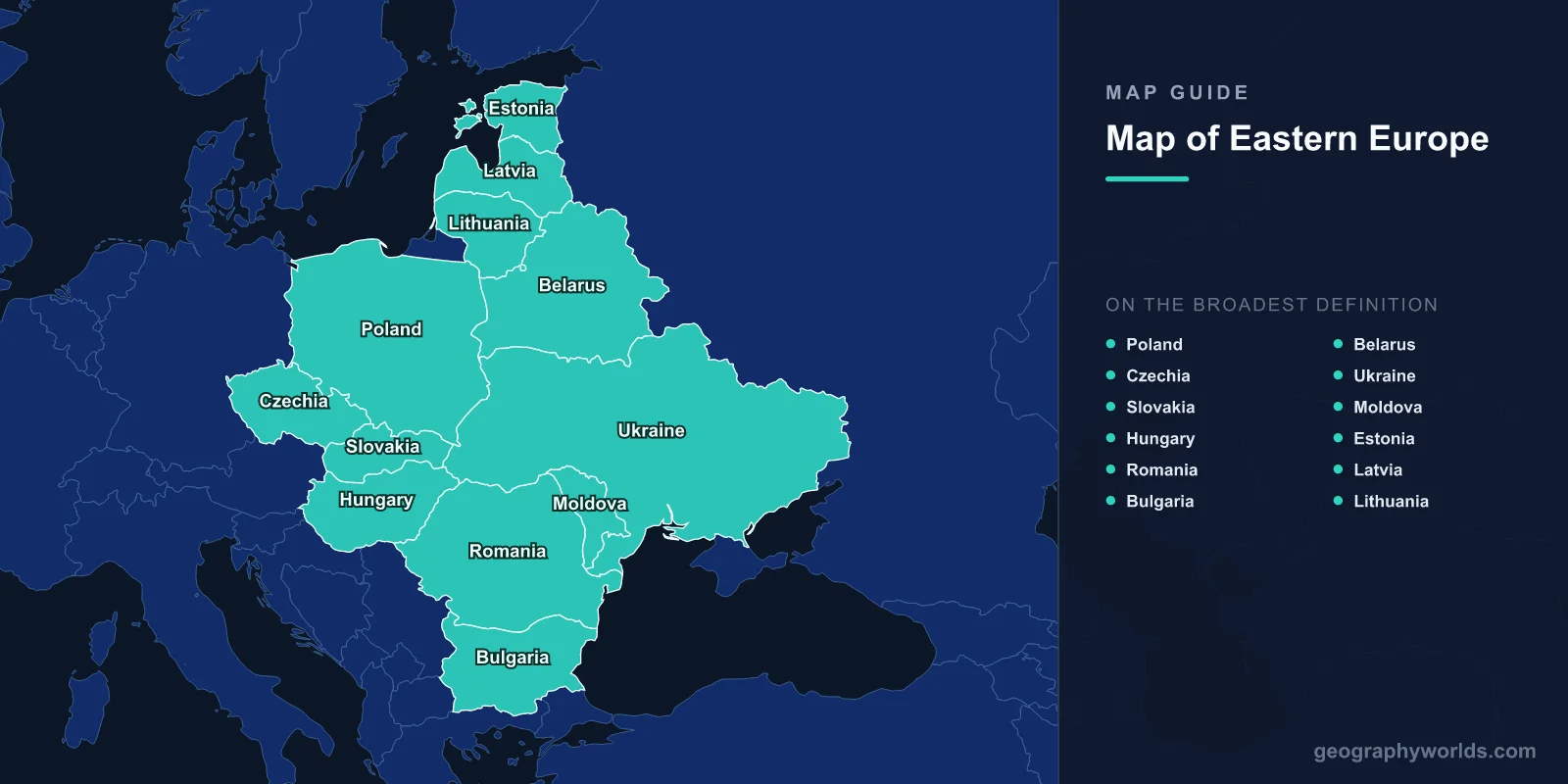
Eastern Europe is the region of the European continent between the historical centres of German and Russian power. The exact definition of "Eastern Europe" is contested and depends substantially on whether one uses a geographic, cultural, religious, political, or historical frame. The most expansive definitions include all the countries between Germany and Russia: Poland, the Czech Republic, Slovakia, Hungary, Romania, Bulgaria, Belarus, Ukraine, Moldova, the Baltic states (Estonia, Latvia, Lithuania), and various parts of the Balkans. More restrictive definitions exclude the countries that are more accurately "Central European" (the Czech Republic, Slovakia, Poland, Hungary, sometimes the Baltic states) and reserve "Eastern Europe" for the countries with deeper Orthodox Christian and post-Soviet identity (Russia, Belarus, Ukraine, Moldova, sometimes the Balkans). The combined population of the maximally defined Eastern Europe is approximately 290 million. The political and cultural identity of the region has been substantially shaped by the experience of communist rule from 1945 to 1989-91, by the post-1989 transitions, and most recently by the 2022 Russian invasion of Ukraine and its broader regional consequences.
The Three Definitions
The most common framing of Eastern Europe is the Cold War-era political definition: the countries that were on the eastern side of the Iron Curtain. By this definition, Eastern Europe includes Poland, East Germany (until 1990), Czechoslovakia (until 1993), Hungary, Romania, Bulgaria, Yugoslavia (sometimes), Albania, and the Soviet Union. This definition is historically clear but has become outdated since 1991 — most of these countries have integrated into Western institutions (EU, NATO) and many of their citizens now object to being called "Eastern European" because of the implied association with backwardness or post-Soviet status. The cultural-historical definition emphasises Orthodox Christianity, Slavic linguistic heritage, and Byzantine cultural inheritance — this framing puts Russia, Belarus, Ukraine, Bulgaria, Serbia, Montenegro, and parts of Romania and Greece in Eastern Europe, while Poland, the Czech Republic, Hungary, Slovenia, and Croatia are categorised as Central or Western European on cultural grounds. The geographic definition simply uses the Ural mountains as Europe's eastern boundary and divides the continent at convenient longitudes — this definition has the advantage of being neutral and stable but the disadvantage of producing categories that don't align well with the cultural-political realities.
The Central European Pushback
From the 1980s onwards, intellectuals from the countries between Germany and Russia — particularly the Czech writer Milan Kundera, the Hungarian historian Jenő Szűcs, and the Polish writer Czesław Miłosz — argued substantially against the inclusion of their countries in "Eastern Europe." Kundera's influential 1984 essay "The Tragedy of Central Europe" argued that the Cold War division of Europe had artificially placed countries with deep cultural and historical ties to Western Europe (Catholic religion, Latin alphabet, Renaissance and Reformation traditions, Habsburg and German political influence) in an "Eastern" category to which they did not naturally belong. The "Central European" alternative concept — encompassing roughly the former Habsburg territories plus Poland and sometimes Lithuania — gained substantial traction in the 1990s and 2000s and is now widely used to describe Poland, the Czech Republic, Slovakia, Hungary, and sometimes Slovenia and Croatia. The Visegrad Group (V4) — Poland, Czech Republic, Slovakia, Hungary — has institutionalised the Central European framing politically, with somewhat varied success over the decades.
The Communist Period
The shared experience of communist rule from 1945-49 to 1989-91 is the single most important formative event for what is now understood as Eastern Europe. The various national experiences varied considerably — Yugoslavia outside the Warsaw Pact, Albania's extreme isolation under Hoxha, Hungary's relative liberalisation after 1956, Romania's neo-Stalinist Ceaușescu period, Czechoslovakia's 1968 Prague Spring and subsequent "normalisation," Poland's Solidarity movement, East Germany's Stasi-state surveillance — but the shared experience of single-party rule, planned economies, restricted travel, censorship, and political repression created a common reference framework that continues to shape regional politics. The 1989-91 transitions varied as well — peaceful in most countries (the "Velvet Revolution" in Czechoslovakia, the "Round Table" negotiations in Poland and Hungary, the rapid East German collapse), violent in Romania (the December 1989 overthrow of Ceaușescu), and prolonged in Yugoslavia (which collapsed into civil war from 1991-95 and again in Kosovo in 1998-99). The post-1989 economic transitions ("shock therapy" in Poland, "gradualist" approaches elsewhere) produced highly varied outcomes that have continued to shape national trajectories.
The EU Enlargement
The 2004 EU enlargement — the "big bang" addition of ten new member states (Estonia, Latvia, Lithuania, Poland, Czech Republic, Slovakia, Hungary, Slovenia, Malta, Cyprus) — was the most consequential single political event in post-1989 European integration. The 2004 enlargement was followed by Romania and Bulgaria in 2007 and Croatia in 2013. The EU enlargement substantially reshaped the political map of Europe — the former Iron Curtain became an internal EU boundary; freedom of movement and labour mobility across the continent transformed economic and demographic patterns; cohesion policy transfers substantially supported infrastructure development in the new member states. The enlargement was not entirely uncontroversial; some of the post-2004 political developments in particular countries (Hungary's rule-of-law erosion under Orbán since 2010, Poland's judicial reforms under PiS from 2015-23) have raised serious questions about how well the EU's political framework can manage genuinely diverse internal preferences.
The Remaining Outsiders
The Eastern European countries outside the EU as of 2026 — Belarus, Ukraine, Moldova, the Western Balkans (Albania, Bosnia and Herzegovina, Kosovo, Montenegro, North Macedonia, Serbia) — are in various stages of association with or candidacy for EU membership. Ukraine and Moldova received candidate status in 2022, an acceleration triggered by the Russian invasion. Belarus is currently moving in the opposite direction, with the Lukashenko regime substantially more aligned with Russia after the contested 2020 election and subsequent crackdown. The Western Balkans have been in candidate status for years with limited progress. Russia is, by every relevant measure, the most decisive case of a European country moving away from rather than toward European integration; the post-2022 political and economic isolation of Russia from the EU is substantial and likely to be lasting.
The Population Shifts
One of the major themes of post-1989 Eastern Europe has been emigration. Almost all the post-communist countries have seen substantial outflow of working-age population to Western Europe (particularly to the UK pre-Brexit, Germany, and the Nordic countries). Bulgaria, Latvia, Lithuania, and Romania have seen population declines of approximately 15-25 percent since 1989, with substantial implications for labour markets, social systems, and demographic trajectories. Some of this emigration has reversed in recent years as wage convergence between East and West has reduced the economic incentive to emigrate, but the demographic effects of the 30+ years of outflow will continue for decades. The Russian-speaking minority populations of Estonia and Latvia, the Hungarian minorities in Slovakia and Romania, and various other ethnic-minority distributions add additional complexity to the demographic picture.
The 2022 Reconfiguration
The Russian invasion of Ukraine in February 2022 produced the most significant reconfiguration of Eastern European political alignment in over 30 years. NATO substantially strengthened its eastern presence (battlegroups in Poland, the Baltic states, Romania, Bulgaria, and Slovakia have grown into brigade-scale deployments). Sweden and Finland — long-neutral Northern European states — joined NATO in 2023 and 2024. The Visegrad Group has been substantially divided over policy toward Russia and Ukraine (Hungary's Orbán has been the EU's most Russia-friendly leader; Poland has been one of the most Ukraine-supporting). The energy systems of the region have been substantially restructured, with substantial reductions in Russian gas dependence and substantial new LNG and pipeline infrastructure. The economic, military, and political fallout of the invasion has placed Eastern Europe at the centre of European policy debates in ways it has not been since the 1990s.
The Cultural Trajectory
The cultural identity of Eastern Europe has continued to evolve. The "post-communist" framing that dominated 1990s and 2000s discussions has progressively faded as the post-communist generation has aged out of political relevance. The new political and cultural cleavages in the region — between liberal democratic and illiberal populist tendencies, between pro-EU and Eurosceptic positions, between secular and religious-traditional currents — increasingly cut across the old East-West divide rather than tracking it. The cultural and intellectual production of the region in literature, film, art, and music has substantially internationalised; the major Eastern European cities (Warsaw, Prague, Budapest, Bucharest, Tallinn) are now substantial cultural centres in their own right rather than provincial outposts of either Soviet or Western culture. The region's identity is in this sense substantially less "Eastern" than it was 30 years ago, even as the political consequences of its location continue to be highly visible.
The Region's Future
Eastern Europe's next few decades will be shaped by the resolution (or continuation) of the Russian war on Ukraine, the political trajectory of Russia itself, the success or failure of EU integration of the remaining outsiders (particularly Ukraine and Moldova), and the demographic, economic, and political evolution of the region's 290 million people. The historical pattern in which Eastern Europe is the buffer zone between larger powers to its west and east has been the dominant structural feature of regional politics for centuries, and it has not gone away. The 2020s configuration — with the eastern boundary of the Western system pushed substantially eastward but also substantially under pressure from Russian revanchism — is unstable in ways that will continue to drive political and military developments. Eastern Europe in 2026 is in some ways more important to global politics than it has been at any time since the early Cold War.