
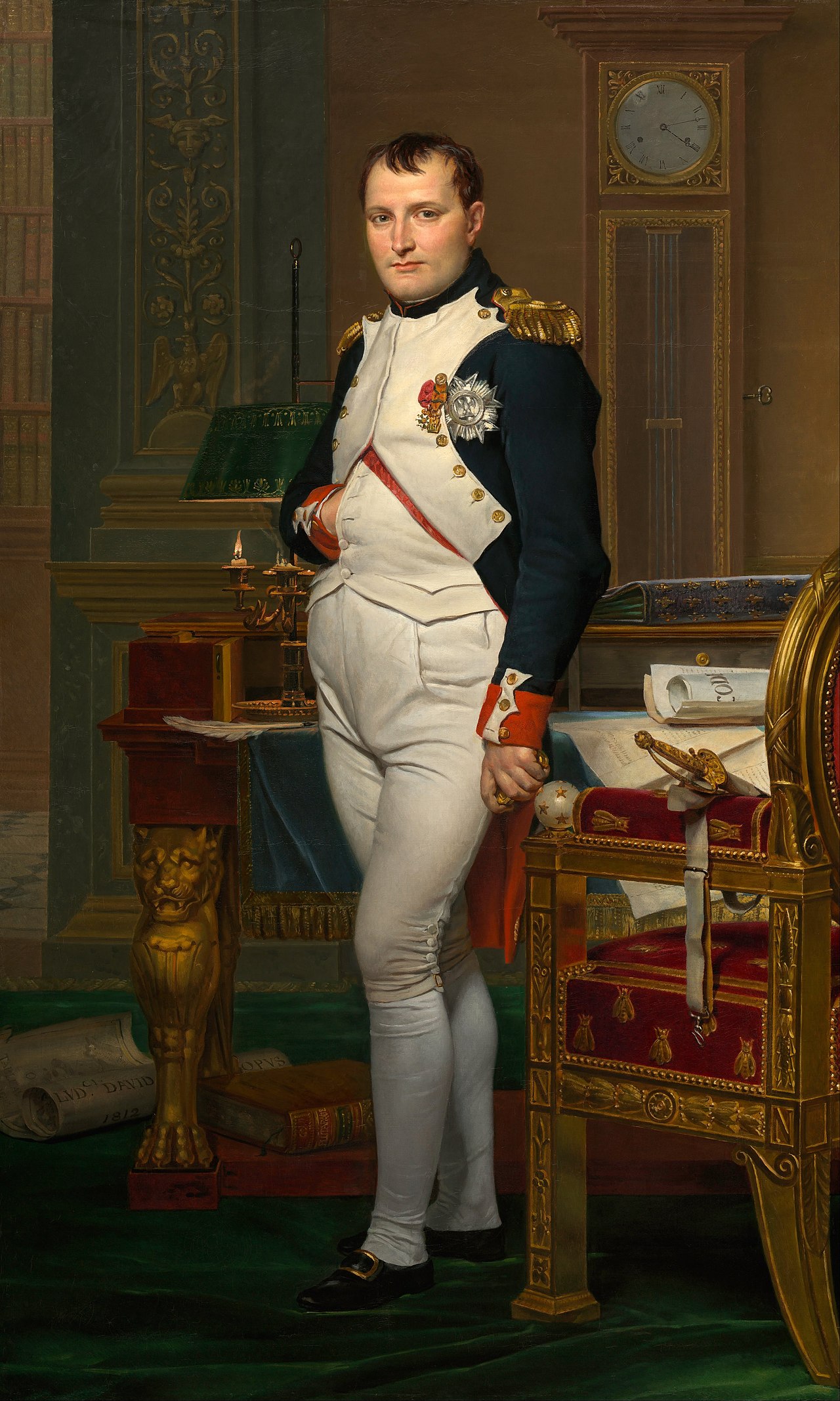
Ask almost anyone outside France to name a French person and the answers are Napoleon Bonaparte, the Corsican-born general who crowned himself Emperor of the French in 1804; Joan of Arc, who lifted the siege of Orléans in 1429; Marie Curie, the Polish-born physicist who won Nobel Prizes in 1903 and 1911; Louis Pasteur, whose laboratory produced the first rabies vaccine; Victor Hugo, author of Les Misérables (1862); Coco Chanel, who launched Chanel No. 5 in 1921; and Zinedine Zidane, who scored twice in the 1998 World Cup final. Inside France, though, the list changes. The Resistance leader Jean Moulin, the minister Simone Veil, the singer Georges Brassens and the rock star Johnny Hallyday are household names at home and far less known abroad, while a third group, from Pierre L'Enfant in Washington to Victor Wembanyama in San Antonio, made their names outside the country altogether. This guide takes the three groups in turn.
Napoleon, Joan of Arc, Victor Hugo and Claude Monet: History and Art the World Recognises
Napoleon Bonaparte (1769–1821) was born on Corsica to a family of Italian origin, a year after the island passed to France, and moved to the mainland in 1779 to train as an officer. He rose as a general during the Revolution and was Emperor of the French from 18 May 1804 until his first abdication in 1814, returning briefly in 1815 for the Hundred Days. His battlefield record, including Austerlitz in 1805, is only part of his reach: the Civil Code of 1804, known as the Napoleonic Code, is still in force in France in amended form and served as a model for civil law in many other countries.
Joan of Arc (c. 1412–1431) came from a peasant family at Domrémy in north-eastern France. In 1428 she asked to be taken to the uncrowned Charles VII, saying she was guided by visions, and in 1429 she helped lift the English siege of Orléans and secured Charles's coronation. Captured and handed to the English, she was tried for heresy at Rouen and executed on 30 May 1431; a church court overturned the verdict in 1456, and she is now a patron saint of France.
The 20th-century figure known almost as widely is Charles de Gaulle (1890–1970), born in Lille. Wounded and captured in the First World War, he refused to accept the armistice with Germany in June 1940, fled to London and in his Appeal of 18 June urged the French to keep fighting. He led the Free French Forces, headed the provisional government after the liberation, and returned to power during the Algerian crisis of May 1958. The constitution he commissioned that year, approved by referendum, created the Fifth Republic, which France still lives under; he served as its president until he resigned in 1969, having granted Algeria its independence along the way. Paris's main airport, Charles de Gaulle at Roissy, carries his name.
Victor Hugo (1802–1885) was born in Besançon, the son of one of Napoleon's generals. The Hunchback of Notre-Dame (1831) and Les Misérables (1862) have been adapted into operas, films and musicals, while French readers value his poetry, such as Les Contemplations, at least as highly. Claude Monet (1840–1926) was born in Paris and raised in Le Havre. His painting Impression, Sunrise, shown at the first Impressionist exhibition in 1874, gave the movement its name, and his series of haystacks, Rouen Cathedral and the water lilies of his garden at Giverny hang in museums worldwide.
Marie Curie, Louis Pasteur, Coco Chanel and Zidane: French Names in Science, Fashion and Football
Marie Curie (1867–1934) was born Maria Skłodowska in Warsaw and became a naturalised French citizen; she did all her prize-winning work in Paris. She shared the 1903 Nobel Prize in Physics with her husband Pierre and Henri Becquerel for research on radioactivity, and won the 1911 Nobel Prize in Chemistry alone for discovering radium and polonium. She was the first woman to win a Nobel Prize, the first person to win two, and remains the only person to win in two different sciences.

Louis Pasteur (1822–1895), a tanner's son from Dole in the Jura, gave his name to pasteurisation and showed how microbes cause fermentation and disease. His laboratory, working with his colleague Émile Roux, produced the first rabies vaccine, and his vaccines against rabies and anthrax are credited with saving millions of lives. The Institut Pasteur in Paris, which he founded in 1887, still carries his name.
Coco Chanel (1883–1971) was born in a charity hospital in Saumur, on the Loire, to a laundrywoman. After the First World War her clothes popularised a sporty, casual look for women; she launched her first perfume, Chanel No. 5, in 1921, and she is the only fashion designer on Time magazine's list of the 100 most influential people of the 20th century. Simone de Beauvoir (1908–1986) reached a comparable audience in ideas: The Second Sex (1949) became a founding text of modern feminism.
Zinedine Zidane (born 1972) grew up in La Castellane, a housing estate in Marseille, the youngest of five children of Algerian Kabyle parents. In the 1998 World Cup final at the Stade de France he scored two headers from corners as France beat Brazil 3–0, and that year he won the Ballon d'Or. He was named FIFA World Player of the Year three times, in 1998, 2000 and 2003.
Revered at Home: Jean Moulin, Simone Veil, Georges Brassens and Johnny Hallyday
Some of the most honoured figures in France are barely known elsewhere. Jean Moulin (1899–1943) was born in Béziers and served as a prefect before the war. Working for Charles de Gaulle, he united the main Resistance networks and became the first president of the National Council of the Resistance in May 1943. Arrested at Caluire, outside Lyon, on 21 June 1943 and tortured by the Gestapo officer Klaus Barbie, he died in custody. His presumed ashes were moved to the Panthéon on 19 December 1964, with a speech by André Malraux that is counted among the most famous in French history. Jean Jaurès (1859–1914), from Castres in the Tarn, led the French socialists and campaigned against war; a nationalist shot him in the Café du Croissant in Paris on 31 July 1914, days before France entered the First World War.
Simone Veil (1927–2017) was born in Nice to a Jewish family and deported as a teenager to Auschwitz-Birkenau and Bergen-Belsen. As health minister she carried the 1975 law that legalised abortion in France, still called the loi Veil, and in 1979 she became the first president of the newly elected European Parliament. She entered the Académie française in 2008 and, after her death, the Panthéon.

Music draws the sharpest line between fame at home and abroad. Georges Brassens (1921–1981), from the Mediterranean port of Sète, sang his own poems, and settings of Villon, Hugo and Aragon, to a lone guitar; he is regarded as one of France's finest post-war poets, and he asked in a 1966 song to be buried on the beach at Sète. Johnny Hallyday (1943–2017), born Jean-Philippe Smet in the 9th arrondissement of Paris, is credited with bringing rock and roll to France. Over 57 years he released 79 albums and sold more than 110 million records, mostly in French-speaking countries, and the French simply called him "Johnny".
One Panthéon figure crossed the line the other way. Josephine Baker (1906–1975) was born in St. Louis, Missouri, became a star of the Folies Bergère in the 1920s, took French citizenship on her marriage in 1937 and worked for the Resistance during the war. In 2021 she was granted Panthéon honours, only the sixth woman to receive them.
The French Abroad: From L'Enfant's Washington to Wembanyama's San Antonio
The third group made their names mainly outside France, often in the United States, while keeping their French identity. Pierre Charles L'Enfant (1754–1825), a French-born military engineer who served in the American Revolutionary War, drew the 1791 plan for Washington, D.C.; the L'Enfant Plan later influenced the designs of Canberra, New Delhi and Brasília. Éleuthère Irénée du Pont (1771–1834) sailed to America in 1800 and by 1802 had set up a gunpowder mill on Brandywine Creek in Delaware, the start of the DuPont company.
In the modern era, Christine Lagarde (born 1956), raised in Paris, became the first woman to run the International Monetary Fund (2011–2019) and then the European Central Bank, which she has led since 2019. Yann LeCun (born 1960), from Soisy-sous-Montmorency outside Paris, moved to North America after his doctorate, taught at New York University and was chief AI scientist at Meta before co-founding his own laboratory, Advanced Machine Intelligence Labs, in December 2025; he shared the 2018 Turing Award with Yoshua Bengio and Geoffrey Hinton for work on deep learning. Victor Wembanyama (born 2004), from Le Chesnay in the Paris region, was the first pick in the 2023 NBA draft and was the unanimous NBA Rookie of the Year in 2024 with the San Antonio Spurs.
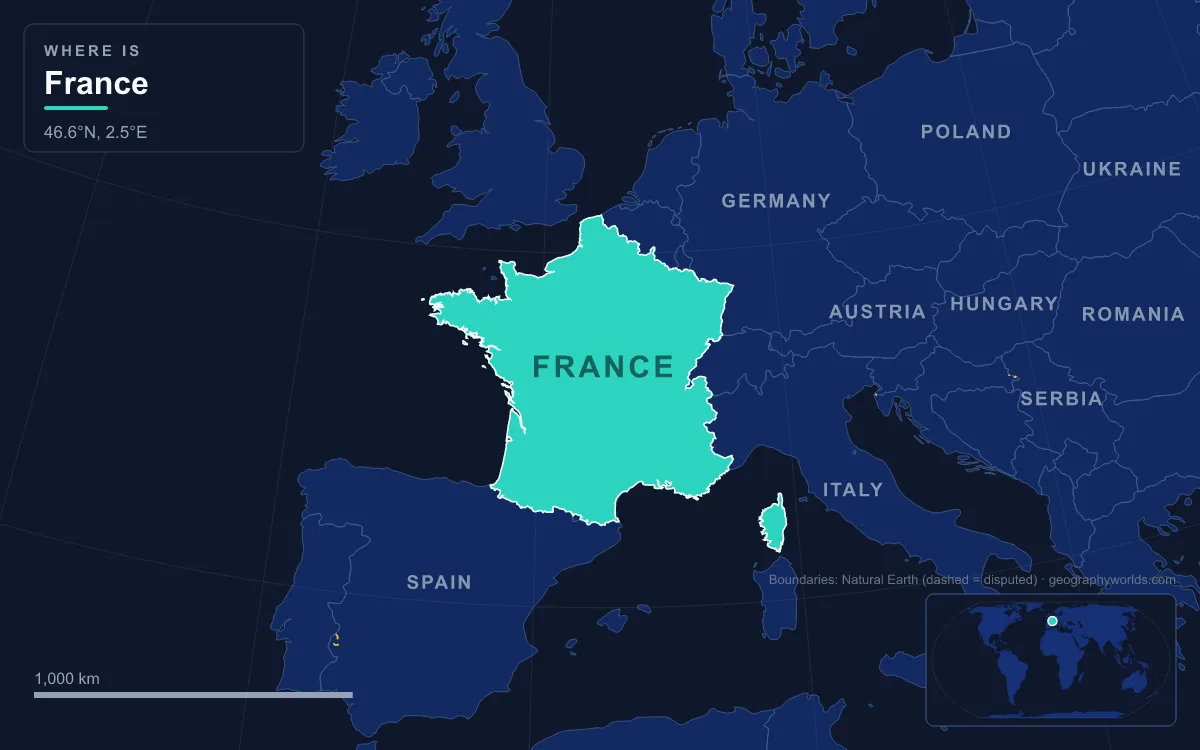
Many of these people appear on French street signs and in the Panthéon, and their birthplaces, from Corsica to Sète and Béziers on the Mediterranean, are spread across the whole country. For the places behind the names, see our guide to France's regions and their capitals, or read about the monument Napoleon commissioned after Austerlitz in our Arc de Triomphe guide.