

Indonesia's best-known people span two centuries: Sukarno, who proclaimed independence on 17 August 1945 and became the first president; Kartini, the Javanese noblewoman whose letters made her the symbol of women's education; the novelist Pramoedya Ananta Toer, who wrote the Buru Quartet as a political prisoner; Susi Susanti, who won the country's first Olympic gold in badminton in 1992; the engineer and president B. J. Habibie; and Joko Widodo, the furniture exporter who became president in 2014. Because so many of these lives are tied to turning points in the nation's history, the clearest way to meet them is in order, era by era, from the wars against Dutch rule to the democracy that followed 1998.
Diponegoro, Cut Nyak Dhien and Kartini under Dutch rule, 1825–1904
The earliest figure on most Indonesian lists is Prince Diponegoro (1785–1855), born in Yogyakarta as the eldest son of Sultan Hamengkubuwono III. Twice passed over for the throne, and backed by nobles and farmers angry at Dutch land rules and rising taxes, he led the Java War of 1825 to 1830, a guerrilla campaign across central Java in which at least 200,000 Javanese civilians died from fighting, disease and famine, along with about 15,000 soldiers on the Dutch side and 20,000 rebels. When his forces were close to defeat he agreed to negotiate at Magelang, where on 28 March 1830 he was seized despite a flag of truce. He was exiled first to Manado and from 1833 to Fort Rotterdam in Makassar, on Sulawesi, where he died in 1855. Streets across Indonesia and Diponegoro University in Semarang carry his name.
In the far north of Sumatra the Dutch fought a longer war. Cut Nyak Dhien (1848–1908), born into an aristocratic Muslim family in Aceh Besar, lost her first husband, Teuku Ibrahim Lamnga, in battle in 1878. After the death of her second husband, the commander Teuku Umar, she led Acehnese guerrilla forces herself until her small army was destroyed in 1901. She was then exiled to Sumedang in West Java because the colonial government feared her influence in Aceh, and she died there. Indonesia declared her a National Hero in 1964.
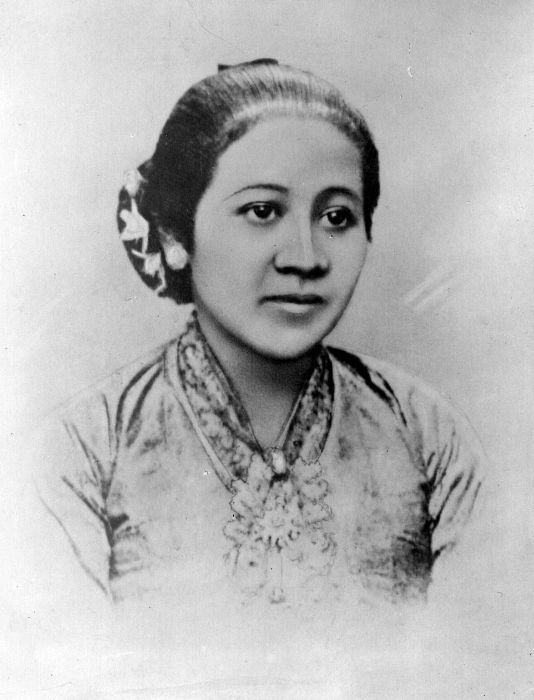
Raden Adjeng Kartini (1879–1904) fought with a pen. Born in the village of Mayong near Jepara on the north coast of Java, she was the daughter of the local regent and went to a Dutch-language primary school, but Javanese girls of her class were barred from further education. She wrote long letters in Dutch to friends in the Netherlands opposing arranged marriage, polygamy and the seclusion of teenage girls, and began opening schools with her sisters. She died aged 25, days after the birth of her son, and was buried in Rembang. In 1911 her letters were published as Door Duisternis tot Licht (From Darkness to Light), and in 1964 she too was named a National Hero; her birthday, 21 April, is celebrated as Kartini Day.
Supratman, Sukarno, Hatta and Chairil Anwar: from the 1928 Youth Pledge to 1949
The idea of a single Indonesian nation took shape in the 1920s. At the Second Indonesian Youth Congress in Batavia (now Jakarta) on 28 October 1928, the journalist and violinist Wage Rudolf Supratman (1903–1938) introduced "Indonesia Raya", a song for which he wrote both the words and the melody. It became the national anthem after independence. Supratman did not live to hear it adopted: he died on 17 August 1938, exactly seven years before independence was proclaimed.
Sukarno (1901–1970) was born in Surabaya in East Java to a Javanese schoolteacher and a Balinese mother. He qualified as a civil engineer at the Technische Hoogeschool in Bandung in 1926, set up the architectural firm Soekarno & Anwari there with a university friend, and turned to nationalist politics, which cost him years in Dutch prisons and internal exile, including a spell from 1934 in the town of Ende on the island of Flores. During the Japanese occupation he and Mohammad Hatta (1902–1980), an economist trained in Rotterdam, from Bukittinggi in West Sumatra, cooperated with the occupying authorities in exchange for room to spread nationalist ideas. Two days after Japan surrendered, on 17 August 1945, the two men proclaimed Indonesian independence in Jakarta. Sukarno became president and Hatta vice-president, and after four years of fighting and diplomacy Hatta, by then also prime minister, headed the delegation to the Round Table Conference in The Hague in August 1949, which ended with the Netherlands recognising Indonesian sovereignty that year. The partnership did not last: as Sukarno moved towards what he called Guided Democracy, introduced in 1959, Hatta resigned the vice-presidency on 1 December 1956. By the early 1960s Sukarno had made Indonesia a leading voice of the Non-Aligned Movement.
The revolution also produced the country's best-known poet. Chairil Anwar (1922–1949), born in Medan in North Sumatra, moved to Batavia in 1940 and became the leading voice of the "1945 Generation" of writers, using everyday language in untraditional ways. Editors under the Japanese occupation rejected many of his poems in 1943 as too individualistic; his best-loved poem, "Aku" ("Me"), is a defiant first-person declaration. He died in Jakarta in April 1949, aged 26.
Suharto’s New Order, 1967–1998: Pramoedya on Buru and the badminton champions
Suharto (1921–2008), born in the village of Kemusuk near Yogyakarta, was an army general who took control after the violent upheaval of 1965. The People's Consultative Assembly named him acting president in March 1967, replacing Sukarno, who was held under house arrest until his death in 1970. Suharto then ruled for 31 years, the longest of any Indonesian president, under a system he called the New Order. Corruption and growing authoritarianism fed discontent that boiled over in the 1997 Asian financial crisis, and after widespread unrest he resigned in May 1998.
The regime's best-known prisoner was Pramoedya Ananta Toer (1925–2006), born in Blora in central Java. Branded a communist, he was held without trial from 1969 to 1979 on the island of Buru in Maluku, where, denied writing materials, he recited to fellow prisoners the story that became the Buru Quartet, beginning with This Earth of Mankind and continuing through Child of All Nations, Footsteps and House of Glass. The four novels follow the rise of Indonesian nationalism at the start of the twentieth century. The novels were banned in Indonesia for years but translated widely abroad. He won the Ramon Magsaysay Award in 1995 and was nominated for the Nobel Prize in Literature eight times.
The same decades were a golden age for Indonesian badminton. Rudy Hartono (born 1949 in Surabaya) won the men's singles at the All England Championships eight times, including seven in a row from 1968 to 1974, a record that still stands, and he won the 1980 world championship on his only attempt at the title. Susi Susanti (born 1971) then won the first women's Olympic badminton title at Barcelona in 1992, which was also Indonesia's first Olympic gold medal of any kind. Her future husband, Alan Budikusuma, won the men's singles at the same Games. Between 1990 and 1994 Susanti won the All England four times and the 1993 world title, and she is the only woman to have held the Olympic, world and All England singles titles at once.

Reformasi since 1998: Habibie, Megawati, Jokowi, Anggun and Iko Uwais
B. J. Habibie (1936–2019), born in Parepare in South Sulawesi, had one of the most unusual routes to power of any head of state. He studied aeronautical engineering in Delft and Aachen, earned a doctorate in 1965, worked for Messerschmitt-Bölkow-Blohm in Hamburg on the Airbus A300B, and came home to lead the state aircraft maker IPTN, which pioneered the N-250 passenger plane in 1995, a technical showpiece that proved a commercial failure. Vice-president for barely two months, he succeeded Suharto in May 1998 and held office until 1999.
Habibie was followed by the Muslim scholar Abdurrahman Wahid (1940–2009), known as Gus Dur, a long-time leader of the mass organisation Nahdlatul Ulama from Jombang in East Java, who was president from 1999 until he was removed in 2001. His vice-president and successor, Megawati Sukarnoputri (born 1947), the eldest daughter of Sukarno, became Indonesia's first and so far only woman president, serving from 2001 to 2004. The first direct presidential election was held in 2004, and Joko Widodo (born 1961), known as Jokowi, is the clearest product of that change: born and raised in Surakarta in central Java, he exported furniture before becoming the city's mayor in 2005, governor of Jakarta in 2012 and president from 2014 to 2024. How that elected presidency and the regional governments fit together is set out in our guide to the government of Indonesia.
Indonesian performers have also built careers abroad. Anggun (born 1974 in Jakarta) recorded a children's album at nine and was a teenage rock star before she moved to Europe in 1994; her album Snow on the Sahara (1997) was released in 33 countries and made her known internationally. In 2000 she became a French citizen, which meant giving up her Indonesian citizenship because Indonesia does not allow dual nationality, though she still calls herself Indonesian. Iko Uwais (born 1983 in Jakarta), grandson of a silat master, was discovered in 2007 by the Welsh director Gareth Evans while Evans was filming a documentary about the martial art in Uwais's training hall. Their film The Raid (2011), about a police raid on a drug lord's apartment block in Jakarta, took silat to cinema audiences around the world. For the islands, languages and regions all these people come from, see our Indonesia country guide.