
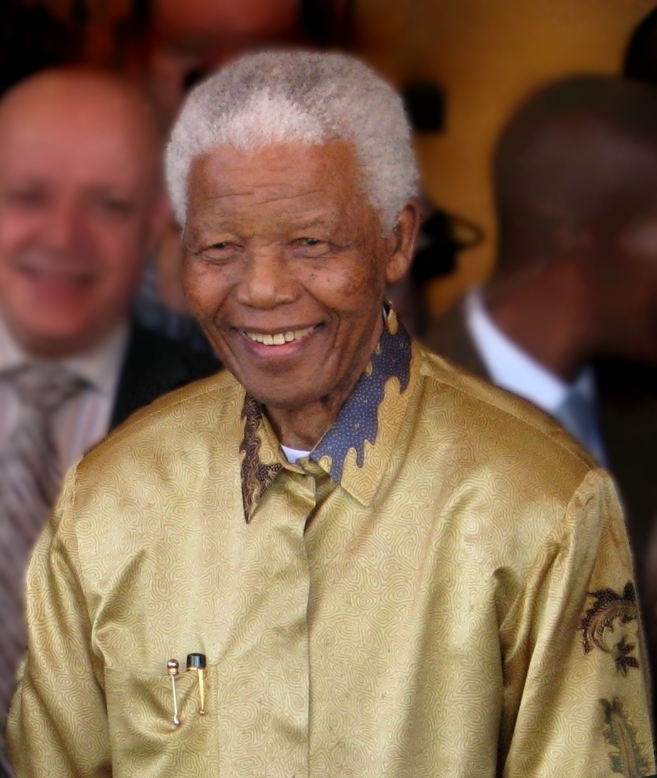
The best-known people from South Africa are Nelson Mandela, the anti-apartheid leader who became the country's first black president in 1994; Archbishop Desmond Tutu, winner of the 1984 Nobel Peace Prize; the singer Miriam Makeba, known worldwide as "Mama Africa"; the surgeon Christiaan Barnard, who performed the first human heart transplant in Cape Town in 1967; the novelists Nadine Gordimer and J. M. Coetzee, both Nobel laureates in literature; the actress Charlize Theron, the first South African to win an acting Oscar; the comedian Trevor Noah, host of The Daily Show; and the entrepreneur Elon Musk, born in Pretoria. This guide follows them home, grouping each person by the town, township or city that shaped them, from Mvezo in the Eastern Cape to Ga-Masehlong in Limpopo.
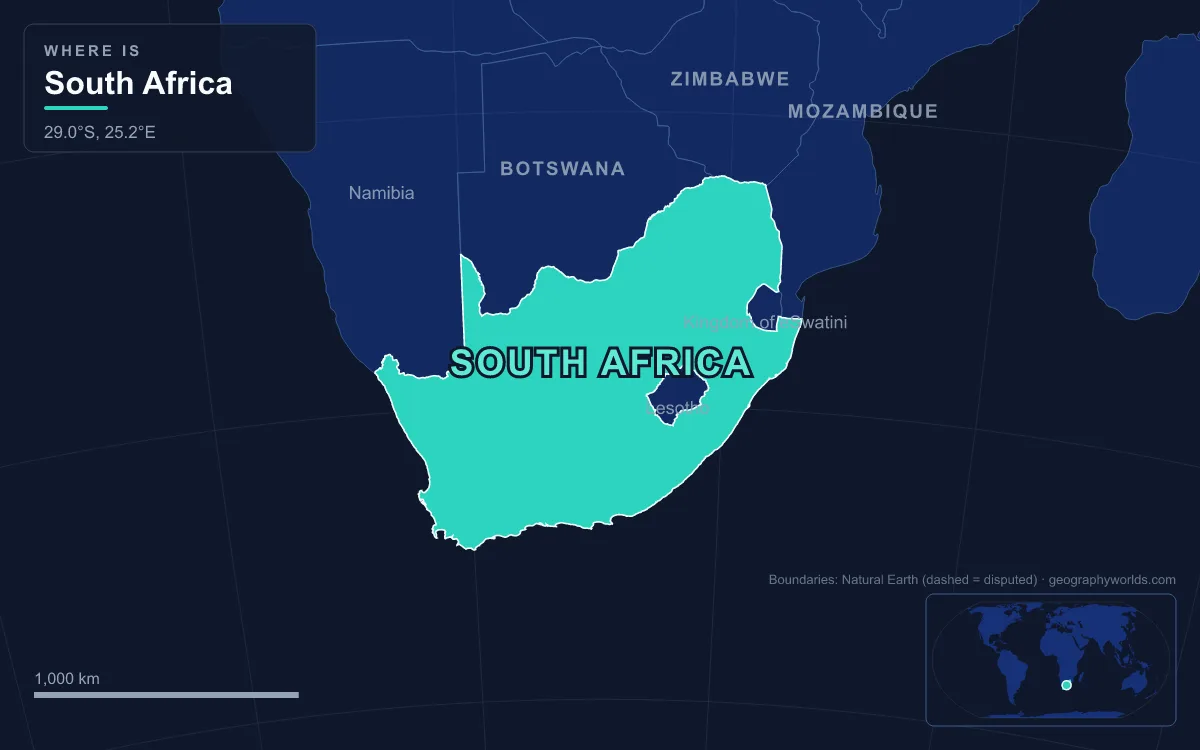
The Eastern Cape: Mvezo, Qunu, Ginsberg and Zwide
Nelson Mandela (1918–2013) was born on 18 July 1918 in Mvezo, a village on the Mbashe River, into the Thembu royal family. He grew up in his mother's homestead at Qunu, herding cattle, and was given the English name "Nelson" by a teacher at a Methodist school. He studied law at the University of Fort Hare and the University of the Witwatersrand, joined the African National Congress in 1943 and co-founded its Youth League in 1944. Sentenced to life imprisonment at the Rivonia Trial, he served 27 years, first on Robben Island off Cape Town and later at Pollsmoor and Victor Verster prisons. President F. W. de Klerk released him in 1990; the two shared the Nobel Peace Prize in 1993, and Mandela served as president from 1994 to 1999. In retirement he divided his time between Johannesburg and a house he built at Qunu, the village of his childhood.
The same province produced Steve Biko (1946–1977), born at his grandmother's house in Tarkastad and raised in Ginsberg township outside King William's Town. As a medical student at the University of Natal he broke away from the white-led student union to found what became the Black Consciousness Movement, and he wrote under the pen name "Frank Talk". Arrested in August 1977, he was beaten to death by state security officers; more than 20,000 people attended his funeral. A generation later, Siya Kolisi (born 1991) grew up in Zwide, a township in Port Elizabeth. In 2018 he became the first black man to captain the Springboks, and he lifted the Rugby World Cup in 2019 against England and again in 2023 against New Zealand, one of only two captains to win the trophy back to back.
Klerksdorp and Vilakazi Street, Soweto: Desmond Tutu
Desmond Tutu (1931–2021) was born in Klerksdorp, a gold-mining town in what is now North West province, to a family of mixed Xhosa and Motswana heritage. He trained as a teacher, was ordained an Anglican priest in 1960 and studied theology at King's College London. He became Bishop of Johannesburg in 1985 and Archbishop of Cape Town in 1986, the first black African to hold either post. He learned in New York that he had won the 1984 Nobel Peace Prize after being nominated in each of the three previous years. After the 1994 election Mandela chose him to chair the Truth and Reconciliation Commission, which heard testimony about human rights abuses committed on all sides.
Tutu's Soweto home stood on Vilakazi Street in Orlando West, the same street where Mandela lived before his imprisonment, so two Nobel Peace laureates once had houses a short walk apart. Mandela's house at number 8115 is now a museum.

The street itself is named after B. W. Vilakazi (1906–1947), a Zulu poet and novelist who lived there too. In 1946 he received the first PhD awarded to a black South African, and he died of meningitis in Johannesburg the following year.
KwaDukuza and Groutville: Shaka, Albert Luthuli and a Zulu poet
Vilakazi was born at the Groutville mission station, on the north coast of KwaZulu-Natal, and that stretch of coast holds two more of the country's defining figures. Shaka kaSenzangakhona (c. 1787–1828) was born at Mthonjaneni and ruled the Zulu Kingdom from 1816 to 1828, reorganising its army into a formidable military force. Around 1820 he founded a royal capital called KwaDukuza, "the place of the lost person", named for its maze of huts. He was assassinated there in 1828, and the town that grew on the site was long called Stanger; since 2006 the municipality that includes it has carried the name KwaDukuza, which local Zulu speakers had used all along.
Next door is Groutville, home of Albert Luthuli (1898–1967). He was born at a mission near Bulawayo in what is now Zimbabwe and moved to Groutville, where his family came from, in 1908 to attend school. He trained as a teacher at Adams College, was elected chief of the Umvoti River Reserve in 1935, and led the ANC as President-General from 1952 until his death. In 1961 he was awarded the 1960 Nobel Peace Prize for leading non-violent resistance to apartheid, the first of South Africa's four Peace laureates.
Johannesburg, Springs and Emalahleni: Makeba, Masekela, Gordimer and Noah
The mining towns of the Witwatersrand and the coalfields east of it produced many of the country's best-known voices. Miriam Makeba (1932–2008) was born in Johannesburg to Swazi and Xhosa parents and sang with the Manhattan Brothers and the all-woman Skylarks in the 1950s. A brief role in the anti-apartheid film Come Back, Africa (1959) took her to Venice, London and New York, where Harry Belafonte became her mentor. She shared a Grammy with him for the 1965 album An Evening with Belafonte/Makeba, released her biggest hit, "Pata Pata", in 1967, and testified against apartheid at the United Nations.
Hugh Masekela (1939–2018) was born in Witbank, now called Emalahleni, and was raised largely by a grandmother who ran an illegal bar for miners. He took up the trumpet at 14 after seeing the film Young Man with a Horn, and in 1968 "Grazing in the Grass" went to number one on the US pop chart. His later songs included "Soweto Blues" and "Bring Him Back Home" (1987), which became an unofficial anthem of the campaign to free Mandela.
Nadine Gordimer (1923–2014) was born to Jewish parents near Springs, an East Rand mining town. Her novel The Conservationist shared the Booker Prize in 1974, Burger's Daughter (1979) was banned by the government, and she won the Nobel Prize in Literature in 1991. She joined the ANC while it was still banned and advised Mandela on the speech he gave from the dock in 1964. Trevor Noah (born 1984) was born in Johannesburg to a Xhosa mother and a Swiss father at a time when their relationship was illegal, the subject of his 2016 memoir Born a Crime. He hosted his own late-night show on M-Net before taking over The Daily Show from Jon Stewart in 2015, a job he held until 2022.
Cape Town and Beaufort West: Christiaan Barnard and J. M. Coetzee
Christiaan Barnard (1922–2001) was born in Beaufort West, a Karoo town on the main road from Cape Town to Johannesburg. After training in Cape Town and in Minnesota, he became head of experimental surgery at Groote Schuur Hospital in 1958. On 3 December 1967 he transplanted the heart of Denise Darvall, a road accident victim, into 54-year-old Louis Washkansky. It was the world's first human-to-human heart transplant; Washkansky regained consciousness and talked with his wife but died of pneumonia 18 days later. Barnard's second patient, Philip Blaiberg, operated on early in 1968, went home and lived for a year and a half.

J. M. Coetzee (born 1940) was born in Cape Town and studied English and mathematics at the University of Cape Town. He was the first writer to win the Booker Prize twice, for Life & Times of Michael K in 1983 and Disgrace in 1999, and he received the Nobel Prize in Literature in 2003. He moved to Australia in 2002, became an Australian citizen in 2006 and lives in Adelaide, so he is now claimed by both countries. The city he left sits beneath the slopes described in our guide to Table Mountain and Cape Town, the same view that frames Groote Schuur.
Pretoria, Benoni and Ga-Masehlong: Theiler, Musk, Theron and Semenya
The administrative capital produced a scientist and an engineer who both made their names abroad. Max Theiler (1899–1972) was born in Pretoria, then capital of the South African Republic, and attended Pretoria Boys High School and the University of Cape Town Medical School before further study in London. He moved to the United States in 1922 and developed a vaccine against yellow fever in 1937, for which he received the Nobel Prize in Physiology or Medicine in 1951, the first African-born Nobel laureate. Elon Musk (born 1971) was also born in Pretoria. He emigrated to Canada in 1989, studied at the University of Pennsylvania, co-founded Zip2 in 1995 and X.com, which merged into PayPal, then founded SpaceX in 2002 and became chief executive of Tesla. He became a US citizen in 2002. More on the city that shaped both men is in our profile of Pretoria.
Charlize Theron (born 1975) was born in Benoni, east of Johannesburg, the only child of two road builders. She became an American citizen in 2007 while keeping her South African citizenship. Her portrayal of the serial killer Aileen Wuornos in Monster (2003) won the Academy Award for Best Actress, the first acting Oscar for a South African, and she was nominated again for North Country (2005) and Bombshell (2019).
Far to the north, Caster Semenya (born 1991) was born in Ga-Masehlong, a village near Polokwane in Limpopo, and grew up in nearby Fairlie. She won the world 800 metres title in 2009 at the age of 18, took Olympic gold in Rio de Janeiro in 2016, and was later awarded the 2011 world title and the 2012 London Olympic gold after the runner who had beaten her, Mariya Savinova, was disqualified for doping. She has refused the testosterone-suppressing medication that World Athletics rules have required in her events since 2019, and has challenged those rules in court as discriminatory.
Read together, these places trace the country's history: a Zulu capital at KwaDukuza, mission schools at Groutville and Fort Hare, the gold and coal towns of the Highveld, a prison island off Cape Town and a Soweto street with two Nobel laureates. For the laws that decided where each of them was allowed to live and study, see our guide to the geography of apartheid in South Africa.