
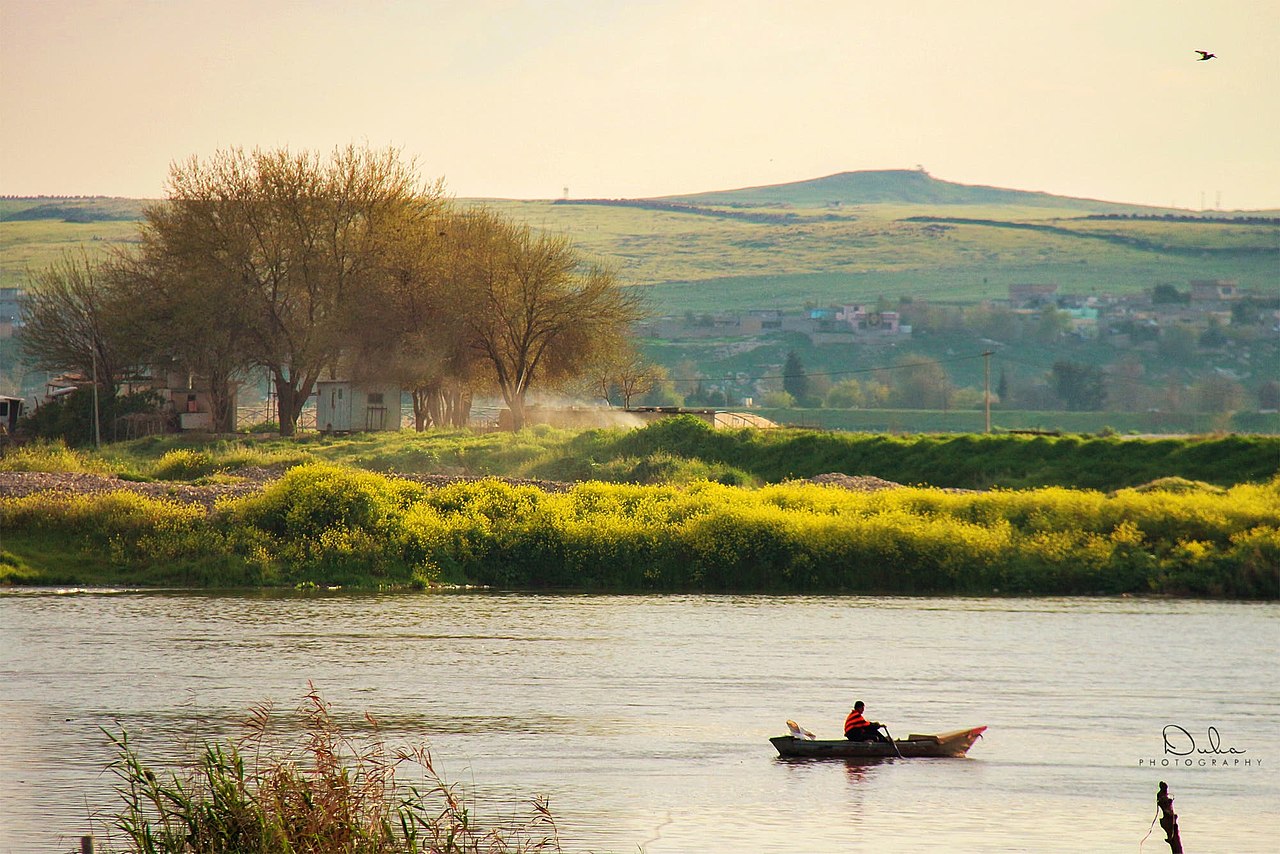
The Fertile Crescent is the arc of well-watered land in the Middle East that curves from the Mediterranean coast of the Levant (modern Israel, Palestine, Lebanon, Syria, and Jordan) north through southern Turkey and east through northern Iraq and western Iran, ending in the Persian Gulf at the mouths of the Tigris and Euphrates rivers. The crescent shape, sweeping around the northern edge of the Syrian and Arabian deserts, was named by the American Egyptologist James Henry Breasted in 1906. The Fertile Crescent is the place where, around 12,000 years ago, humans first domesticated wheat, barley, lentils, chickpeas, sheep, goats, pigs, and cattle — the foundational suite of crops and animals on which European, Middle Eastern, and much of South Asian civilisation was built. It is the region where the first cities (Jericho, Çatalhöyük, Uruk), the first writing systems (cuneiform in Sumer, around 3200 BCE), the first wheel, the first formalised legal codes (Hammurabi's in the 18th century BCE), the first epic literature (Gilgamesh), and many other foundational elements of complex civilisation developed. The combination of geography and biology that made the Fertile Crescent the cradle of agriculture is one of the more important coincidences in human history.
Why It Happened Here
Several factors converged in the Fertile Crescent at the end of the last Ice Age to produce the conditions for agricultural development. The first was the local presence of wild ancestors of several major domesticable crops — wild emmer wheat, wild einkorn wheat, wild barley, wild lentils, wild chickpeas, wild flax — all native to the region's grasslands and dryland forests. The second was the local presence of wild ancestors of several major domesticable animals — wild sheep (mouflon), wild goats (bezoar), wild cattle (aurochs), and wild pigs (Sus scrofa). The third was a climate that combined Mediterranean winter-rainfall patterns (allowing rain-fed agriculture without irrigation in many areas) with substantial year-round water availability from the major river systems. The fourth was the topographic complexity — the crescent includes mountains, foothills, river plains, and coastal lowlands, providing ecological niches for diverse domesticable species and allowing experimentation with cultivation in many environments. The convergence of these factors in one relatively small region around 12,000 years ago is what made the Fertile Crescent the location of the agricultural revolution.
The Natufian Beginnings
The earliest stages of the transition to agriculture in the Fertile Crescent are associated with the Natufian culture, which flourished in the Levant from approximately 14,500 to 11,500 years ago. The Natufians were hunter-gatherers who began intensively collecting and processing wild cereals (wheat and barley) at a scale that suggests they were already living in relatively sedentary villages and storing food at scale. Sites including 'Ain Mallaha in northern Israel and Jericho in the West Bank show stone architecture and food-processing facilities that predate the actual domestication of crops by 1,000-2,000 years. The Natufian period was interrupted by the Younger Dryas cold episode (approximately 12,900-11,700 years ago), which produced cooler and drier conditions and may have forced the Natufians to intensify their food-production strategies further. The full domestication of cereals, with the genetic changes (particularly the loss of the natural seed-shattering mechanism) that distinguish domesticated wheat and barley from wild forms, occurred around 11,500-10,500 years ago in the early Pre-Pottery Neolithic period.
The Founder Crops
The "founder crops" of Fertile Crescent agriculture are eight species that were domesticated within a few thousand years of each other in this region: emmer wheat, einkorn wheat, barley, lentils, peas, chickpeas, bitter vetch, and flax. The eight species together provide a balanced agricultural package — cereals for staple calories and storable grain, legumes for protein and nitrogen-fixing in soil, and flax for fibre and oilseed. The package was both nutritionally sufficient and agronomically self-sustaining (the legumes' nitrogen fixation supports the cereals' soil-nutrient requirements). The Fertile Crescent founder crops spread westward into Europe over the following 5,000 years, eastward into India and East Asia, southward into Africa and the Arabian Peninsula. By approximately 5,000 years ago, the descendants of the Fertile Crescent domesticated crops were under cultivation across most of the temperate and subtropical Old World. The independent agricultural origins in East Asia (rice, millets), the Americas (maize, beans, squash, potatoes), New Guinea (taro, yams), and parts of Africa (sorghum, pearl millet, yams) followed somewhat different trajectories but the Fertile Crescent package was the first and the largest in geographical impact.
Mesopotamia and the First Cities
The eastern end of the Fertile Crescent, in southern Mesopotamia (modern southern Iraq), saw the development of the first large urban civilisations from approximately 4000 BCE onwards. The Sumerian city-states — Uruk, Eridu, Ur, Lagash, Nippur, Kish, and others — emerged on the floodplains of the lower Tigris and Euphrates, supported by intensive irrigation agriculture. Uruk in the mid-4th millennium BCE may have been the largest city in the world, with a population perhaps as high as 40,000-50,000. The development of writing in this region around 3200 BCE began as an accounting system for temple economies and gradually expanded into literary, administrative, and legal uses. The cuneiform writing system, originally developed for Sumerian, was adapted for Akkadian, Babylonian, Assyrian, Hurrian, Hittite, and other languages and was the dominant writing system of the Near East for over 3,000 years. The Sumerian-Akkadian-Babylonian-Assyrian succession of major Mesopotamian civilisations spans from approximately 4000 BCE to 539 BCE (when Babylon fell to Cyrus the Great of Persia).
The Levantine Civilisations
The western end of the crescent, in the Levant, developed differently. The terrain is more rugged and the population centres were smaller and more politically fragmented than in Mesopotamia. The Bronze Age and Iron Age Levant included a succession of states — Canaanite city-states, the Israelite and Judahite kingdoms, the Phoenician city-states (most famously Tyre, Sidon, and Byblos, which produced the alphabet that became the ancestor of Greek, Latin, Hebrew, Arabic, and many other modern alphabets), the Aramaean kingdoms, and various others. The Phoenicians' development of the alphabet (around the 11th century BCE) was one of the most consequential cultural innovations in human history — by replacing the syllabic and logographic systems of Mesopotamia with a much smaller and easier-to-learn alphabetic system, the Phoenicians enabled the much broader spread of literacy that characterises later civilisations.
The Persian and Hellenistic Periods
From the 6th century BCE onwards, the Fertile Crescent came under successive imperial systems: the Achaemenid Persian Empire (550-330 BCE), Alexander's conquests and the Hellenistic Seleucid Empire (330-63 BCE), the Roman Empire in the west and the Parthian/Sasanian Persian Empires in the east (1st century BCE to 7th century CE). The Hellenistic period in particular produced a substantial cultural synthesis — Greek language and ideas spread across the Fertile Crescent, while Mesopotamian and Egyptian intellectual traditions flowed into the broader Mediterranean world. Cities like Antioch (in northern Syria) and Seleucia (on the Tigris) became cosmopolitan centres of the synthesis. The Roman-Sasanian boundary ran approximately through the middle of the Fertile Crescent for centuries, with the boundary itself shifting back and forth in repeated wars.
The Islamic Era
The Islamic conquests of the 7th century brought the entire Fertile Crescent under Arab Muslim rule within approximately 20 years. The Umayyad Caliphate (661-750), based in Damascus, was the first major Islamic state to govern the region. The Abbasid Caliphate (750-1258), based in Baghdad, made Mesopotamia the centre of the Islamic world for centuries. The medieval Islamic period produced enormous cultural, scientific, and economic flourishing in the Fertile Crescent — the House of Wisdom in Baghdad, the medical and astronomical achievements of figures like al-Razi, al-Khwarizmi, and Ibn Sina, the cosmopolitan trade networks connecting the region to East Asia, Africa, and Europe. The Mongol invasion of 1258 (with the sack of Baghdad) ended the Abbasid period and produced substantial demographic and infrastructural devastation; subsequent centuries saw the region under successive Mongol, Turkic, and Mamluk powers before the Ottoman conquest of the 16th century.
The Modern Region
The Fertile Crescent is, in 2026, divided among the modern states of Israel, Palestine, Lebanon, Syria, Jordan, southern Turkey, northern Iraq, and northwestern Iran. The political instability of the region over the past century — the Israeli-Palestinian conflict, the multiple Arab-Israeli wars, the Lebanese civil war of 1975-90, the Iran-Iraq war of 1980-88, the multiple Iraq wars (Gulf War of 1990-91, Iraq War of 2003-11), the Syrian civil war beginning in 2011, the rise and fall of ISIS, and various other conflicts — has produced an environment quite unlike the relative peace under which Fertile Crescent civilisation originally developed. The agricultural systems of the region have also been substantially transformed; much of the original agricultural base has been replaced by urban populations dependent on imported food, and the original ecological conditions that made the region distinctive have been substantially altered by 10,000 years of cultivation, deforestation, and irrigation. The Fertile Crescent today is one of the historically richest and politically most complicated regions on Earth, the cradle of multiple foundational civilisations and the site of ongoing conflicts that have, in various senses, been continuing for centuries.
The Continuing Significance
Despite the political complications, the Fertile Crescent remains central to human history in ways that have not diminished. The crops first domesticated here continue to feed approximately half of the world's population. The writing systems descended from cuneiform and the Phoenician alphabet continue to dominate the world's written communication. The three major Abrahamic religions all originated in the region. The cities of the Fertile Crescent — Damascus and Jericho are among the most continuously inhabited cities in the world — preserve archaeological and architectural records of the longest continuous urban habitation anywhere. The Fertile Crescent is in this sense not just a historical curiosity but the foundational region of much of the modern world's civilisational infrastructure, a place whose contemporary problems are inseparable from its extraordinary historical depth.