

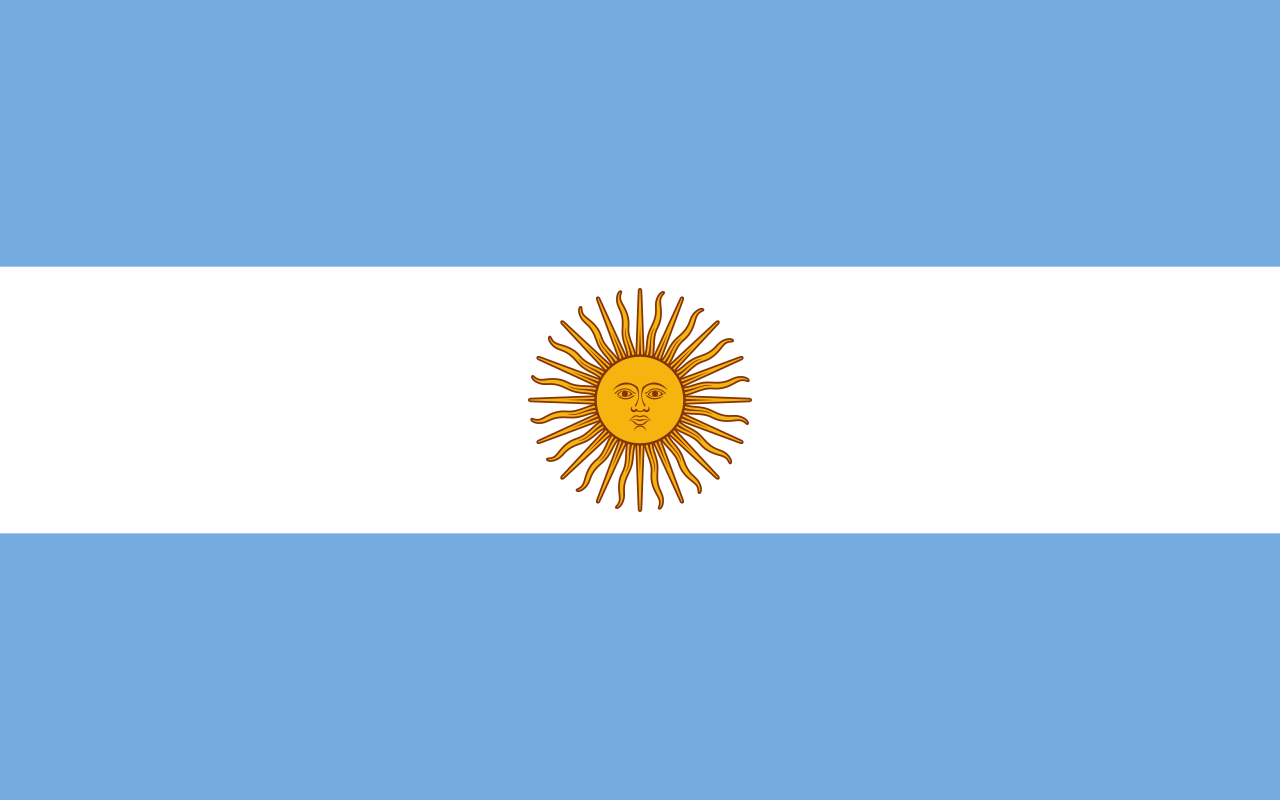
The flag of Argentina features three horizontal bands — light blue (celeste) on top, white in the center, and light blue on the bottom — with the golden Sun of May centered on the white stripe. Designed by General Manuel Belgrano in 1812, the flag represents the sky and clouds, and commemorates the May Revolution that launched Argentina's independence movement.
Argentina's flag is one of the most distinctive in South America, thanks to its unique shade of light blue (celeste) and the radiant golden sun that graces its center. The story of how this flag came to be is intertwined with Argentina's dramatic fight for independence from Spain.

Design and Colors
Argentina's flag consists of three equal horizontal bands. The top and bottom bands are celeste (a distinctive light sky blue), and the center band is white. On the official ceremonial flag (known as the "Flag of War" or bandera oficial de ceremonia), a golden Sun of May with a human face sits centered on the white band. The civil flag — flown by citizens — may omit the sun. The flag's proportions are 5:8.
The precise shade of celeste has been debated for decades. In 2012, a presidential decree standardized the color, defining it as a medium sky blue (Pantone 284C). Before this, various shades from pale baby blue to deeper azure appeared on Argentine flags, leading to considerable variation.
Symbolism of the Colors and Sun
The most popular interpretation holds that the blue and white represent the sky and clouds, as Belgrano reportedly looked up at the sky when choosing the colors. Another theory links the colors to the blue-and-white cockades worn by Argentine patriots during the May Revolution of 1810. Some historians also connect the colors to the House of Bourbon or to the Virgin Mary's traditional blue and white garments, reflecting Argentina's Catholic heritage.
The Sun of May (Sol de Mayo) is a national emblem representing the Inca sun god Inti. Its name refers to the May Revolution of May 25, 1810, the pivotal event in Argentina's independence. The sun has 32 rays — 16 straight and 16 wavy, alternating — and features a human face, a style known as "sol de mayo" that is found in pre-Columbian Andean art. The same sun appears on the flag of Uruguay, reflecting the shared history of the River Plate region.
Historical Origins
General Manuel Belgrano created the Argentine flag on February 27, 1812, in the city of Rosario, on the banks of the Paraná River. Belgrano was a lawyer, economist, and military leader who had been fighting for Argentine independence. He raised the new flag for the first time at a battery overlooking the river, asking his troops to swear allegiance to it. The blue-and-white cockade had already been approved by the First Triumvirate government, and Belgrano extended these colors to a full flag.
Initially, the government in Buenos Aires was displeased with Belgrano's unilateral creation of the flag, ordering him to stop using it. But by then, Belgrano was marching north to fight Spanish royalists and did not receive the order in time. His subsequent military victories under the new banner cemented its legitimacy. The flag was officially adopted by the Congress of Tucumán on July 20, 1816, just 11 days after declaring independence.
The Sun of May: Addition and Evolution
The original 1812 flag did not include the Sun of May. The sun was added in 1818 to create the "official" or ceremonial version, distinguishing it from the plain civil flag. The sun's face was modeled on Inca representations of Inti, with alternating straight and wavy rays radiating outward. Over the years, the sun's artistic style has varied, but its essential features — 32 rays and a human face — have remained constant.
Flag Day and National Celebrations
Argentina celebrates Día de la Bandera (Flag Day) on June 20 each year, the anniversary of Manuel Belgrano's death in 1820. The main celebrations take place in Rosario, at the Monumento a la Bandera (National Flag Monument), a massive 70-meter tower built between 1943 and 1957 at the site where Belgrano first raised the flag. Flag Day is a national holiday, and the ceremony typically includes a reenactment of the flag's first raising.
Flag Protocol
Argentine law governs how the national flag should be displayed. The flag must always be raised to full mast first and then lowered to half-mast during mourning periods. When displayed with other flags, the Argentine flag takes the position of honor (to the right of the observer). The ceremonial flag with the Sun of May is reserved for government buildings, official ceremonies, and the armed forces. Citizens may fly the civil flag (without the sun) from their homes and businesses.
Fun Facts About Argentina's Flag
- Two versions: Argentina is one of the few countries with two official flag versions — with and without the Sun of May.
- Shared sun: Uruguay's flag also features the Sun of May, reflecting the two countries' shared colonial and revolutionary history.
- Belgrano's colors: Some historians believe Belgrano chose celeste and white because they were the least associated with any European power at the time.
- World's largest flag: In 2012, a 60,000-square-meter Argentine flag was unfurled in Buenos Aires to celebrate the bicentennial of the flag's creation.
- Football connection: The Argentine football team's iconic light blue and white striped jersey is directly inspired by the national flag.
Final Thoughts
Argentina's flag is a masterclass in meaningful simplicity. The celeste and white bands evoke the vast Pampas sky, while the Sun of May connects the nation to both its indigenous heritage and its revolutionary birth. Created in the heat of a war for independence by a visionary general, the flag remains a powerful symbol of Argentine identity, pride, and the enduring spirit of the May Revolution.
Test Your Knowledge!
Think you know your world geography? Try our interactive quiz!
Play Geography Games →