
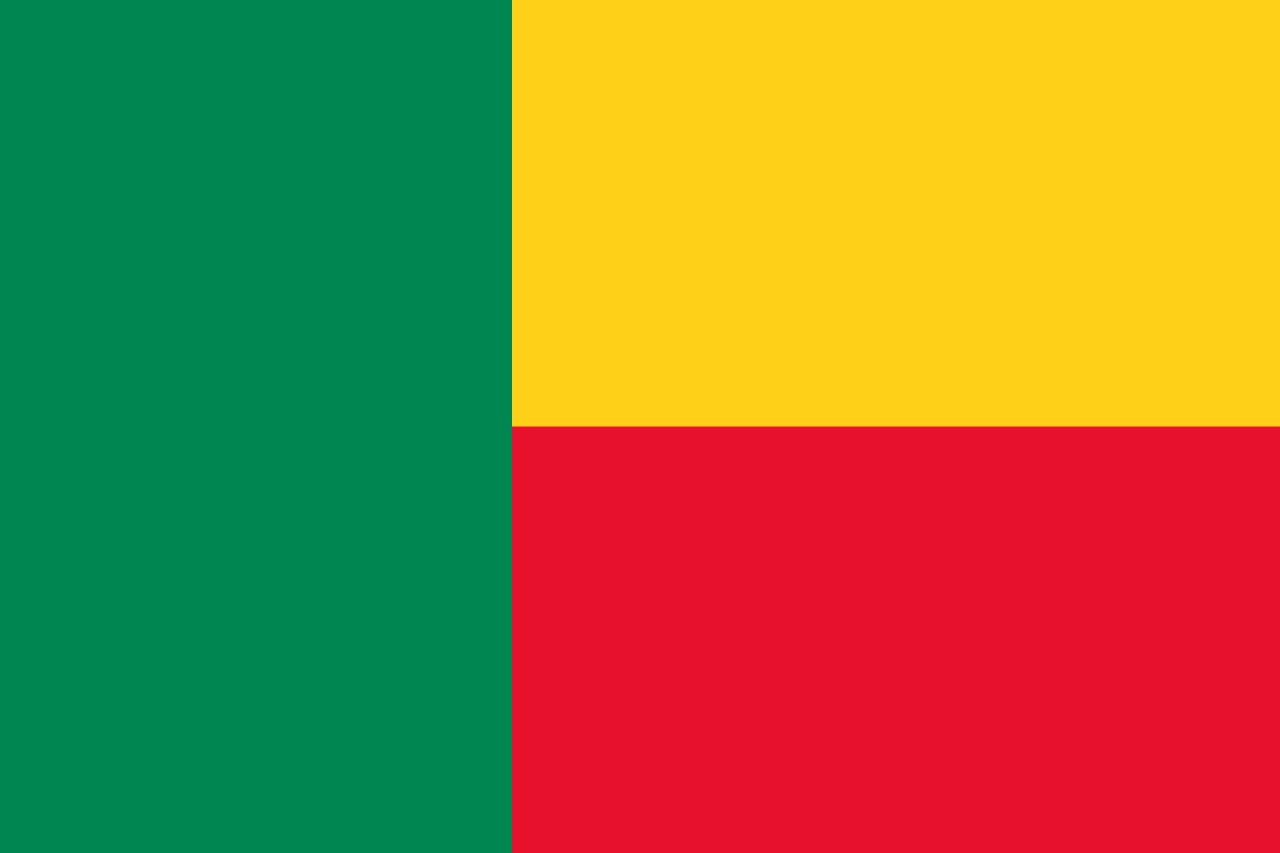
Few flags in West Africa carry as much quiet political drama as the flag of Benin. Look at it and you see three colors arranged in a way you have seen before: a vertical green band on the hoist side, with horizontal yellow and red bands filling the rest of the field. It feels familiar because it is built from the same Pan-African palette that runs across the continent. Yet behind that simple geometry lies a story of independence, revolution, and a flag that was retired for nearly two decades before its triumphant return.
A Banner of Three Colors
The design is elegant in its restraint. A single green band stands vertically along the staff. To its right, two horizontal bands stack on top of one another: yellow above, red below. This arrangement is sometimes described as an L-shaped layout, because the green band and the lower red band together trace the rough shape of the letter when you let your eye follow them. It is an unusual structure among national flags, which tend to favor pure stripes or simple quarters, and it gives Benin's banner an immediately recognizable silhouette.
The proportions are conventional for a national ensign, but the off-center balance, with the green anchored to the hoist and the warm yellow and red opening outward, gives the flag a sense of forward motion when it flies. There is no central emblem, no star, no coat of arms; the meaning rests entirely on color and placement, which is part of why the flag reads so cleanly even at a distance.
What the Colors Mean
Benin's flag wears the three classic Pan-African colors: green, yellow, and red. These hues were popularized in the twentieth century as a shared visual language of African self-determination, and Benin reads them in a hopeful key.
- Green stands for hope and renewal, an optimism rooted in the land and the promise of the young nation's future.
- Yellow evokes wealth, abundance, and the richness of the country's resources.
- Red honors courage, recalling the bravery of those who fought and sacrificed for the nation.
Taken together, the trio expresses a national narrative in shorthand: courage in the past, abundance in the present, hope for what is to come. There is a pleasing logic to the way the colors are stacked, too: the green of the land grounds the flag at the hoist, while the yellow of prosperity rests above the red of sacrifice.
From Dahomey to Benin and Back Again
The most fascinating thing about this flag is that it has lived two lives. When the country, then known as Dahomey, gained independence from France in 1960, it adopted this exact green-yellow-red design. For the first decade of nationhood, it was the banner under which the young state took its place among the world's countries. Before independence, the territory had flown the French tricolor as part of French West Africa, so the move to a Pan-African design was itself a deliberate break from the colonial past.
That changed dramatically in the 1970s. After a political shift toward a socialist, Marxist-Leninist orientation, the government renamed the country in 1975 from Dahomey to the People's Republic of Benin and replaced the tricolor with a new flag built around a green field and a red star in the upper hoist. For roughly fifteen years, the original Pan-African flag was set aside, a casualty of the country's changing ideological direction.
Then came the transformations at the close of the 1980s, as the socialist project unwound and the nation moved toward multiparty democracy. In 1990, the original tricolor was restored, reclaimed as the enduring emblem of a country reborn. That act of restoration is why the same design that flew in 1960 is the one flying today, making Benin's flag a rare example of a national symbol that outlasted the regime that once banished it. That deliberate resurrection gives the modern banner a weight that a simple inheritance never could.
A Symbol of Identity and Continuity
Because it was deliberately brought back rather than merely inherited, the flag carries an added layer of meaning for the people of Benin. It is not just a design handed down without thought; it is a choice, an affirmation that the nation's identity is anchored in hope, wealth, and courage rather than in the slogans of a single political moment.
The flag also signals belonging. Its Pan-African colors place Benin visually alongside its neighbors and the broader continental family, while its distinctive L-shaped layout keeps it unmistakably its own. To learn more about the nation behind the banner, its geography, culture, and history, see our benin country guide.
How It Compares to Other Flags
The green-yellow-red combination is one of the most heavily used color schemes in African vexillology, which is exactly why Benin's flag invites comparison. The palette traces back to the flag of Ethiopia and was embraced by newly liberated states across the twentieth century as a badge of Pan-African solidarity.
- Mali uses the same three colors but arranges them as three equal vertical stripes, green at the hoist, then yellow, then red.
- Senegal mirrors that vertical layout but adds a green five-pointed star in the central yellow band.
- Guinea reverses the order with red, yellow, and green vertical stripes.
- Cameroon keeps vertical stripes of green, red, and yellow with a star in the center.
What none of these neighbors reproduce is Benin's particular structure: a single vertical green band sitting beside two horizontal bands. That mix of vertical and horizontal elements is the flag's signature, and the surest way to pick Benin out of a lineup of look-alikes. With such a widely shared palette, it is the geometry, not the colors, that does the work of identification.
The Flag in Everyday Life
Today the tricolor is woven through public life. It flies over government buildings and schools, appears at national celebrations marking independence on the first of August, and is waved by supporters of Benin's athletes at international competitions. Football matches in particular turn stadiums into seas of green, yellow, and red, the flag doubling as a rallying point for fans of the national team, nicknamed the Squirrels. On currency, stamps, and official documents, the same three colors quietly reinforce a sense of shared belonging. Children encounter it daily in the schoolyard, so that for most citizens the flag is less a distant emblem than a familiar part of the everyday landscape.
Interesting Facts at a Glance
- The flag uses the same three Pan-African colors found on many West African banners, which is why it can be mistaken at a glance for its neighbors'.
- Its layout, one vertical green band beside two horizontal bands, is uncommon among national flags and gives it a distinctive profile.
- The current design was originally adopted at independence in 1960, dropped during the socialist period, and restored in 1990.
- Benin is located in West Africa, on the Gulf of Guinea, placing it firmly on the African continent.
- Because green, yellow, and red are shared so widely, the arrangement and orientation of the bands, not the colors alone, are what make Benin's flag unique.
Frequently Asked Questions
When was the flag of Benin adopted?
The current flag was restored in 1990. However, this same green, yellow, and red design dates back further: it was first used when the country, then called Dahomey, became independent in 1960. It was set aside during the socialist era and reinstated in 1990 as the nation transitioned to democracy.
What do the colors of the Benin flag mean?
The colors are the Pan-African trio. Green represents hope, yellow represents wealth, and red represents courage. Together they tell a compact story of the nation's past sacrifices, present resources, and future aspirations.
What continent is Benin on?
Benin is in Africa, specifically in the West African region along the Gulf of Guinea coast. Its Pan-African flag colors reflect that continental identity and its solidarity with neighboring African states.
Why does Benin's flag look like other West African flags?
Many West African nations draw on the same green, yellow, and red Pan-African colors, so a quick glance can blur them together. What sets Benin apart is its specific layout: a single vertical green band on the hoist with yellow over red to the right, an L-shaped composition that no neighbor reproduces exactly.
What flag did Benin use before the current one?
During the socialist People's Republic of Benin, from 1975 until 1990, the country flew a green flag with a red five-pointed star in the upper hoist corner. That revolutionary design replaced the original 1960 tricolor and was itself replaced when the Pan-African flag was restored at the start of the 1990s.