
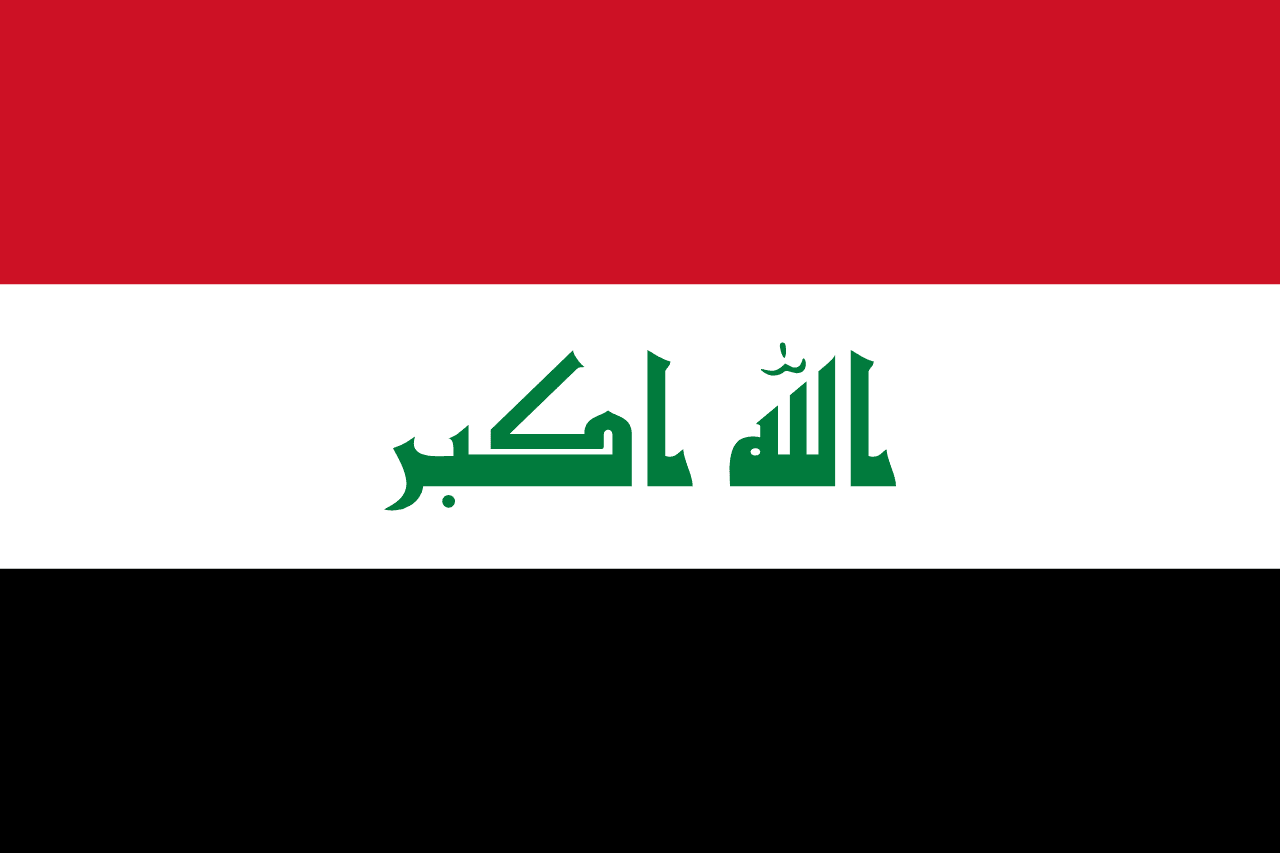
Few flags in the modern world have changed as often, or for reasons as turbulent, as the flag of Iraq. The banner that flies over Baghdad today is a horizontal tricolor of red, white, and black, with the Arabic phrase known as the Takbir written in green script across its central stripe. It is at once simple and deeply loaded with meaning, a design that speaks to Arab solidarity, to faith, and to a nation that has redrawn its own emblem several times within living memory. To understand this flag is to understand a country that has spent the better part of a century negotiating its identity in public, one revision at a time.
The version flown since 2008 represents a deliberate streamlining of earlier designs. Gone are the three green stars that once sat between the words of the inscription; what remains is a cleaner field that still carries the weight of history. This article walks through what those colors mean, how the layout is arranged, why the flag has evolved so frequently, and how it compares to the other red-white-black banners that fill the Arab world.
A Palette Rooted in Arab Identity
The Iraqi flag draws on what are commonly called the Pan-Arab colors: red, white, black, and green. These four hues recur across the flags of Egypt, Syria, Yemen, Sudan, Jordan, Palestine, and beyond, and they trace their symbolic lineage to the Arab Revolt of the early twentieth century and, further back, to verses of classical Arabic poetry that associated each color with a dynasty or virtue.
On Iraq's flag, the colors carry resonances that have been read in various ways over the decades. Black is often linked to the Abbasid Caliphate, whose capital was Baghdad, and more broadly to struggles endured. White is associated with openness, generosity, and bright deeds. Red is the color of courage and the sacrifices made in the nation's name. And green, the color reserved for the sacred inscription, is the color most closely tied to Islam itself. Rather than assigning each band a single fixed meaning, Iraqis have tended to embrace the colors as a shared Arab and Islamic inheritance rather than a strict code.
How the Design Is Arranged
The construction is a horizontal triband. From top to bottom run three equal stripes: red, then white, then black. Centered on the middle white stripe is the phrase Allahu Akbar, meaning "God is the greatest," rendered in green Arabic calligraphy. This phrase is the Takbir, one of the most recognizable expressions of faith in Islam.
The choice to place text rather than a star, crescent, or coat of arms at the center sets Iraq apart visually. Only a small handful of national flags incorporate script in this way. Because the inscription is written in flowing Arabic, the precise rendering of the calligraphy has itself been a point of revision over the years, with the style of the script changing even when the colors did not. The 2008 specification fixed a particular calligraphic form, giving the words a more uniform, modern appearance than some earlier hand-styled versions.
A Flag Rewritten by History
Iraq has cycled through a striking number of flag designs since gaining independence, and each shift mirrors a change in the country's political life. The mid-twentieth century saw banners influenced by ambitions of Arab union and by successive revolutions. For much of the late twentieth century, the flag carried three green stars on the white band, a feature shared at one point with the flags of allied Arab republics and read by many as a symbol of unity.
The most consequential change came during the Gulf War period. It was then that the Takbir was first added to the flag, inscribed by hand between the three stars. This addition gave the banner an explicitly religious dimension it had not previously displayed in that form. After 2003, debate over the flag intensified, since the inscription and stars were associated by some with the former government. The resolution arrived in 2008, when authorities adopted the current arrangement: the Takbir was retained but rendered in a standardized green Kufic-style script, and the three stars were removed. The result is the cleaner tricolor flown today, which preserves the religious phrase while shedding the older emblems.
Comparing Iraq to Its Red-White-Black Neighbors
To an unfamiliar eye, several Middle Eastern flags can look alike, and Iraq's is part of a recognizable family. The flags of Egypt, Syria, and Yemen all share the same red-white-black horizontal arrangement, a legacy of the Arab nationalist movements of the mid-1900s. The trick to telling them apart lies in what sits on the central white band.
- Yemen keeps its white stripe entirely plain, making it the simplest of the group.
- Egypt places a golden eagle of Saladin in the center.
- Syria has historically used two or three stars on the white band, depending on the era.
- Iraq is unique in this cluster for carrying Arabic calligraphy, the green Takbir, rather than a star or animal emblem.
That green inscription is the single most reliable way to identify the Iraqi flag at a glance. No other widely flown national flag pairs this exact red-white-black field with a centered religious phrase in green, which makes the banner instantly distinguishable once you know what to look for.
Meaning, Memory, and National Feeling
For Iraqis, the flag is bound up with a complicated history that includes monarchy, republic, war, and reconstruction. Because the design has changed so many times, the banner can mean different things to different generations, and discussions about its appearance have at times been genuinely contentious. The 2008 revision was itself partly an attempt to settle some of those tensions and to present a symbol that could be embraced broadly.
The Takbir at the heart of the flag anchors it firmly in the country's Islamic identity, while the Pan-Arab colors connect Iraq to a wider regional family. Readers who want the fuller picture of the country's geography, peoples, and landmarks can explore our iraq country guide for context beyond the banner itself.
The Flag in Everyday and Public Life
Today the flag appears wherever national identity is on display: above government ministries, at embassies abroad, on the jerseys and in the hands of fans following the national football team, and during national observances. Iraq's footballers, the "Lions of Mesopotamia," have given the banner some of its most joyful modern outings, particularly during continental tournaments where the red, white, and black are waved en masse by supporters.
The flag also surfaces in the daily texture of civic life, from school ceremonies to official correspondence. Because the inscription is sacred, the banner is treated with particular care, and its handling carries an added layer of respect beyond the customary etiquette afforded to national flags.
Quick Facts Worth Knowing
- Iraq sits in Asia, in the region historically known as Mesopotamia, the "land between the rivers" Tigris and Euphrates.
- The current flag was officially adopted in 2008.
- The green script reads Allahu Akbar ("God is the greatest"), known as the Takbir.
- The Takbir was first added to the flag during the Gulf War era, before being standardized in its present form.
- The 2008 redesign removed the three green stars that had appeared on earlier versions.
- Its red-white-black layout places it within the Pan-Arab flag tradition shared with Egypt, Syria, and Yemen.
Frequently Asked Questions
When was the current flag of Iraq adopted?
The flag flown today was adopted in 2008. It kept the green Takbir inscription from earlier designs but removed the three green stars and standardized the calligraphy into a uniform green script, producing the cleaner red-white-black tricolor seen now.
What do the colors of the Iraqi flag mean?
The flag uses the Pan-Arab colors of red, white, black, and green. These are commonly associated with courage and sacrifice (red), generosity and bright deeds (white), the Abbasid heritage and hardships endured (black), and Islam (green). The green specifically colors the sacred inscription on the central stripe.
Who designed the Iraqi flag?
The flag is the product of repeated official revisions by Iraqi governments rather than a single named designer. The Takbir was added during the Gulf War period, and the current standardized form was established through the 2008 adoption, which set the precise calligraphic style and removed the earlier stars.
How is Iraq's flag different from Egypt's, Syria's, and Yemen's?
All four share the same red-white-black horizontal tricolor from the Arab nationalist tradition, so the difference lies in the center band. Yemen leaves it plain, Egypt adds a golden eagle, Syria has used stars, and Iraq is the only one of the group to display the green Takbir in Arabic calligraphy, which makes it easy to identify.