
Few national emblems carry the weight of a continent's hopes quite like the flag of Mali. A clean vertical band of green, gold, and red, it looks at first glance like a study in simplicity. Yet behind that tidy tricolor lies a story of independence, of a short-lived federation, and of a curious human figure that once stood at its center before being quietly erased. Adopted in 1961, a year after Mali shook off colonial rule, the flag distills a vast Sahelian nation into three bold stripes.
Three Colors, One Pan-African Statement
Mali's flag is painted in the classic Pan-African palette of green, gold, and red, a combination that ripples across the banners of Ghana, Guinea, Senegal, and many other African states. On the Malian flag they are read together as a declaration that the country belongs to a wider family of newly independent African nations, all of whom adopted similar hues to signal solidarity and a shared break from European empire.
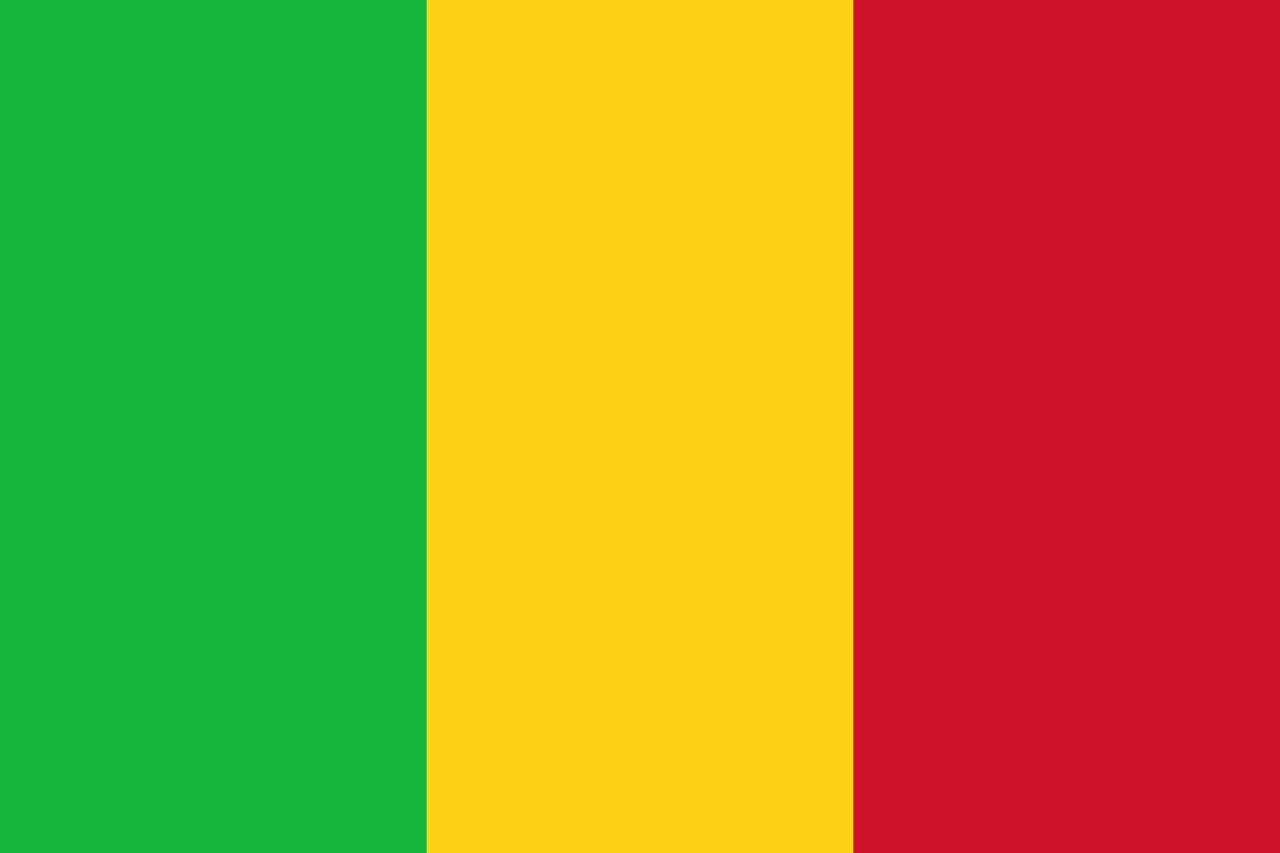
Each color also carries its own meaning. The green at the hoist evokes the land itself, the fields and natural wealth of a country that stretches from the Niger River into the Sahara. The gold in the middle stands for purity and, fittingly for a nation with a deep history of gold mining, for the mineral riches buried in its soil. The red at the fly honors the blood shed in the long struggle for independence. Read from one edge to the other, the flag traces an arc from the living land, through the ideal of a clean new beginning, to the sacrifice that made it possible.
The Pan-African scheme itself has deep roots, widely traced to the green, gold, and red of Ethiopia, the one African state that preserved its independence through the colonial era and so became a beacon for liberation movements. When Ghana adopted these colors at its own independence in 1957, it set a template that a wave of newly free nations, Mali among them, would follow.
A Design Built on Balance
The layout could hardly be more straightforward: three vertical stripes of equal width, green nearest the flagpole, gold in the center, and red on the outer edge. There is no emblem, no crest, no star or crescent. That restraint is deliberate. A vertical triband reads instantly, photographs cleanly, and works just as well on a tiny lapel pin as it does flying over a government ministry.
The flag is built to a width-to-length ratio of 2:3, and because the stripes are exactly equal, no single color dominates; the eye reads them as a balanced sequence rather than a hierarchy. The simplicity is also intensely practical: with no fine detail to reproduce, the flag can be manufactured identically by any factory or hand-sewn in a market stall without losing fidelity.
The vertical orientation also distinguishes Mali from neighbors whose tricolors run horizontally, and it deliberately echoes the proportions of the French flag, a visual nod to the colonial relationship that newly independent francophone states were leaving behind even as, in design terms, they built upon it.
From the Mali Federation to the Stick Figure That Vanished
The flag's path to its present form is more eventful than its calm appearance suggests. In the final years of French rule, the territory briefly joined neighboring Senegal in a political union known as the Mali Federation, formed in 1959. Green, gold, and red were already in circulation as symbols of this shared aspiration, but the union collapsed within months when Senegal withdrew in August 1960. French Sudan then took the name Mali for itself and declared full independence in September 1960, keeping the tricolor but adding a striking detail.
The earliest version placed a black human figure squarely in the center gold band, often described as a stylized stick figure with arms raised. This was a kanaga, a motif drawn from the masks and cosmology of the Dogon people, one of Mali's most culturally renowned communities. With its crossbar limbs reaching upward and downward, it is among the most recognizable shapes in Dogon ceremonial art, and placing it at the heart of the flag was a bold attempt to root a brand-new state in an ancient indigenous tradition rather than borrowed European symbolism.
That experiment did not last. In 1961, the figure was removed, leaving the plain tricolor we know today. The most commonly cited explanation is that the human image sat uneasily with religious sensitivities in a predominantly Muslim country, where the depiction of human figures can be discouraged. Whatever the reasoning, the change gave Mali a flag that was simpler and more universally acceptable, and the 1961 design has flown unchanged ever since. For a fuller picture of the nation behind the banner, the mali country guide traces its geography, history, and culture in depth.
How Mali's Flag Compares to Its Cousins
Because Mali shares its colors with several neighbors, telling the flags apart takes attention to detail. The closest match is Guinea, whose flag uses the identical colors in three vertical stripes but reverses the order, placing red at the hoist and green at the fly. Mali and Guinea are, in effect, mirror images of one another, a fact that trips up even seasoned flag-watchers.
Senegal, Mali's former federation partner, also flies a vertical green-gold-red tricolor, but adds a green five-pointed star in the center, a reminder of the shared history the two countries once embodied. Cameroon, too, uses the same three vertical colors with a central star. What sets Mali apart in this crowded family is its lack of ornament: its gold band stays plain and undecorated, making it the purest, most stripped-down expression of the Pan-African vertical tricolor.
A Banner Woven Into National Life
Today the tricolor is the constant backdrop to Malian public life. It rises over ministries and embassies, drapes the platforms at Independence Day celebrations each September, and flutters along the streets of the capital, Bamako, during national festivities. Schoolchildren learn its colors, and athletes carry it into stadiums. Football gives the flag vivid outings: when the national team, the Eagles, plays at the Africa Cup of Nations, stands fill with painted faces and draped tricolors.
Because it shares its palette with so many other African nations, the flag also functions as a passport into a larger identity. At pan-African gatherings, Mali's stripes blend into a sea of related colors, reinforcing the message of solidarity the founders intended. Yet the vertical arrangement keeps it distinct, so that even amid a crowd of green-gold-red banners, the Malian flag remains recognizably its own.
Quick Facts Worth Remembering
- The flag is a simple vertical triband of green, gold, and red, with green at the hoist.
- It was adopted in its current form in 1961, one year after independence.
- The original 1960 design featured a kanaga, a black stick-figure motif tied to Dogon culture, in the center.
- The colors are Pan-African, symbolizing nature, purity, and the blood of independence.
- The standard proportions are 2:3, with three stripes of equal width and no emblem.
- Mali sits in West Africa, sharing the Pan-African tradition with Ghana, Guinea, and Senegal.
Frequently Asked Questions
When was the flag of Mali adopted?
The current flag was adopted in 1961, the year after Mali gained independence. An earlier 1960 version used the same three colors but included a human figure in the central band, which was removed to produce the plain tricolor still in use today.
What do the colors of the Malian flag mean?
Green represents the land and nature, gold stands for purity and the country's mineral wealth, and red honors the blood shed during the fight for independence. Together they form the Pan-African scheme shared by many newly independent African states.
Why was a figure removed from the original flag?
The first design carried a stylized human figure known as a kanaga, inspired by Dogon tradition. It was removed in 1961, with the common explanation being that depicting a human form did not sit comfortably in a largely Muslim country. The result was the simpler tricolor seen today.
What continent is Mali on, and which flags resemble its own?
Mali is a landlocked country in West Africa. Its green, gold, and red tricolor closely resembles the flags of Guinea and Senegal; the key difference is the central emblem or color order, with Mali keeping its gold band plain.
How can I tell the flags of Mali and Guinea apart?
Both use the same three vertical stripes, so the trick is the order. On Mali's flag, green sits at the hoist nearest the pole and red at the outer fly. Guinea's flag is the exact reverse. They are essentially mirror images of each other.