
Introduction
France 🇫🇷 and Italy 🇮🇹 sit side by side at the heart of Europe, sharing a long Alpine border yet pulling the continent in two different directions. France anchors the west; Italy reaches south into the Mediterranean. Both shaped European art, cuisine, and politics for centuries, which makes setting them next to each other unusually revealing.
This comparison walks through the numbers that actually distinguish them: how much land each covers, how many people live there, where their capitals sit, and what their landscapes and economies look like. If you are studying for a geography test, mapping out a trip, or just settling a debate, the tables below give you the figures and the context to read them.
Size & Geography
| Feature | France 🇫🇷 | Italy 🇮🇹 |
|---|---|---|
| Area | 643,801 km² | 301,340 km² |
| Continent | Europe | Europe |
| Region | Western Europe | Southern Europe |
| Land Borders | Belgium, Luxembourg, Germany, Switzerland, Italy, Spain, Andorra, Monaco | France, Switzerland, Austria, Slovenia, San Marino, Vatican City |
| Landscape | mostly flat plains; hills and mountains along borders | boot-shaped peninsula; Alps in north, Apennines central spine |
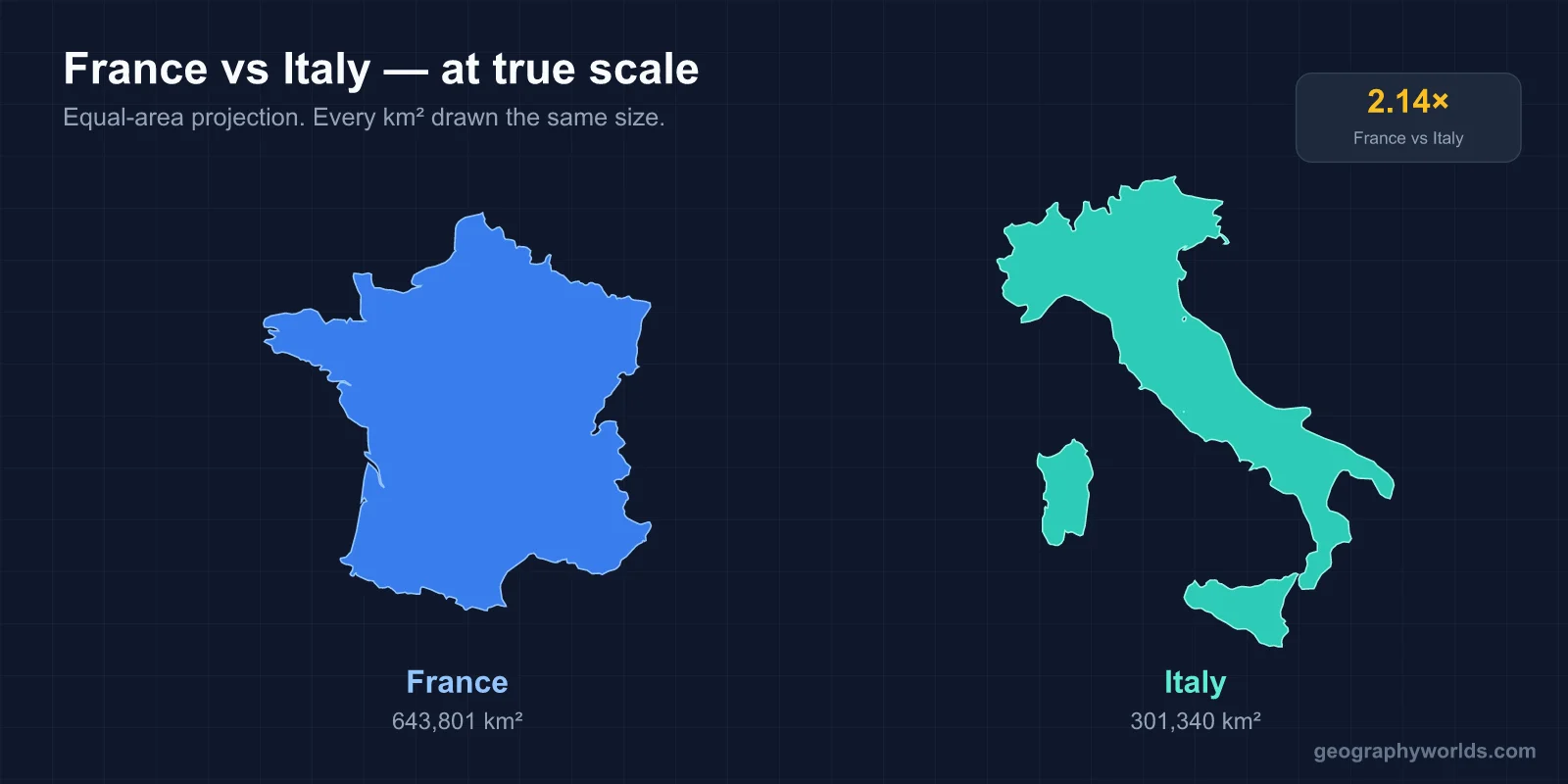
The size gap is the first thing that stands out. At 643,801 km², France covers roughly 2.1 times the area of Italy's 301,340 km², making it the largest country in Western Europe. The two also occupy very different shapes of land. France spreads out as a broad hexagon of mostly flat plains, with its hills and mountains pushed to the edges along the borders. Italy, by contrast, is the famous boot-shaped peninsula: the Alps wall off the north, the Apennines run down the middle like a spine, and the country stretches far out into the Mediterranean.
Their borders tell a similar story of west versus south. France touches eight neighbours, from Belgium and Germany in the north to Spain and Andorra in the south. Italy borders six, including two of the world's smallest states entirely surrounded by its territory, San Marino and Vatican City. The one country on both lists is each other, since France and Italy meet along the Alps.
Population & Demographics
| Metric | France 🇫🇷 | Italy 🇮🇹 |
|---|---|---|
| Population | 66.7 million | 58.9 million |
| Population Density | 103.7 per km² | 195.5 per km² |
The population figures are closer than the land area would suggest. France has 66.7 million people to Italy's 58.9 million, so France is only about 1.1 times more populous despite being more than twice the size. That mismatch shows up clearly in density. Italy packs 195.5 people into every square kilometre, while France averages 103.7, a gap of roughly 91.9 people per km². In practical terms, France's extra land spreads its population thin, whereas Italy's mountainous terrain concentrates people into the plains, coastlines, and valleys where living is easiest.
Capital Cities
Paris is the capital of France, and Rome is the capital of Italy. Both anchor their countries politically and culturally, but they sit in different corners of Europe: Paris in the north of Western Europe, on the Seine, and Rome further south in Southern Europe, near Italy's west coast. The contrast matches the wider geographic split between the two nations.
Language, Currency & Culture
| Aspect | France 🇫🇷 | Italy 🇮🇹 |
|---|---|---|
| Languages | French (official) | Italian (official) |
| Currency | Euro (EUR) | Euro (EUR) |
Here the two countries converge. France uses French as its official language and Italy uses Italian, and both descend from Latin, which is why a French and an Italian speaker can often recognise familiar words in each other's speech. On money there is no difference at all: both nations use the Euro (EUR) as founding members of the eurozone, so travellers moving between them never need to change currency.
Climate & Natural Features
| Aspect | France 🇫🇷 | Italy 🇮🇹 |
|---|---|---|
| Climate | Mediterranean in south, oceanic in west, continental in east | Mediterranean in south, alpine in far north |
| Key Features | Alps, Pyrenees, Loire Valley, French Riviera, Mont Blanc | Alps, Amalfi Coast, Mount Vesuvius, Dolomites, Po Valley |
| Economy | aerospace, tourism, agriculture, luxury goods, nuclear energy | manufacturing, fashion, tourism, agriculture, automotive |
France's larger landmass gives it a wider range of climates. The country runs Mediterranean in the south, oceanic in the west, and continental in the east, so a single nation covers warm coastal summers, mild Atlantic weather, and colder inland winters. Italy's climate is simpler to summarise but no less varied for its size: Mediterranean in the south and alpine in the far north, where the mountains keep things cool year-round.
Both countries claim a share of the Alps, which is fitting given they share that border. From there their headline landmarks diverge. France points to the Pyrenees, the Loire Valley, the French Riviera, and Mont Blanc, while Italy is defined by the Amalfi Coast, Mount Vesuvius, the Dolomites, and the Po Valley. Their economies split along similar lines. France leans on aerospace, tourism, agriculture, luxury goods, and nuclear energy, whereas Italy is built on manufacturing, fashion, tourism, agriculture, and automotive production. Tourism and agriculture matter enormously to both, but France's strength in aerospace and nuclear power contrasts sharply with Italy's reputation in fashion and car-making.
What Makes Each Country Unique
France is internationally renowned for the Eiffel Tower, fine cuisine and wine, fashion capital Paris, and world-class art museums. France is the most visited country in the world, attracting over 89 million international tourists annually, a flow that touches everything from its Riviera beaches to its vineyards and city museums.
Italy is best known for the Roman Colosseum, Renaissance art, pasta and pizza, and having more UNESCO World Heritage Sites than any country. Italy holds more UNESCO World Heritage Sites (59) than any other nation on Earth, a tally that reflects layer upon layer of Roman, medieval, and Renaissance history packed into a peninsula half the size of France.
Key Differences at a Glance
- Area: France (643,801 km²) vs Italy (301,340 km²) — France is 2.1x larger
- Population: France (66.7 million) vs Italy (58.9 million) — France is 1.1x more populous
- Capitals: Paris vs Rome
- Currency: Euro (EUR) vs Euro (EUR)
- Continents: Europe vs Europe
- Density: Italy is more densely populated (difference of ~91.9 people per km²)
- Languages: French (official) vs Italian (official)
Verdict
France and Italy are two of Europe's cultural heavyweights, and comparing them shows how differently similar-sounding countries can be built. France wins on raw land area by a factor of 2.1, yet it leads in population by only 1.1x, a reminder that a bigger map does not automatically mean a bigger crowd. Italy's far higher density follows directly from that: more people on less, and more mountainous, land.
They share plenty too. Both use the Euro, both border the Alps, and both lean heavily on tourism and agriculture. Where they part ways is in identity and industry. France spans Mediterranean, oceanic, and continental climates and powers itself with aerospace and nuclear energy, while Italy stretches from Mediterranean south to alpine north and makes its name through fashion, manufacturing, and automotive production.
Neither country is simply the bigger or better version of the other. France offers breadth, in land, climate zones, and tourist numbers, while Italy offers depth, with the densest concentration of World Heritage Sites anywhere. Read together, their numbers paint a fuller picture of how Western and Southern Europe took shape.
Test Your Knowledge!
Think you know your countries? Try our interactive geography quiz!
Play Geography Games →