
Introduction to GCC Countries
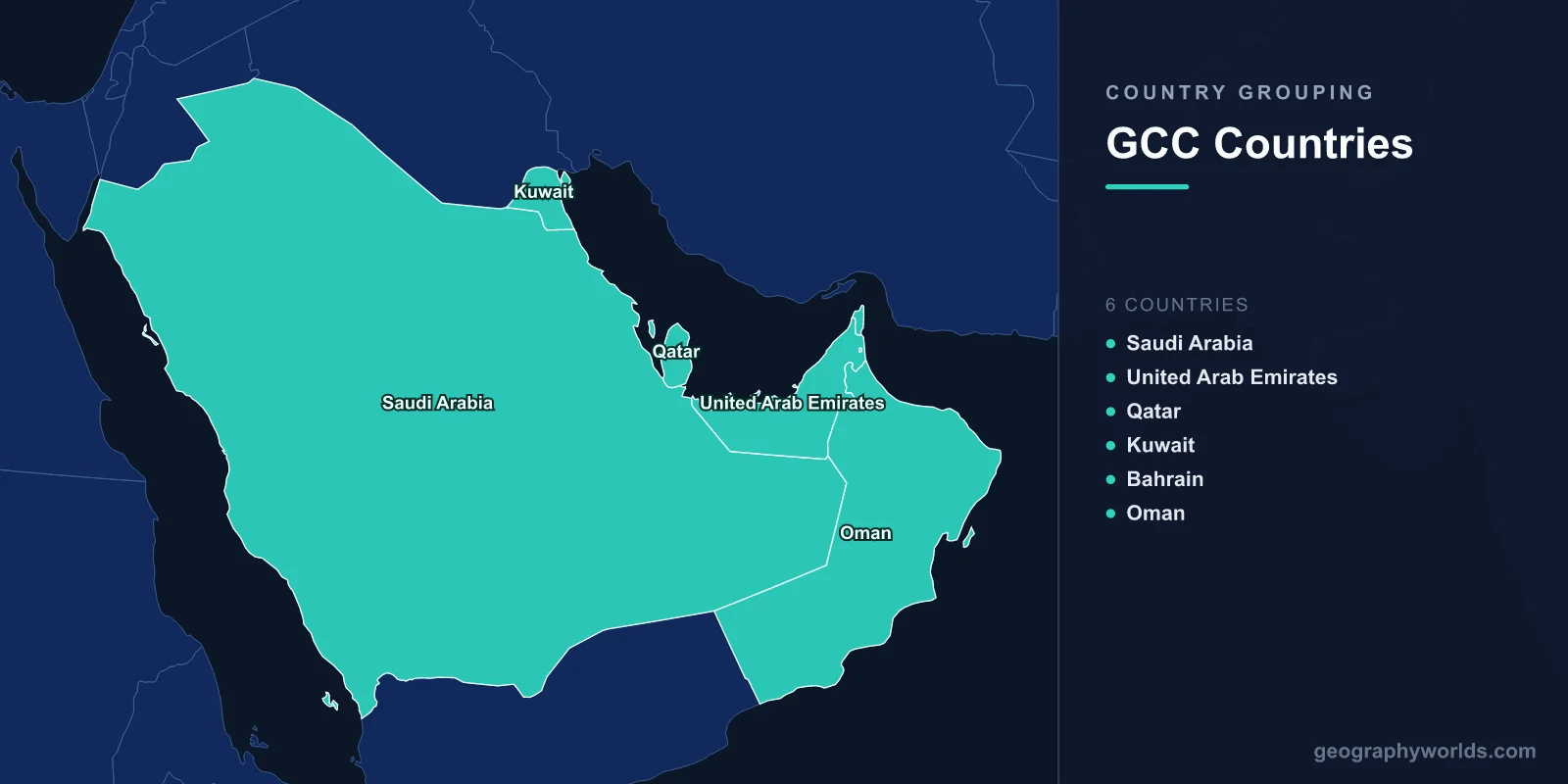
The Gulf Cooperation Council (GCC) is a political and economic alliance of six Arab monarchies on the Arabian Peninsula: Saudi Arabia, the United Arab Emirates, Qatar, Kuwait, Bahrain, and Oman. Founded on May 25, 1981, in Abu Dhabi, the GCC was established to foster coordination, integration, and cooperation among its member states in economic, security, and cultural affairs. Together these six nations sit atop approximately 30 percent of the world's proven oil reserves and 20 percent of its natural gas, making the GCC one of the most economically powerful regional blocs on Earth. With a combined GDP exceeding $2 trillion and a population of roughly 60 million — nearly half of whom are expatriate workers — the GCC countries have transformed from modest trading and pearling communities into some of the wealthiest and most rapidly modernizing societies in human history. From the futuristic skyline of Dubai to the ancient frankincense trails of Oman, the GCC nations blend deep-rooted Arabian traditions with breathtaking ambition for the future.

Countries in GCC Countries
- Saudi Arabia
- United Arab Emirates
- Qatar
- Kuwait
- Bahrain
- Oman
Location: Arabian Peninsula, bordering the Persian Gulf and the Arabian Sea
Shared Characteristics: Oil-driven wealth, Arab and Islamic heritage, monarchies, rapid modernization, Gulf Cooperation Council membership
History
The history of the GCC nations stretches back thousands of years. The Arabian Peninsula was home to ancient trading civilizations, including the Dilmun culture in Bahrain (circa 3000 BCE), which served as a commercial hub between Mesopotamia and the Indus Valley. Oman's maritime heritage made it a dominant naval power in the Indian Ocean for centuries, with an empire that stretched to Zanzibar in East Africa. The coastal communities of the Gulf were historically centered on pearl diving, fishing, and trade, with pearling forming the economic backbone of Kuwait, Bahrain, Qatar, and the Trucial States (now the UAE) well into the twentieth century. The rise of Islam in the seventh century, originating in the Hejaz region of modern Saudi Arabia with the Prophet Muhammad, transformed the peninsula into the spiritual heartland of a civilization that would stretch from Spain to Central Asia. The modern political landscape took shape in the early twentieth century: Saudi Arabia was unified by Abdulaziz ibn Saud in 1932, while the smaller Gulf states were British protectorates until gaining independence between 1961 (Kuwait) and 1971 (UAE, Bahrain, Qatar). The discovery of oil — first in Bahrain in 1932, then in Saudi Arabia, Kuwait, and the other Gulf states — fundamentally transformed these societies within a single generation, turning desert kingdoms into global economic players. The GCC was established in 1981 partly in response to the Iranian Revolution and the Iran-Iraq War, which threatened regional stability.
Geography & Climate
The GCC countries occupy the Arabian Peninsula and its coastal fringes along the Persian Gulf, the Gulf of Oman, the Arabian Sea, and the Red Sea. Saudi Arabia dominates the region geographically, covering roughly 2.15 million square kilometers — about 80 percent of the peninsula. Its terrain includes the Rub' al Khali (Empty Quarter), the world's largest contiguous sand desert at approximately 650,000 square kilometers, as well as the Hejaz Mountains along the Red Sea coast rising above 3,000 meters, and the Asir highlands in the southwest, which receive enough rainfall to support terraced agriculture. The smaller Gulf states — Kuwait, Bahrain, Qatar, and the UAE — are predominantly flat, low-lying desert terrain along the Persian Gulf coast, with Bahrain being an archipelago of 33 islands. The UAE's landscape ranges from the coastal salt flats (sabkha) of Abu Dhabi to the sand dunes of Liwa and the rugged Hajar Mountains shared with Oman, which rise to over 3,000 meters at Jebel Shams, Oman's highest peak. Oman is the most geographically diverse GCC state, featuring dramatic wadis (dry riverbeds), the lush Dhofar region that receives monsoon rains, and over 3,000 kilometers of coastline. The climate across the GCC is predominantly arid and hot, with summer temperatures routinely exceeding 45 degrees Celsius in the interior, though Oman's Dhofar and Saudi Arabia's Asir enjoy cooler, wetter conditions. Water scarcity is a defining challenge, and the GCC nations are among the world's largest users of desalination technology to meet freshwater needs.
Culture & Society
GCC culture is rooted in Arab tribal traditions, Islamic faith, and the harsh beauty of desert life. Hospitality is a core value — offering Arabic coffee (gahwa) and dates to guests is a cherished ritual across all six nations. Traditional dress remains widely worn: men in the white thobe (or dishdasha) and women in the black abaya, though styles vary subtly between countries. Islam shapes daily life through the five daily prayers, Ramadan fasting, and the Hajj pilgrimage to Mecca, which draws over two million Muslims to Saudi Arabia annually. Falconry, camel racing, and horse breeding are prized heritage sports, with falconry recognized by UNESCO as intangible cultural heritage. Pearl diving traditions are celebrated in museums and festivals across Bahrain, Qatar, and the UAE. The GCC nations have invested heavily in cultural institutions in recent decades: Abu Dhabi's Louvre museum, Qatar's Museum of Islamic Art, and Saudi Arabia's Diriyah Season reflect ambitions to become global cultural destinations. Arabic calligraphy, traditional music (including the oud and rebab), and Nabati poetry remain living art forms alongside a growing contemporary arts scene. Cuisine features dishes like kabsa (spiced rice with meat), harees (wheat and meat porridge), machboos, and luqaimat (sweet dumplings), with each country adding regional variations influenced by Persian, Indian, and East African culinary traditions.
Economy
The GCC economies are among the wealthiest in the world, built on vast hydrocarbon reserves. Saudi Arabia is the world's largest oil exporter and holds approximately 15 percent of global proven reserves. Qatar possesses the world's third-largest natural gas reserves, anchored by the massive North Field, making it the world's top exporter of liquefied natural gas (LNG). Kuwait and the UAE (particularly Abu Dhabi) are also major oil producers, while Bahrain, the first Gulf state to discover oil, has a more diversified economy centered on banking and financial services. All six nations are pursuing ambitious economic diversification to reduce dependence on hydrocarbons. Saudi Arabia's Vision 2030, launched by Crown Prince Mohammed bin Salman in 2016, is the most sweeping plan, aiming to develop tourism, entertainment, technology, and renewable energy sectors through mega-projects like NEOM, a planned $500 billion futuristic city on the Red Sea coast, and The Line, a 170-kilometer linear smart city. The UAE, particularly Dubai, has already achieved significant diversification, establishing itself as a global hub for aviation (Emirates airline), logistics (Jebel Ali port), finance, and tourism — the Burj Khalifa and Palm Jumeirah are globally recognized landmarks. Qatar leveraged the 2022 FIFA World Cup to invest over $200 billion in infrastructure. Sovereign wealth funds — including Abu Dhabi's ADIA, Saudi Arabia's PIF, and Kuwait's KIA — manage trillions of dollars in assets globally. The GCC labor market is heavily dependent on expatriate workers, who make up over 80 percent of the workforce in Qatar and the UAE, raising important questions about labor rights and demographic balance.
The Region Today
The GCC today stands at a transformative crossroads. Economic diversification dominates the agenda as global energy transition threatens the long-term viability of oil-dependent models. Saudi Arabia's Vision 2030 and similar programs in the UAE (We the UAE 2031), Qatar (National Vision 2030), Oman (Vision 2040), Bahrain (Economic Vision 2030), and Kuwait (New Kuwait 2035) all aim to build knowledge-based, innovation-driven economies. Social reforms are advancing rapidly, particularly in Saudi Arabia, where women gained the right to drive in 2018, cinemas reopened after a 35-year ban, and entertainment and tourism sectors are being built from scratch. The UAE and Bahrain normalized relations with Israel through the 2020 Abraham Accords, reshaping regional diplomacy. Geopolitical dynamics remain complex: a diplomatic rift isolated Qatar from 2017 to 2021 before reconciliation, and the GCC nations carefully balance relationships with the United States, China, and other global powers. Climate change poses an existential challenge for a region already among the hottest on Earth, driving investments in renewable energy — Saudi Arabia's NEOM includes plans for a massive green hydrogen facility, and the UAE hosted COP28 in 2023. Sports diplomacy has become a major soft-power tool, with Saudi Arabia hosting Formula 1, boxing, and golf events, Qatar hosting the 2022 World Cup, and the UAE establishing itself in cricket, tennis, and combat sports.
Interesting Facts About GCC Countries
- Qatar has the highest GDP per capita in the world, driven by its enormous natural gas reserves
- The UAE's Burj Khalifa in Dubai stands at 828 meters — the tallest building ever constructed
- Bahrain was the first Gulf state to discover oil in 1932 and the first to begin diversifying away from it
- Oman's frankincense trade dates back over 5,000 years and its Land of Frankincense is a UNESCO World Heritage Site
- Saudi Arabia has no rivers or permanent lakes — it is the largest country in the world without any
- Kuwait's Dinar is the highest-valued currency unit in the world
Conclusion
GCC Countries (Saudi Arabia, United Arab Emirates, Qatar, Kuwait, Bahrain, Oman) represent a fascinating regional grouping with shared history, cultural ties, and common challenges. Whether you're studying world geography, planning travel, or simply curious about how the world's nations connect, understanding these regional groupings provides valuable context for making sense of our complex and interconnected world.