

Corn, known as maize outside the Americas, is the most produced crop on Earth by weight, with annual production exceeding 1.2 billion tonnes. Domesticated from a wild grass called teosinte in the Balsas River Valley of southern Mexico approximately 9,000 years ago, corn has become the foundational crop of the Americas and a global agricultural powerhouse.
Introduction
The geography of corn production is dominated by the American Corn Belt, a swath of fertile land stretching from Ohio to Nebraska. However, corn is also a staple food across Sub-Saharan Africa, a key crop in China and Brazil, and the basis of Mexico's culinary identity. No other crop has been so completely transformed by human selection from its wild ancestor.
Origins & History
- Origin: Balsas River Valley, Mexico, ~7000 BCE
- Wild Ancestor: Teosinte grass
- Columbian Exchange: Brought to Europe and Asia after 1492
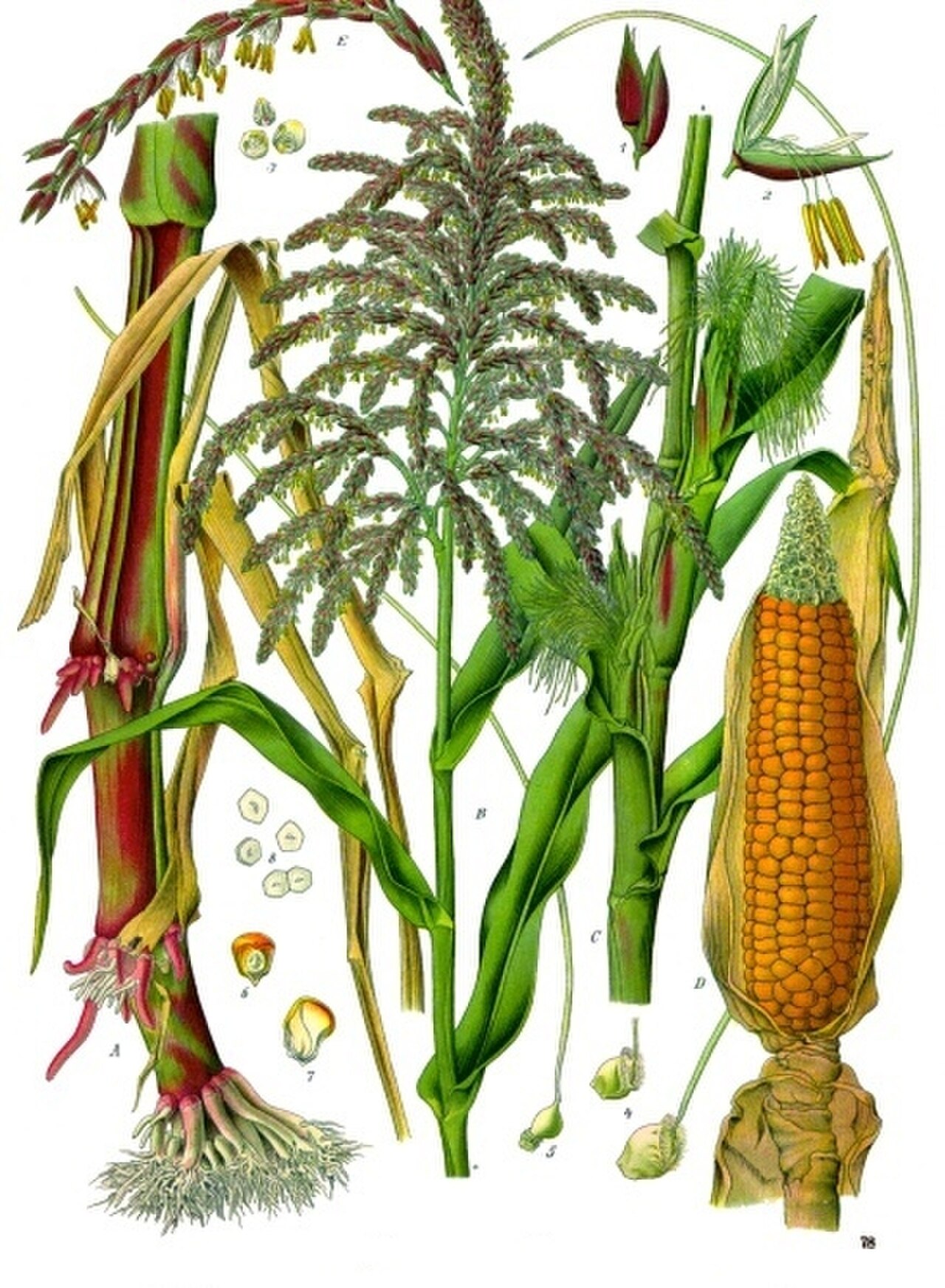
Teosinte, corn's wild ancestor, barely resembles modern corn. Its tiny ears carry only 5-12 hard kernels, compared to the 800 kernels on a modern ear. The transformation of teosinte into corn through selective breeding is considered one of the greatest feats of plant domestication in human history.
Corn spread throughout the Americas long before European contact, reaching the Great Lakes region by 200 CE and becoming the staple of civilizations from the Aztec to the Inca. After 1492, the Columbian Exchange carried corn to Europe, Africa, and Asia, where it quickly became a major crop.
Growing Regions
- Top Producer: United States (384 million tonnes/year)
- US Corn Belt: Iowa, Illinois, Nebraska, Minnesota, Indiana
- Global Total: 1.2+ billion tonnes annually
The United States produces roughly one-third of the world's corn, with the Corn Belt states of Iowa, Illinois, Nebraska, Minnesota, and Indiana at the heart of production. Iowa alone produces more corn than most countries, with the state's deep, prairie-derived soils and warm, humid summers providing ideal growing conditions.
China is the second-largest producer at about 277 million tonnes, followed by Brazil at 130 million tonnes. Brazil's corn geography has expanded dramatically into the cerrado (tropical savanna), often as a second crop following soybeans. In Africa, Nigeria, South Africa, and Ethiopia are the leading producers.
Climate & Conditions
- Ideal Temperature: 21-30°C during growing season
- Rainfall: 500-800 mm during growing season
- Frost-Free Days: 120-140 minimum
- Soil: Deep, fertile, well-drained
Corn requires warm temperatures, adequate moisture during its critical pollination period in midsummer, and a long frost-free season. The American Corn Belt provides these conditions perfectly, with deep prairie soils, summer thunderstorms, and 140 or more frost-free days.
Corn is remarkably adaptable and now grows from the tropics to 50 degrees latitude. However, it is sensitive to drought stress during pollination, which makes summer rainfall patterns critical. A single week of extreme heat during tasseling can reduce yields by 20% or more.
Global Trade & Economics
- US Corn Use: ~40% ethanol, ~36% animal feed, ~12% export
- Top Exporter: United States
- Ethanol: 16+ billion gallons produced annually in US
Unlike most staple crops, less than 10% of corn is consumed directly as food. In the United States, about 40% of the corn crop goes to ethanol production, 36% to animal feed, and only a fraction to human food products like corn syrup, starch, and cereal. This makes corn as much an energy and industrial crop as a food crop.
The United States dominates global corn exports, followed by Argentina, Brazil, and Ukraine. Disruptions to US corn production, whether from drought, policy changes, or ethanol mandates, have outsized effects on global feed and food prices.
Cultural Impact
- Mesoamerican Sacred Crop: Maya creation myth: humans made from corn
- Tortilla: Foundation of Mexican cuisine for millennia
- Corn Derivatives: In 75% of processed foods
Corn holds sacred status in Mesoamerican cultures. The Maya creation story in the Popol Vuh describes the gods creating humans from corn dough. In Mexico, the corn tortilla remains the foundation of the diet, and the nixtamalization process (treating corn with lime) developed 3,500 years ago unlocks niacin and makes the grain a complete food.
In the modern industrialized world, corn derivatives appear in an estimated 75% of processed foods, including high-fructose corn syrup, corn starch, corn oil, and hundreds of additives. This ubiquity makes corn perhaps the most influential crop in the modern global food system.
Key Facts
- Corn is the most produced crop on Earth at over 1.2 billion tonnes per year.
- The United States produces roughly one-third of the world's corn, led by Iowa and Illinois.
- Corn was domesticated from teosinte grass in Mexico about 9,000 years ago.
- About 40% of US corn goes to ethanol production, not food.
- Corn derivatives appear in approximately 75% of processed foods in industrialized countries.
Fun Facts
- An ear of corn always has an even number of rows, typically 16.
- The Maya believed the gods created humans from corn dough after failed attempts with mud and wood.
- A single corn plant can produce over 1,000 kernels arranged in 16 rows on one or two ears.
- The Corn Palace in Mitchell, South Dakota, is redecorated with real corn murals each year.
Final Thoughts
The geography of corn stretches from its origins as a humble grass in a Mexican river valley to its current status as the most produced crop on Earth. Whether as sacred sustenance in Mesoamerica, animal feed in the Corn Belt, or ethanol in gas tanks, corn has reshaped landscapes, economies, and diets across the globe.
Test Your Knowledge!
Think you know your food geography? Try our interactive quiz!
Play Geography Games →