
The date palm (Phoenix dactylifera) is one of the oldest cultivated plants on Earth, with evidence of domestication in Mesopotamia dating back over 6,000 years. Today, more than 9.5 million tonnes of dates are produced annually across a narrow geographic band stretching from Morocco to Pakistan, defined by the hot, arid conditions the date palm requires: temperatures above 35°C during fruit ripening, minimal rainfall, and access to groundwater or irrigation.
Introduction
Dates are far more than a food crop — they are the foundation of oasis economies that have sustained civilizations across the Sahara, Arabian Peninsula, and Persian Gulf for millennia. The date palm provides fruit, syrup, vinegar, animal feed (from the seeds), building materials (trunks and fronds), and basket-weaving fiber. In many desert regions, the date palm is still called the "tree of life," and its geographic distribution maps almost exactly onto the world's major desert civilizations.
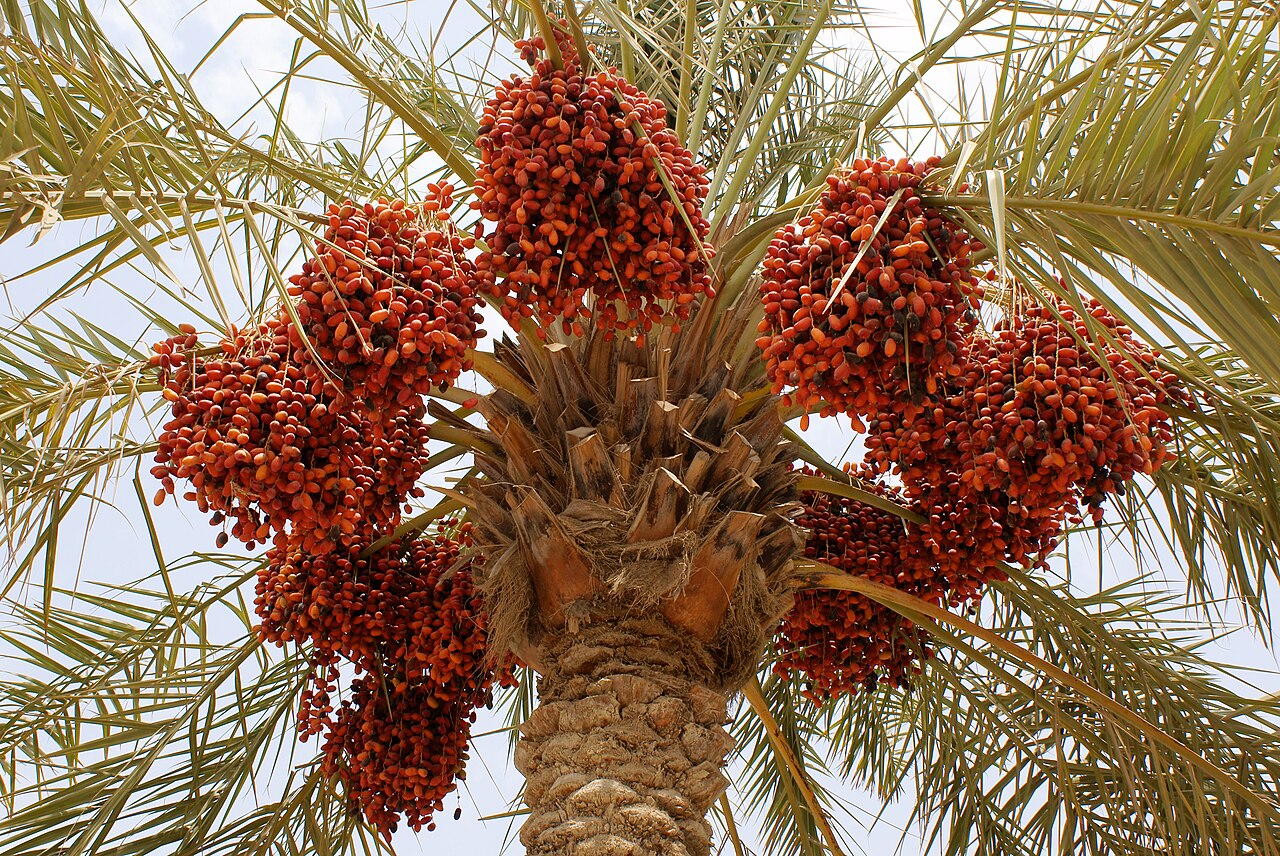
The Date Belt: Where Dates Grow
- Geographic Range: North Africa to Pakistan, roughly 15°N to 35°N
- Top Producer: Egypt (~1.7 million tonnes/year)
- Second: Saudi Arabia (~1.5 million tonnes)
- Third: Iran (~1.3 million tonnes)
- Global Total: ~9.5 million tonnes/year
Date production is concentrated in a narrow belt between 15° and 35° North latitude, from the Atlantic coast of Morocco and Mauritania to the Indus Valley in Pakistan. This band corresponds to the world's hot desert and semi-arid climate zones, where the date palm's requirement for intense heat and minimal humidity during fruiting is met. Egypt leads global production at approximately 1.7 million tonnes annually, grown primarily in the Siwa Oasis, the Nile Delta, and Upper Egypt.
Saudi Arabia and Iran each produce over 1 million tonnes, with Saudi Arabia's Al-Ahsa oasis — the world's largest — containing over 3 million date palms. Iraq, historically the world's leading date producer (30 million palms in the 1970s), has seen production collapse due to decades of war, salt intrusion, and neglect, dropping from 22 million palms to roughly 9 million by 2020. Algeria's Saharan oases, particularly the M'zab Valley, produce the prized Deglet Noor variety, while Tunisia's Tozeur and Nefta oases are famous for the same variety.
Date Varieties & Terroir
- Known Varieties: 3,000+ named cultivars worldwide
- Medjool: "King of Dates," originally from Morocco, large and caramel-like
- Deglet Noor: "Date of Light," semi-dry, grown in Algeria/Tunisia/California
- Ajwa: Sacred variety from Medina, Saudi Arabia, $20-50/kg
- Khalas: UAE and Oman premium variety, honey-like flavor
Over 3,000 named date varieties exist worldwide, each adapted to specific microclimates and valued for distinct flavor, texture, and culinary uses. The Medjool, originally from the Tafilalet oasis in southern Morocco, is the world's most commercially valuable date — large, soft, and caramel-flavored, it dominates the premium market and sells for $10-20 per kilogram. When a disease threatened Moroccan Medjool palms in the 1920s, offshoots were sent to California's Coachella Valley, which became the primary Medjool production center outside the Middle East.
Date terroir is remarkably precise. The Ajwa date, grown exclusively in the Medina region of Saudi Arabia and considered sacred in Islamic tradition, commands prices of $20-50 per kilogram. Its flavor, attributed to Medina's specific volcanic soils and groundwater, has never been replicated elsewhere despite numerous attempts. Similarly, the Khalas variety from the UAE's Al Ain region and Oman's Nizwa oasis produces a honey-flavored date that changes character when grown in other locations.
Oasis Economies & Cultural Significance
- Date Palms Worldwide: ~120 million trees
- Livelihoods: Directly supports ~50 million people
- Ramadan Consumption: Dates are traditionally the first food to break the fast
- UNESCO Recognition: Date palm knowledge recognized as Intangible Cultural Heritage (2019)
The date palm supports approximately 50 million people across the Middle East and North Africa, primarily in oasis communities where alternative livelihoods are scarce. A single productive palm can yield 70-140 kilograms of fruit annually for 60-80 years, making it one of the most productive perennial crops per unit of water consumed. Traditional oasis agriculture is a three-tier system: date palms at the top providing shade, fruit trees (citrus, pomegranate, olive) in the middle, and vegetables and grains at ground level.
Dates hold deep cultural and religious significance across the Islamic world. During Ramadan, dates are traditionally the first food consumed to break the daily fast, following the practice of the Prophet Muhammad. Saudi Arabia distributes millions of kilograms of dates to pilgrims during the Hajj each year. In 2019, UNESCO recognized the "knowledge, skills, and traditions associated with the date palm" as Intangible Cultural Heritage, acknowledging the palm's role in sustaining desert civilizations for millennia.
New Frontiers & Climate Challenges
- California: ~35,000 tonnes/year from Coachella Valley
- Israel: Pioneer in date palm research and drip irrigation
- Australia: Emerging producer in Northern Territory and Queensland
- Climate Threats: Rising temperatures disrupting flowering, increased humidity
Date cultivation is expanding to new geographies. California's Coachella Valley produces approximately 35,000 tonnes annually, primarily Medjool and Deglet Noor varieties, using drip irrigation in the Sonoran Desert. Israel, despite its small land area, is a leader in date palm genetics and irrigation technology, producing premium Medjool dates in the Jordan Valley and Arava Desert. Australian date farms in the Northern Territory and Queensland are growing, targeting Asian export markets.
Climate change presents a paradox for date production. While dates require extreme heat, the increasingly erratic weather patterns in traditional growing regions are disrupting the delicate flowering and pollination window. Higher humidity — predicted for parts of the Arabian Peninsula as sea temperatures rise — promotes fungal diseases that can destroy entire harvests. In Iraq and Iran, rising soil salinity from groundwater depletion is killing palms that have produced for decades. Conservation of ancient oasis ecosystems, some dating back 4,000 years, is becoming an urgent priority.
Key Facts
- Global date production exceeds 9.5 million tonnes annually from approximately 120 million palms.
- Egypt is the world's largest date producer at ~1.7 million tonnes per year.
- Over 3,000 named date varieties exist, each adapted to specific microclimates.
- A single productive date palm can yield 70-140 kg of fruit annually for 60-80 years.
- Iraq's palm population declined from 30 million to roughly 9 million due to war and neglect.
Fun Facts
- The oldest known cultivated date seeds, found near the Dead Sea, were carbon-dated to 2,000 years ago — and scientists successfully germinated them in 2005.
- Saudi Arabia distributes millions of kilograms of free dates to Hajj pilgrims every year.
- The Medjool date was saved from extinction when disease-resistant offshoots were sent from Morocco to California in the 1920s.
- Date palms are dioecious — each tree is either male or female — and a single male palm can pollinate up to 50 female trees.
Final Thoughts
The date palm is the original crop of the desert — a plant so perfectly adapted to extreme heat and aridity that it has sustained entire civilizations for over 6,000 years. Its geography maps onto the world's great arid zones with remarkable precision, and its cultural significance across the Islamic world and beyond is unmatched by any other fruit. As climate change and water scarcity reshape arid landscapes, the date palm's future will depend on the same resilience that has made it the tree of life for millennia.
Test Your Knowledge!
Think you know your food geography? Try our interactive quiz!
Play Geography Games →