
Introduction
Germany 🇩🇪 and France 🇫🇷 sit side by side at the heart of the European Union, and together they anchor much of the continent's economy and politics. They share a long border, the same currency, and a tangled history, yet a closer look reveals two countries shaped very differently by their land and their people.
This comparison lays out the essentials, area, population, capitals, climate, and natural features, so that whether you are revising for a geography class, mapping out a trip, or just curious, you can see exactly where these neighbours line up and where they diverge.
Size & Geography
| Feature | Germany 🇩🇪 | France 🇫🇷 |
|---|---|---|
| Area | 357,022 km² | 643,801 km² |
| Continent | Europe | Europe |
| Region | Western Europe | Western Europe |
| Land Borders | Denmark, Poland, Czech Republic, Austria, Switzerland, France, Luxembourg, Belgium, Netherlands | Belgium, Luxembourg, Germany, Switzerland, Italy, Spain, Andorra, Monaco |
| Landscape | lowlands in north, central uplands, Alps in south | mostly flat plains; hills and mountains along borders |
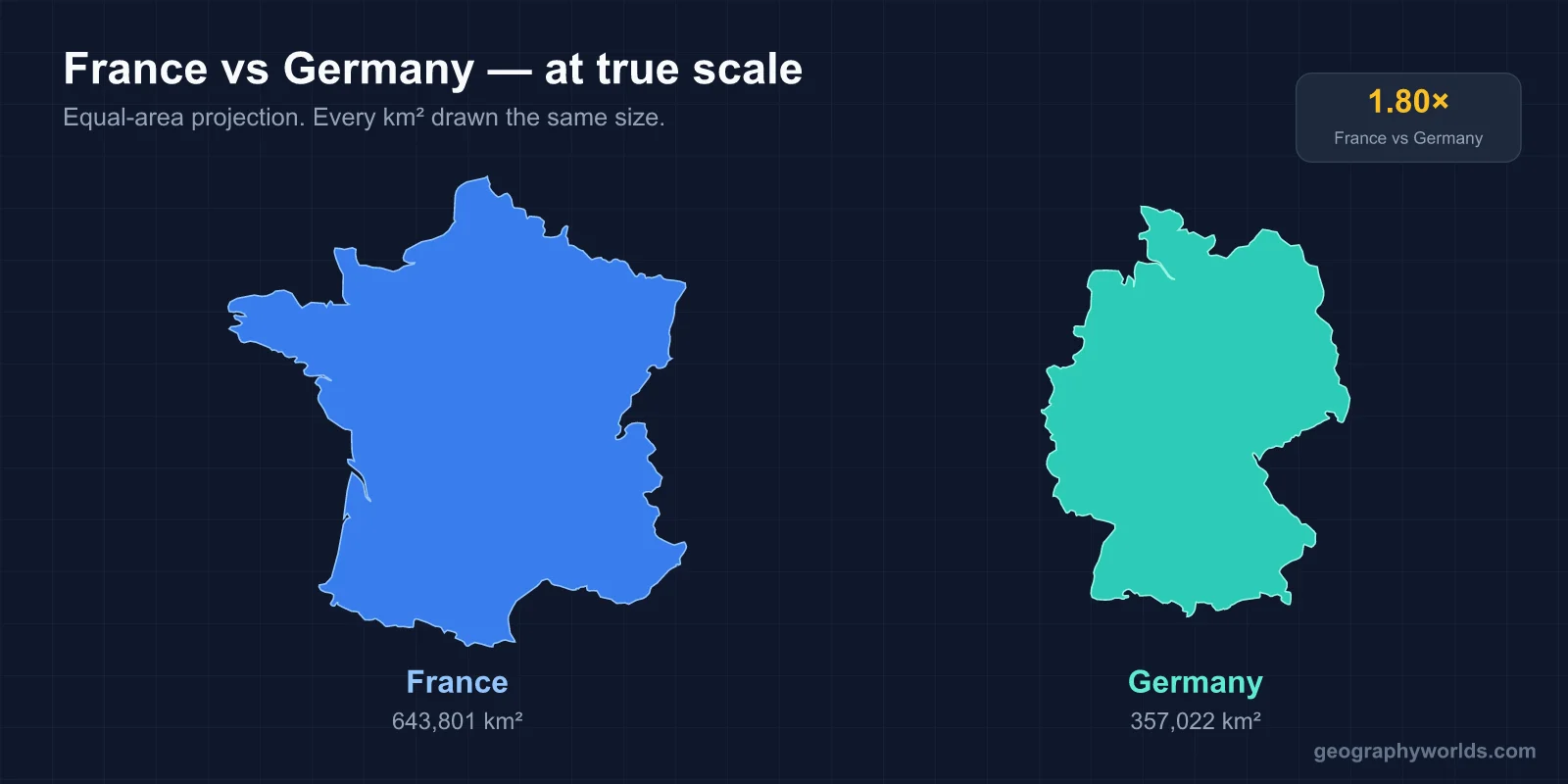
France is the larger of the two by a clear margin, covering 643,801 km² to Germany's 357,022 km², roughly 1.8 times the size. Both belong to Western Europe and both ring themselves with neighbours: Germany touches nine countries and France eight, with each appearing on the other's list. The shape of the land differs too. Germany rises from flat lowlands in the north through central uplands to the Alps in the south, while France is mostly flat plains with its hills and mountains pushed out toward the borders it shares with Spain, Italy, and Switzerland.
Population & Demographics
| Metric | Germany 🇩🇪 | France 🇫🇷 |
|---|---|---|
| Population | 83.6 million | 66.7 million |
| Population Density | 234.3 per km² | 103.7 per km² |
Here the picture flips. Germany is the more crowded country despite being the smaller one, with 83.6 million people against France's 66.7 million, about 1.3 times as many. Pack that larger population into a smaller area and the contrast in density becomes stark: 234.3 people per km² in Germany versus 103.7 in France, a gap of roughly 130.6 per km². In other words, France has far more room to spread out, which is part of why so much of it remains farmland and open countryside.
Capital Cities
Germany governs from Berlin and France from Paris, both major Western European capitals. Beyond that shared status, the two cities trace very different stories, Paris a long-unbroken seat of power on the Seine, Berlin a capital reunited only in 1990 after decades split by the Cold War.
Language, Currency & Culture
| Aspect | Germany 🇩🇪 | France 🇫🇷 |
|---|---|---|
| Languages | German (official) | French (official) |
| Currency | Euro (EUR) | Euro (EUR) |
On money the two are identical: both use the Euro (EUR), and indeed both were among the founding members of the eurozone, so a traveller crossing the border needs no currency exchange. Language is where they part. German is the official language on one side and French on the other, two tongues from different branches of the European language family, each carrying its own literary and cultural tradition.
Climate & Natural Features
| Aspect | Germany 🇩🇪 | France 🇫🇷 |
|---|---|---|
| Climate | temperate; cool, wet winters and mild summers | Mediterranean in south, oceanic in west, continental in east |
| Key Features | Black Forest, Rhine River, Bavarian Alps, North Sea coast | Alps, Pyrenees, Loire Valley, French Riviera, Mont Blanc |
| Economy | automotive, engineering, chemicals, technology | aerospace, tourism, agriculture, luxury goods, nuclear energy |
Germany's weather is fairly uniform, temperate throughout, with cool, wet winters and mild summers from the Rhine River valley to the North Sea coast. France is more varied, splitting into a Mediterranean climate in the south, an oceanic one in the west, and a continental one in the east, which is why a single country can offer ski slopes, Atlantic surf, and sun-baked vineyards. Their landmarks reflect that geography: Germany draws visitors to the Black Forest and the Bavarian Alps, while France ranges across the Alps, the Pyrenees, the Loire Valley, the French Riviera, and Mont Blanc, the highest peak in Western Europe. The two also share the Alpine range, which arcs along their southern and southeastern reaches.
Their economies lean in distinct directions as well. Germany is built on automotive manufacturing, engineering, chemicals, and technology, while France spreads across aerospace, tourism, agriculture, luxury goods, and nuclear energy, the last of which supplies a large share of its electricity.
What Makes Each Country Unique
Germany is internationally renowned for automotive engineering (BMW, Mercedes, Volkswagen), Oktoberfest, castles, and the Black Forest. It is also a beer nation in the fullest sense, home to over 1,500 different types of beer and more than 1,300 breweries, with brewing woven deep into regional identity.
France is best known for the Eiffel Tower, its celebrated cuisine and wine, fashion-capital Paris, and world-class art museums. It is also the most visited country on Earth, drawing over 89 million international tourists a year, more than its own population.
Key Differences at a Glance
- Area: Germany (357,022 km²) vs France (643,801 km²) — France is 1.8x larger
- Population: Germany (83.6 million) vs France (66.7 million) — Germany is 1.3x more populous
- Capitals: Berlin vs Paris
- Currency: Euro (EUR) vs Euro (EUR)
- Continents: Europe vs Europe
- Density: Germany is more densely populated (difference of ~130.6 people per km²)
- Languages: German (official) vs French (official)
Verdict
The neatest summary of Germany versus France is a trade-off: France holds the land, Germany holds the people. France is about 1.8 times larger by area, yet Germany has roughly 1.3 times the population, a reminder that a bigger map does not always mean more inhabitants. It also explains the density gap, with Germans living far closer together than the French.
Climate and landscape underline the difference. Germany offers a single temperate rhythm of cool, wet winters and mild summers, anchored by features like the Black Forest, while France stretches across Mediterranean, oceanic, and continental zones and showcases the Alps among its highlights. Economically, Germany leans on its automotive and engineering strength while France diversifies into aerospace, tourism, and more.
For all these contrasts, the two share a currency, a border, and a central role in Europe. Comparing them side by side is one of the clearest ways to see how geography, population, and climate combine to give each country its own character.
Test Your Knowledge!
Think you know your countries? Try our interactive geography quiz!
Play Geography Games →