
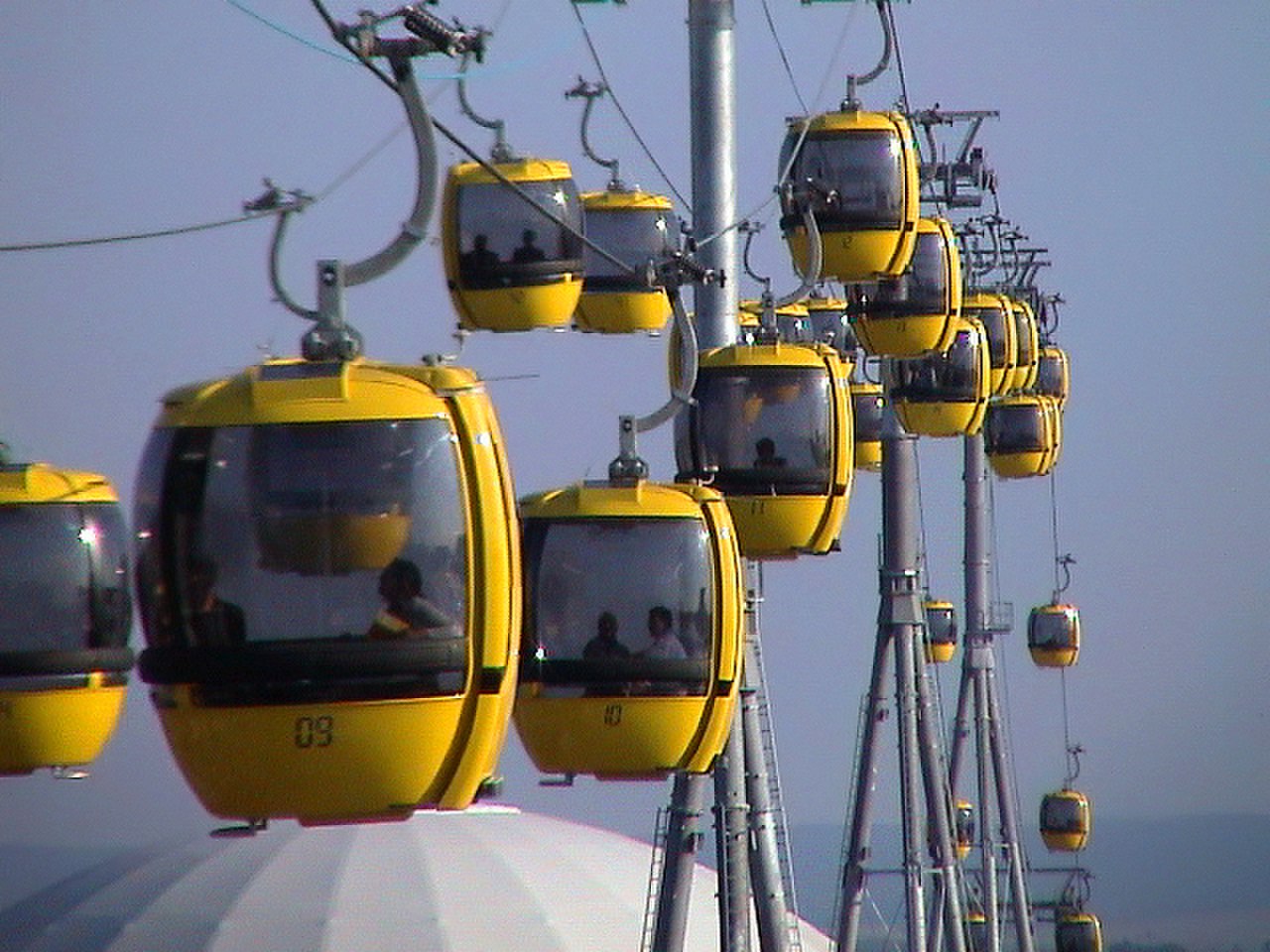
The word "gondola" encompasses two remarkably different transport modes united by geography: the flat-bottomed boats navigating Venice's 150 canals, and the aerial cable cars ascending mountains and crossing valleys worldwide. Both exist because conventional transport cannot serve the terrain — water in Venice's case, steep elevation in La Paz's. Together they demonstrate how extreme geography drives transportation innovation.
Introduction
Venice's 400 remaining gondolas are the survivors of a fleet that once numbered 10,000, while modern urban gondola systems are booming: La Paz's Mi Teleférico is the world's longest urban cable car network at 33 kilometers, and cities from Medellín to Istanbul to Algiers have built aerial gondola lines to connect hillside neighborhoods that buses and trains cannot reach.

Venice's Canal Gondolas
- Active Gondolas: ~400 (down from ~10,000 in 16th century)
- Length: 10.85 m, width 1.42 m
- Weight: ~350 kg (built from 280 pieces of 8 wood types)
- Cost: €40,000-€60,000 per gondola
- Ride Price: €80 for 30 minutes (up to 6 passengers)
Venice's gondola is one of the most recognizable vehicles in the world, a flat-bottomed boat specifically designed for the city's shallow lagoon (average depth 1.5 m) and narrow canals (some just 2 meters wide). Each gondola is built from 280 pieces of eight different wood types — cherry, elm, fir, larch, lime, mahogany, oak, and walnut — and is deliberately asymmetric, with the left side 24 centimeters longer than the right to counterbalance the gondolier's rowing stroke.
Today only about 400 gondolas remain, operated by 433 licensed gondoliers (including just a handful of women since the first female license in 2010). While tourist rides at €80 for 30 minutes dominate, the traghetto service — gondola ferries crossing the Grand Canal at seven points for €2 — remains a genuine daily transport for Venetians. The gondola's shallow draft of just 30 centimeters makes it uniquely suited to Venice's geography.
La Paz's Mi Teleférico
- Network Length: 33 km (11 lines)
- Daily Passengers: ~300,000
- Elevation Range: 3,200 m (El Alto) to 3,600 m
- Opened: 2014 (first 3 lines)
- Cost: 3 bolivianos (~$0.43) per ride
La Paz, Bolivia sits in a canyon at 3,640 meters above sea level, with the satellite city of El Alto perched on the altiplano rim at 4,150 meters. The 400-meter elevation difference and steep canyon walls make conventional surface transit extremely difficult, creating massive traffic congestion on the few connecting roads. Mi Teleférico, the world's longest urban cable car network, was the solution.
Opened in 2014 with three lines and expanded to 11 lines covering 33 kilometers by 2019, Mi Teleférico carries approximately 300,000 passengers daily at 3 bolivianos (~$0.43) per ride. The system was built by Austrian manufacturer Doppelmayr and cost $750 million. It has transformed La Paz's geography of mobility, reducing commute times from El Alto by up to 60% and connecting previously isolated hillside neighborhoods to the urban core.
Medellín's MetroCable
- Opened: 2004 (Line K, first urban gondola transit)
- Lines: 5 cable car lines integrated with metro
- Daily Ridership: ~30,000 per line
- Impact: Reduced commute times by 70% in steep barrios
Medellín, Colombia pioneered the concept of urban gondola transit for social equity when it opened MetroCable Line K in 2004, connecting the steep, impoverished barrios of Santo Domingo to the city's metro system. Built on hillsides with grades up to 45%, these neighborhoods had been effectively cut off from the formal economy by geography. The cable car reduced a 2-hour bus journey to 12 minutes.
The MetroCable's success triggered a global wave of urban gondola construction. Medellín now has five cable car lines integrated with its metro and bus rapid transit system. Crucially, the cable car stations became catalysts for broader urban development: libraries, parks, schools, and commercial centers were built around stations, transforming some of the city's most marginalized neighborhoods. Homicide rates in served areas dropped by 79% in the decade after construction.
Urban Gondolas Worldwide
- Istanbul: Maçka-Taşkışla cable car over Bosphorus hills
- Algiers: 2 lines connecting hillside kasbah to city center
- Ankara: Cable car to Ankara Castle
- Coblenz, Germany: Crosses the Rhine to Ehrenbreitstein Fortress
The urban gondola trend has spread to dozens of cities worldwide. Istanbul operates several cable car lines navigating the city's steep hills above the Bosphorus. Algiers uses aerial gondolas to connect the historic hillside Kasbah to the modern city center below. Coblenz, Germany operates a spectacular gondola crossing the Rhine River to the Ehrenbreitstein Fortress, built for the 2011 Federal Garden Show and now a permanent transit link.
The advantages of urban gondolas in hilly terrain are compelling: they require minimal land acquisition (only station footprints), can traverse obstacles like rivers, highways, and steep slopes that block surface transit, and cost $3-12 million per kilometer compared to $50-400 million for metro construction. Capacity ranges from 2,000 to 6,000 passengers per hour per direction, comparable to a bus rapid transit line.
Mountain & Tourism Gondolas
- Longest: Vanoise Express, France (45-person cabins, 1.8 km span)
- Highest: Chamonix Aiguille du Midi, 3,842 m
- Capacity: Up to 200 passengers per cabin (Vanoise Express)
- Global Market: ~$5 billion annual gondola/cable car industry
Mountain gondola systems remain the backbone of the global ski industry and mountain tourism. The Aiguille du Midi cable car in Chamonix ascends to 3,842 meters in just 20 minutes, offering views of Mont Blanc. The Vanoise Express in France carries 200 passengers per cabin across a 1.8-kilometer span between two ski valleys. Globally, the gondola and cable car industry generates approximately $5 billion annually.
Modern mountain gondolas have become engineering marvels. The 3S (three-rope) system used at ski resorts like Whistler Blackcomb can carry 4,000 passengers per hour in cabins holding 28-35 people, operating in winds up to 100 km/h. The Peak 2 Peak Gondola at Whistler holds the record for the longest unsupported span (3.03 km) and highest point above ground (436 m) for a lift of its type.
Key Facts
- Venice has ~400 active gondolas, each built from 280 pieces of 8 types of wood.
- La Paz's Mi Teleférico is the world's longest urban cable car network at 33 km with 11 lines.
- Medellín's MetroCable, opened in 2004, pioneered urban gondola transit for social equity.
- Urban gondolas cost $3-12 million per km, compared to $50-400 million for metro systems.
- The Peak 2 Peak Gondola at Whistler has a 3.03 km unsupported span, 436 m above ground.
Fun Facts
- Venice's gondolas are deliberately asymmetric — the left side is 24 cm longer than the right to counterbalance the gondolier's rowing stroke.
- Medellín's MetroCable stations became such powerful catalysts for neighborhood improvement that homicide rates in served areas dropped 79% in a decade.
- The word "gondola" likely comes from the Greek "kondyle" meaning "small boat," though its exact etymology is debated.
- La Paz's cable car system cost less than the price of building a single metro line in most Western cities.
Final Thoughts
Gondola transport, whether gliding through Venice's canals or soaring over La Paz's canyon, represents humanity's ingenious response to challenging geography. The explosive growth of urban aerial gondolas in the 21st century — from Medellín to Istanbul to Algiers — demonstrates that when conventional transport cannot conquer the terrain, the gondola offers an elegant, affordable, and transformative solution that literally lifts communities above their geographic barriers.
Test Your Knowledge!
Think you know your transportation geography? Try our interactive quiz!
Play Geography Games →