
Introduction
Greece 🇬🇷 and Italy 🇮🇹 sit across the Mediterranean from one another, and the two nations have shaped European history for thousands of years. Greece gave the ancient world its philosophy, drama, and the first experiments in democracy; Italy later built the Roman Empire on that foundation and went on to lead the Renaissance. Today they remain neighbours in spirit and geography, yet they differ in scale, terrain, and the rhythm of daily life in ways worth laying out side by side.
This comparison walks through the numbers and the landscapes: how much land each country covers, how many people live there, what their capitals and currencies are, and which natural features define them. The data is presented plainly so you can see where the two countries align and where they part ways.
Size & Geography
| Feature | Greece 🇬🇷 | Italy 🇮🇹 |
|---|---|---|
| Area | 131,957 km² | 301,340 km² |
| Continent | Europe | Europe |
| Region | Southern Europe | Southern Europe |
| Land Borders | Albania, North Macedonia, Bulgaria, Turkey | France, Switzerland, Austria, Slovenia, San Marino, Vatican City |
| Landscape | mountainous mainland; 6,000 islands and islets | boot-shaped peninsula; Alps in north, Apennines central spine |
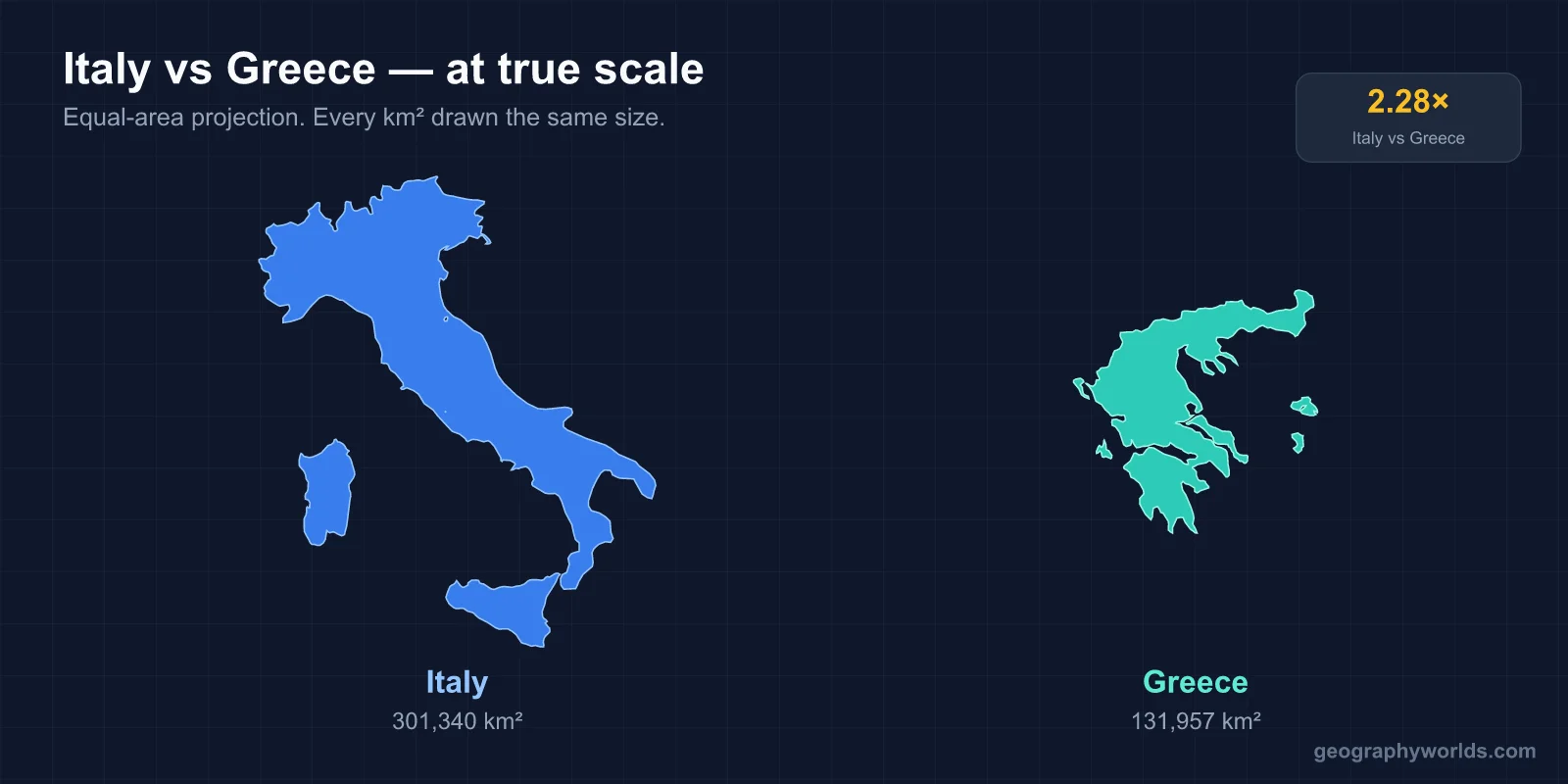
At 301,340 km², Italy covers roughly 2.3 times the area of Greece, which spans 131,957 km². The shape of that land tells much of the story. Italy is the unmistakable boot-shaped peninsula reaching into the central Mediterranean, walled off from the rest of Europe by the Alps in the north and threaded down its length by the Apennines, its central spine. Greece, by contrast, is a fragmented country: a mountainous mainland trailing off into roughly 6,000 islands and islets scattered across the Aegean and Ionian seas. Both are firmly part of Southern Europe, but Greece looks east toward Turkey and the Balkans, sharing land borders with Albania, North Macedonia, Bulgaria, and Turkey, while Italy's frontier runs north along France, Switzerland, Austria, and Slovenia, and even wraps around the two tiny enclaves of San Marino and Vatican City.
Population & Demographics
| Metric | Greece 🇬🇷 | Italy 🇮🇹 |
|---|---|---|
| Population | 9.9 million | 58.9 million |
| Population Density | 75.0 per km² | 195.5 per km² |
The population gap is wider than the difference in land area. Italy is home to 58.9 million people, about six times the 9.9 million who live in Greece. Because Italy packs far more people into a country only a little over twice the size, it is also much more crowded: 195.5 people per km² against 75.0 per km² in Greece, a gap of roughly 120.5 people per km². In practice that means Italy's cities and plains, especially the heavily settled Po Valley in the north, hold dense populations, while in Greece a large share of the land is mountainous or made up of small islands where relatively few people live.
Capital Cities
Each country's capital is also its largest and most historically loaded city. Athens anchors Greece, a metropolis still crowned by the Acropolis and counted among the oldest continuously inhabited cities in the world. Rome serves the same role for Italy, the former heart of an empire and now home to the Vatican within its limits. Both sit in the Southern Europe region, and both function as the political, economic, and cultural centres of their nations.
Language, Currency & Culture
| Aspect | Greece 🇬🇷 | Italy 🇮🇹 |
|---|---|---|
| Languages | Greek (official) | Italian (official) |
| Currency | Euro (EUR) | Euro (EUR) |
On money, the two countries are identical: both Greece and Italy use the Euro (EUR), so a traveller crossing between them never has to change currency. Language is where they diverge. Greek (official) is the language of Greece and uses its own distinctive alphabet, while Italy speaks Italian (official), a Romance language descended from Latin. Both tongues have ancient roots that run straight back to the classical civilizations these countries are known for, but they belong to entirely different branches of the European language family.
Climate & Natural Features
| Aspect | Greece 🇬🇷 | Italy 🇮🇹 |
|---|---|---|
| Climate | Mediterranean; mild, wet winters and hot, dry summers | Mediterranean in south, alpine in far north |
| Key Features | Mount Olympus, Greek islands, Peloponnese, Aegean Sea | Alps, Amalfi Coast, Mount Vesuvius, Dolomites, Po Valley |
| Economy | tourism, shipping, agriculture, services | manufacturing, fashion, tourism, agriculture, automotive |
Greece enjoys a thoroughly Mediterranean climate, with mild, wet winters and hot, dry summers that suit the olive groves and beach resorts it is famous for. Italy shares that warmth across most of the country but is more varied: Mediterranean in south, alpine in far north, so a Sicilian summer and a winter in the high Alps can feel like different worlds within the same borders. The landmarks follow the terrain. Greece's defining features run along its mainland and seas, Mount Olympus, the Greek islands, the Peloponnese, and the Aegean Sea, while Italy's range from the Alps and the Dolomites in the north down through the Po Valley to Mount Vesuvius and the cliffs of the Amalfi Coast. Their economies reflect these settings, too. Greece leans on tourism, shipping, agriculture, and services, with one of the world's largest merchant fleets, whereas Italy combines manufacturing, fashion, tourism, agriculture, and automotive production into one of Europe's larger industrial economies.
What Makes Each Country Unique
Greece is internationally renowned for ancient democracy, the Acropolis, Mediterranean islands, mythology, and olive oil. Greece has more archaeological museums than any other country and is considered the birthplace of Western civilization, democracy, and the Olympic Games.
Italy is best known for the Roman Colosseum, Renaissance art, pasta and pizza, and having more UNESCO World Heritage Sites than any country. Italy has more UNESCO World Heritage Sites (59) than any other country in the world, reflecting its extraordinary cultural legacy.
Key Differences at a Glance
- Area: Greece (131,957 km²) vs Italy (301,340 km²) — Italy is 2.3x larger
- Population: Greece (9.9 million) vs Italy (58.9 million) — Italy is 6.0x more populous
- Capitals: Athens vs Rome
- Currency: Euro (EUR) vs Euro (EUR)
- Continents: Europe vs Europe
- Density: Italy is more densely populated (difference of ~120.5 people per km²)
- Languages: Greek (official) vs Italian (official)
Verdict
Greece and Italy are two of the Mediterranean's oldest civilizations, and comparing them shows how unevenly size and population can track. Italy holds the larger land area, about 2.3 times that of Greece, but its lead in population is far steeper at 6.0 times, which is why its 195.5 people per km² so far outpaces the 75.0 per km² spread thinly across the Greek mainland and islands.
Geographically, Greece is the country of the sea, its identity built around the Aegean, the islands, and peaks like Mount Olympus under a classic Mediterranean climate of mild, wet winters and hot, dry summers. Italy stretches across more climate zones, Mediterranean in south, alpine in far north, and its landscape runs from the Alps down to a long, varied peninsula. Their economies sort along the same lines, with Greece relying heavily on tourism and shipping while Italy adds large-scale manufacturing, fashion, and automotive industry to a comparable tourism draw.
Neither country is simply a bigger or smaller version of the other. Each rewards a closer look, and seeing them side by side, share a currency and a region yet differ sharply in scale and terrain, makes both easier to understand and a richer picture of how varied even neighbouring countries can be.
Test Your Knowledge!
Think you know your countries? Try our interactive geography quiz!
Play Geography Games →