
Introduction
Greece 🇬🇷 and Turkey 🇹🇷 sit on opposite shores of the Aegean Sea, close enough that on a clear day you can see one country from the other. Their histories are deeply intertwined, yet they belong to different worlds in size and scale. This comparison walks through how the two differ in land area, population, capitals, climate, and the landmarks that define each one.
Whether you are studying for a geography class, mapping out a Mediterranean trip, or just curious how these old rivals measure up, the facts and figures below lay it out side by side.
Size & Geography
| Feature | Greece 🇬🇷 | Turkey 🇹🇷 |
|---|---|---|
| Area | 131,957 km² | 783,562 km² |
| Continent | Europe | Asia |
| Region | Southern Europe | Middle East |
| Land Borders | Albania, North Macedonia, Bulgaria, Turkey | Greece, Bulgaria, Georgia, Armenia, Iran, Iraq, Syria |
| Landscape | mountainous mainland; 6,000 islands and islets | high central plateau (Anatolia), narrow coastal plain |
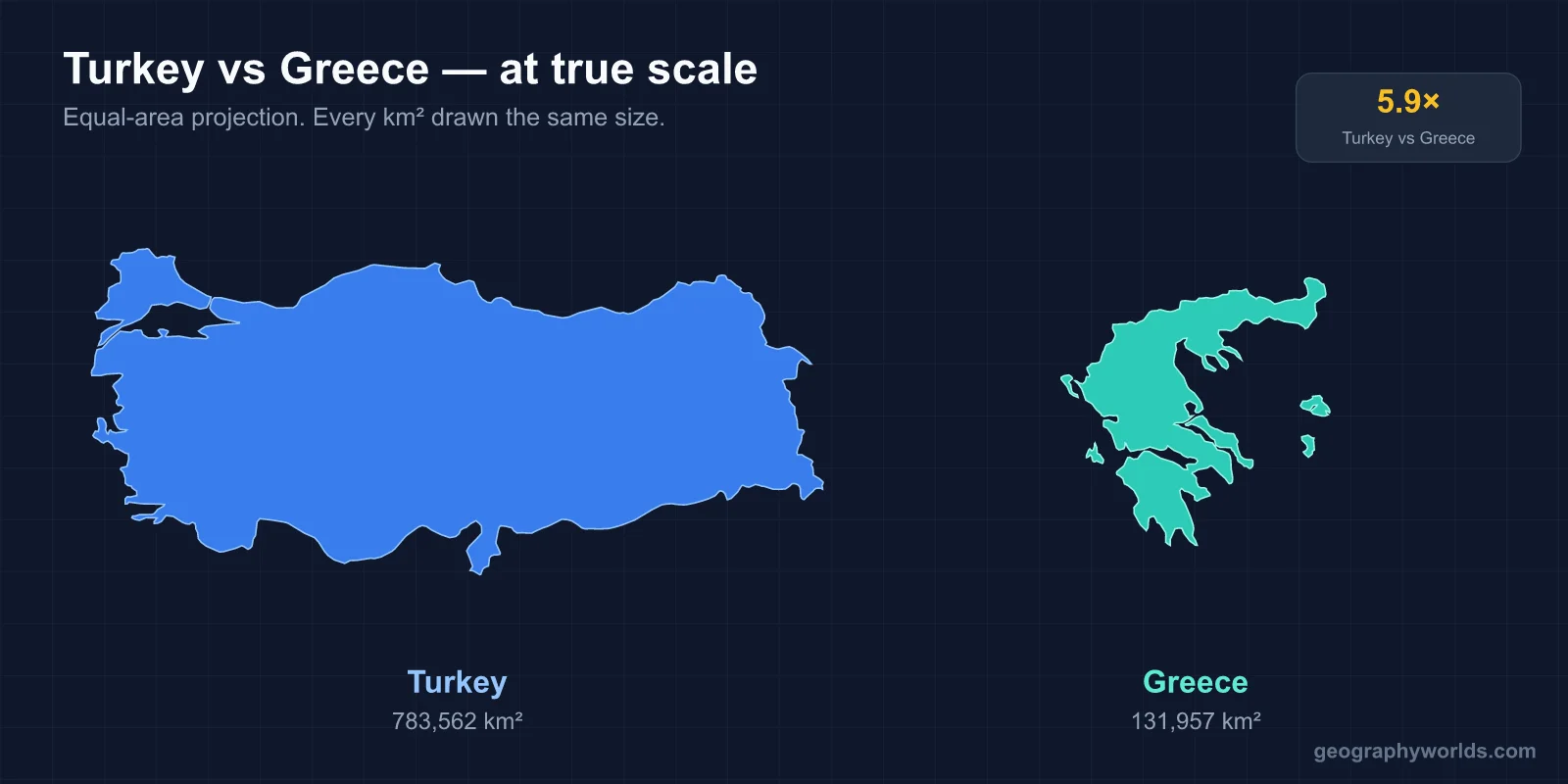
Turkey dwarfs Greece on the map, covering 783,562 km² to Greece's 131,957 km² — roughly 5.9 times the land. The contrast goes beyond size to shape. Greece is famously fragmented, a mountainous mainland scattered with some 6,000 islands and islets across the Aegean and Ionian seas, which gives it one of the longest coastlines in Europe relative to its area. Turkey, by comparison, is dominated by the high Anatolian plateau ringed by a narrow coastal plain. The two share a land border, and the table shows how differently they are positioned: Greece looks west and north into the Balkans, while Turkey fans out across seven neighbors stretching toward the Caucasus and the Middle East.
Population & Demographics
| Metric | Greece 🇬🇷 | Turkey 🇹🇷 |
|---|---|---|
| Population | 9.9 million | 87.9 million |
| Population Density | 75.0 per km² | 112.2 per km² |
The population gap is even wider than the size gap. Turkey is home to 87.9 million people against Greece's 9.9 million — close to nine times as many. Turkey is also the more crowded of the two on average, at 112.2 people per km² versus 75.0 in Greece, a difference of about 37.2 people per km². That said, neither figure tells the whole story: in Greece, the population clusters heavily around Athens and Thessaloniki and along the coasts, leaving large stretches of mountain and many small islands very sparsely settled.
Capital Cities
Athens has anchored Greek civic life for thousands of years and remains the country's capital and largest city, sitting in Europe. Ankara, Turkey's capital, lies inland on the Anatolian plateau in Asia. It is worth noting that Ankara is not Turkey's best-known city — that distinction belongs to Istanbul — but it has served as the political center since the founding of the modern republic.
Language, Currency & Culture
| Aspect | Greece 🇬🇷 | Turkey 🇹🇷 |
|---|---|---|
| Languages | Greek (official) | Turkish (official), Kurdish |
| Currency | Euro (EUR) | Turkish Lira (TRY) |
Language is one of the clearest dividing lines. Greek, with its own distinctive alphabet, is the official language of Greece, while Turkish is official in Turkey, alongside Kurdish spoken by a sizeable minority. The currencies point to a deeper divergence: Greece adopted the Euro as a member of the European Union, tying its economy to the wider eurozone, whereas Turkey retains its own Turkish Lira. Each language and tradition carries centuries of layered history shaped by empire, religion, and trade across this corner of the Mediterranean.
Climate & Natural Features
| Aspect | Greece 🇬🇷 | Turkey 🇹🇷 |
|---|---|---|
| Climate | Mediterranean; mild, wet winters and hot, dry summers | temperate; hot summers, mild winters; harsher in interior |
| Key Features | Mount Olympus, Greek islands, Peloponnese, Aegean Sea | Cappadocia, Bosphorus Strait, Mount Ararat, Pamukkale |
| Economy | tourism, shipping, agriculture, services | automotive, textiles, agriculture, tourism |
Both countries enjoy warm summers, but the interior of Turkey swings to greater extremes. Greece has a classic Mediterranean climate of mild, wet winters and hot, dry summers, the kind of weather that built its reputation as a summer destination around Mount Olympus, the Peloponnese, and the islands of the Aegean. Turkey is broadly temperate along its coasts, with hot summers and mild winters, but conditions turn harsher across the Anatolian interior — and its standout sights run from the rock formations of Cappadocia and the terraces of Pamukkale to the Bosphorus Strait and Mount Ararat. The economies overlap on tourism and farming, though Greece leans heavily on shipping while Turkey has built large automotive and textile industries.
What Makes Each Country Unique
Greece is widely regarded as the birthplace of Western civilization, democracy, and the Olympic Games. Its draw is hard to overstate: the Acropolis, a mythology that still echoes through Western culture, sun-soaked islands, and an olive-oil tradition stretching back millennia. The country is said to have more archaeological museums than any other.
Turkey is the rare nation with one foot in Europe and one in Asia. Istanbul is the only city in the world that spans two continents, split by the Bosphorus Strait, and the country pairs that geographic distinction with treasures like the Hagia Sophia, the hot-air balloons drifting over Cappadocia, and one of the world's most celebrated cuisines.
Key Differences at a Glance
- Area: Greece (131,957 km²) vs Turkey (783,562 km²) — Turkey is 5.9x larger
- Population: Greece (9.9 million) vs Turkey (87.9 million) — Turkey is 8.9x more populous
- Capitals: Athens vs Ankara
- Currency: Euro (EUR) vs Turkish Lira (TRY)
- Continents: Europe vs Asia
- Density: Turkey is more densely populated (difference of ~37.2 people per km²)
- Languages: Greek (official) vs Turkish (official)
Verdict
Greece and Turkey are Aegean neighbors bound by ancient ties, yet they sit at very different scales. Turkey holds the upper hand on both fronts the table measures — 5.9 times the land area and 8.9 times the population — which is a useful reminder that here, unlike many country pairings, the larger country is also the more populous one.
What sets them apart is character. Greece is defined by its Mediterranean climate and a constellation of islands gathered around landmarks like Mount Olympus, while Turkey stretches across the temperate, sometimes severe Anatolian interior, with showpieces such as Cappadocia. Their economies tell a parallel story: Greece earns much of its keep from tourism and shipping, while Turkey leans on automotive and textile manufacturing.
Together they make one of the most rewarding comparisons in the region — two countries whose shared seas and tangled history only sharpen how distinct each one really is.
Test Your Knowledge!
Think you know your countries? Try our interactive geography quiz!
Play Geography Games →