
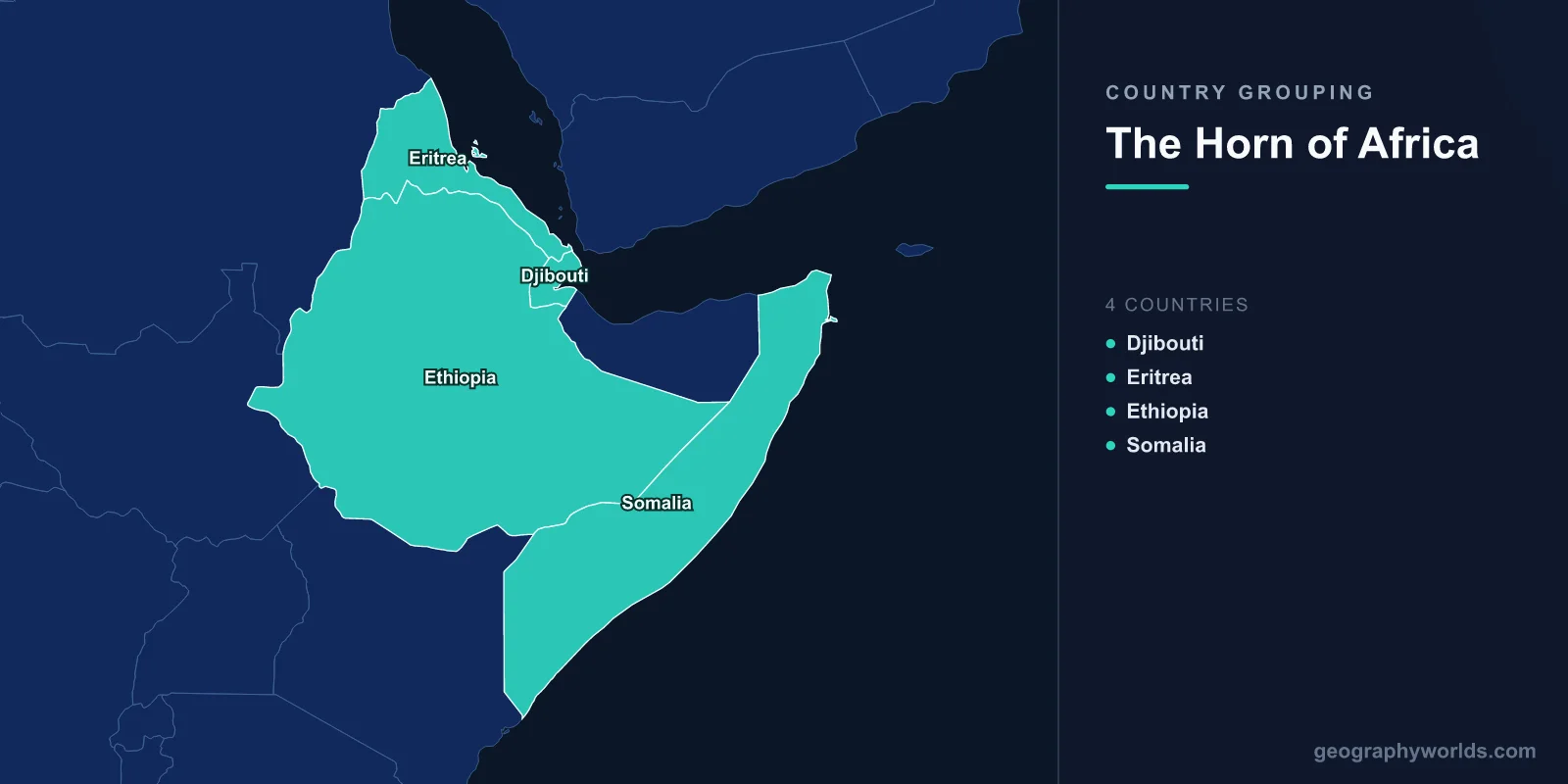
Introduction to The Horn of Africa
The Horn of Africa is a striking peninsula in eastern Africa that juts out into the Indian Ocean and the Gulf of Aden, forming the continent's easternmost point. Named for its horn-like shape on the map, this region encompasses four countries — Djibouti, Eritrea, Ethiopia, and Somalia — with a combined population of over 130 million people. The Horn is one of the most culturally and linguistically diverse regions on Earth, home to dozens of ethnic groups speaking over 100 languages across Semitic, Cushitic, and Nilotic families. It is also one of the oldest continuously inhabited regions, with Ethiopia's archaeological sites yielding some of the earliest evidence of human ancestors. Despite its immense historical and cultural wealth, the Horn has been marked by conflict, famine, and political instability, though it is also a region of remarkable resilience and strategic global importance.

Countries in The Horn of Africa
- Djibouti
- Eritrea
- Ethiopia
- Somalia
Location: Eastern Africa, the peninsula jutting into the Arabian Sea and Gulf of Aden
Shared Characteristics: Ancient civilizations, strategic location on global shipping lanes, diverse ethnicities
History
The Horn of Africa holds some of humanity's oldest civilizations. The ancient Kingdom of Aksum (modern Ethiopia and Eritrea), which flourished from the 1st to 7th centuries CE, was one of the great powers of the ancient world, trading with Rome, Persia, and India. Ethiopia is unique in Africa for never being colonized by a European power (though Italy briefly occupied it from 1936-1941), and its dynasty claimed descent from King Solomon and the Queen of Sheba. Somalia's coastal cities were major hubs of Indian Ocean trade for centuries. The colonial era saw Italy take Eritrea and part of Somalia, France take Djibouti, and Britain control northern Somalia. Ethiopia's Emperor Haile Selassie became a global figure and symbol of African independence. The latter 20th century brought revolution and upheaval: Ethiopia's Derg military regime, the devastating famines of the 1980s, the Eritrean war of independence (achieved in 1993), and Somalia's descent into civil war and state collapse after 1991.
Geography & Climate
The Horn of Africa's geography is spectacularly varied. Ethiopia's highlands, often called the "Roof of Africa," include peaks over 4,500 meters and the source of the Blue Nile, which provides most of the water reaching Egypt's Nile River. The Great Rift Valley cuts through Ethiopia, creating dramatic escarpments, volcanic lakes, and the Danakil Depression — one of the hottest and lowest places on Earth, with colorful sulfur springs and salt flats. Eritrea's terrain descends from highlands to a long Red Sea coastline with pristine coral reefs. Somalia has the longest coastline in mainland Africa at over 3,000 km, bordered by semi-arid plains and the Jubba and Shabelle rivers. Djibouti, the smallest country in the Horn, features a dramatic landscape of salt lakes (Lake Assal is Africa's lowest point), volcanic formations, and the strategic Bab-el-Mandeb strait through which roughly 30% of global shipping passes.
Culture & Society
The Horn of Africa's cultures are extraordinarily diverse. Ethiopia alone has over 80 ethnic groups, with the Oromo, Amhara, and Tigray being the largest. Ethiopian Orthodox Christianity, one of the world's oldest Christian traditions, has shaped the country's art, music, calendar (which is seven years behind the Gregorian calendar), and cuisine. Ethiopian coffee ceremonies are elaborate social rituals reflecting the beverage's origins — coffee was discovered in Ethiopia's Kaffa region. Somali culture is centered on pastoral nomadism, oral poetry (Somalia is known as a "Nation of Poets"), and clan-based social structures. Eritrea's nine ethnic groups each maintain distinct traditions, from the Tigrinya highland farmers to the Afar and Rashida nomads. Islam is the predominant religion in Somalia, Djibouti, and Eritrea's lowlands, while Christianity dominates in the Ethiopian and Eritrean highlands. The region's cuisine features injera (a spongy sourdough flatbread) as its centerpiece, particularly in Ethiopia and Eritrea.
Economy
The Horn of Africa's economies face significant challenges but also hold considerable potential. Ethiopia has been one of Africa's fastest-growing economies, with major investments in manufacturing, infrastructure (including the Grand Ethiopian Renaissance Dam on the Nile), and the development of industrial parks. Djibouti's economy is built on its strategic location, hosting military bases for the United States, China, France, and Japan, along with a major port that handles most of landlocked Ethiopia's trade. Somalia's economy is largely informal, driven by livestock exports, remittances from the large diaspora, and a remarkably innovative mobile money system. Eritrea's economy remains heavily controlled by the state, with mining showing potential for growth. The region faces common challenges including food insecurity, climate vulnerability, and the need for economic diversification.
The Region Today
The Horn of Africa remains one of the world's most strategically important and volatile regions. Ethiopia's internal conflicts, particularly in the Tigray region, have caused humanitarian crises and strained the country's development trajectory. Somalia continues its long struggle toward stability, with the federal government gradually extending authority but still facing threats from the al-Shabaab militant group. Djibouti has leveraged its location to become a hub of international military presence and logistics. Eritrea remains one of the world's most isolated and authoritarian states. Climate change is intensifying droughts and threatening the livelihoods of millions of pastoralists. Yet the region's young population, growing connectivity, and strategic importance ensure it will play an increasingly significant role in global affairs.
Interesting Facts About The Horn of Africa
- Ethiopia uses its own calendar that is roughly 7 years behind the Gregorian calendar — it celebrated the millennium in 2007
- Coffee was discovered in Ethiopia, and the country's coffee ceremony is an elaborate social ritual
- Djibouti hosts military bases from the US, China, France, Japan, and Italy, more than almost any other country
- Somalia has the longest coastline in mainland Africa, stretching over 3,000 kilometers
- Ethiopia's Danakil Depression is one of the hottest places on Earth, with temperatures regularly exceeding 50 degrees Celsius
- The ancient Kingdom of Aksum in modern Ethiopia was one of the four great powers of the ancient world
Conclusion
The Horn of Africa (Djibouti, Eritrea, Ethiopia, Somalia) represent a fascinating regional grouping with shared history, cultural ties, and common challenges. Whether you're studying world geography, planning travel, or simply curious about how the world's nations connect, understanding these regional groupings provides valuable context for making sense of our complex and interconnected world.