
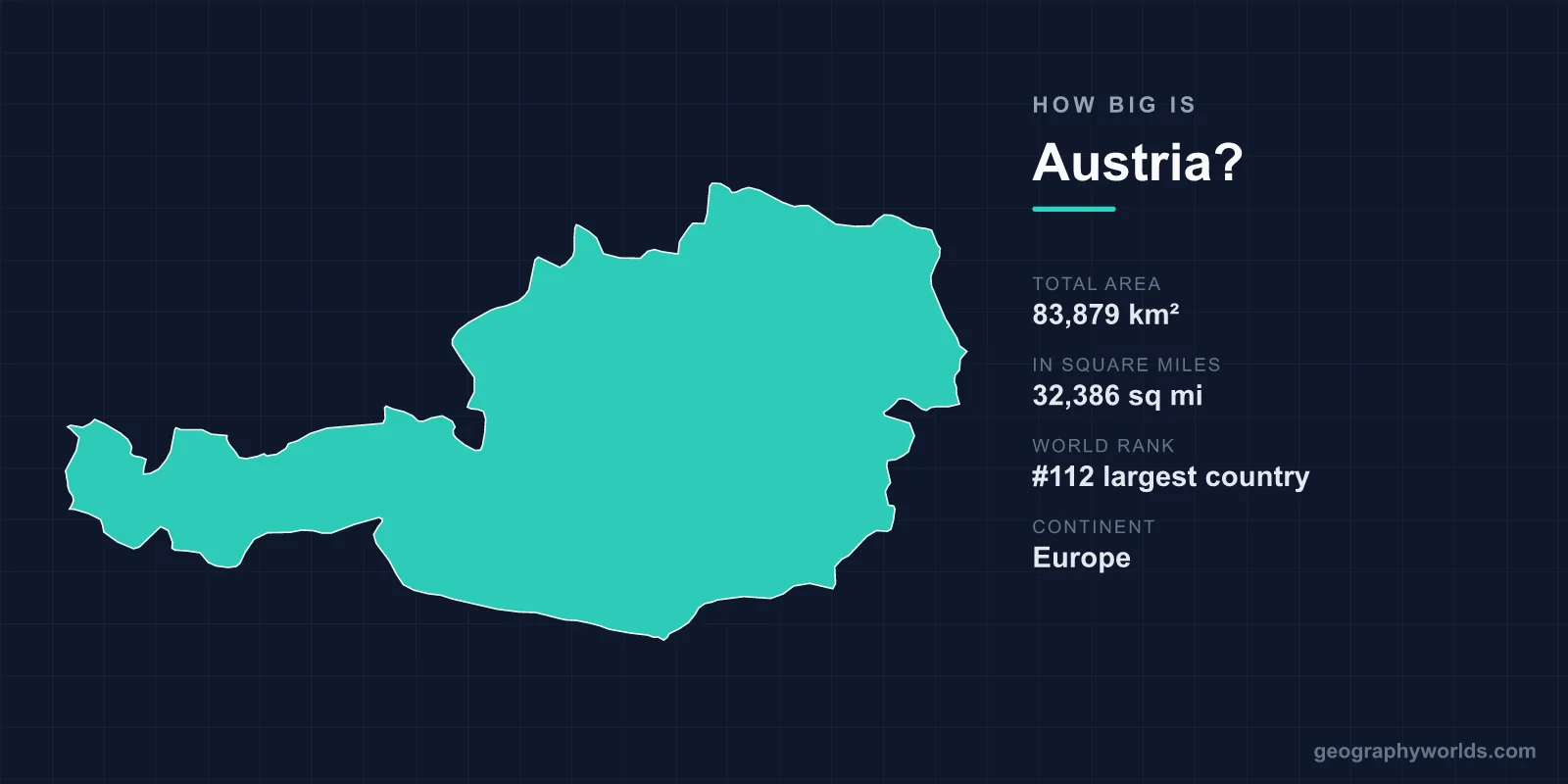
Austria covers a total area of 83,879 km² (32,386 sq mi), making it the 112th largest country in the world — roughly the same size as the US state of South Carolina. It is a compact, landlocked nation in the heart of Central Europe, but its modest footprint packs in some of the continent's most dramatic Alpine scenery.
Austria's Total Area in Numbers
At 83,879 square kilometres, Austria accounts for only about 0.06% of the Earth's total land area of roughly 148.94 million km². Despite ranking 112th globally by size, it is far from a small player in European affairs — its central location has long made it a crossroads for trade, culture, and politics.
- Total area: 83,879 km² (32,386 sq mi)
- World rank: 112th largest country
- Continent: Europe (Central Europe)
- Capital: Vienna
- Coastline: None — Austria is landlocked
The country measures roughly 575 km from east to west but only about 294 km from north to south, giving it an elongated shape that narrows sharply toward its western Alpine provinces of Tyrol and Vorarlberg.
A Land Dominated by Mountains
What makes Austria distinctive is not how large it is, but how much of it stands on end. Roughly 62% of the national territory is covered by the Alps, making Austria one of the most mountainous countries in Europe. This means that while the total area is modest, much of it consists of steep valleys, high passes, and snow-capped peaks rather than flat, easily settled plains.
The highest point is the Grossglockner, rising to 3,798 m (12,461 ft) — the tallest mountain in the country and one of the most prominent in the entire Alpine range. The Pasterze, which spills from its slopes, is the longest glacier in the Eastern Alps. Because so much land is mountainous, the bulk of Austria's population is concentrated in the lower-lying east, especially the Danube Valley, the Vienna Basin, and the rolling country of Lower Austria and Burgenland.
How Austria Compares to Other Places
Size comparisons make Austria's scale easier to picture. It is almost identical in area to South Carolina, and a little larger than the US state of Maine. Within Europe, it is roughly twice the size of Switzerland and slightly larger than the Czech Republic.
- Compared to the United Kingdom (243,610 km²), Austria is about 34% of its size.
- Compared to South Korea (100,210 km²), Austria is about 84% as large.
- Compared to neighbouring Germany (357,022 km²), Austria is roughly one-quarter the size.
For all its compactness, Austria shares borders with eight different countries — Germany, the Czech Republic, Slovakia, Hungary, Slovenia, Italy, Switzerland, and Liechtenstein — one of the highest neighbour counts in Europe. That dense web of frontiers reflects its position at the meeting point of Germanic, Slavic, and Mediterranean Europe. You can explore more of these facts in our austria country guide.
Terrain, Rivers, and Climate
Austria's landscape divides into a few clear zones. The west and south are firmly Alpine; the north-east opens into the Danube basin; and the far east flattens toward the Pannonian Plain shared with Hungary. The Danube River flows about 350 km across the country, threading through Vienna and the UNESCO-listed Wachau Valley before continuing on a journey that links ten nations in total.
The climate is temperate and continental, turning distinctly Alpine at altitude. Winters bring cold temperatures and heavy snowfall to the mountains — a foundation for Austria's world-famous ski industry — while the eastern lowlands enjoy warmer, drier summers. Scenic highlights packed into this small territory include the Salzkammergut lake district, with more than 70 lakes, the fairy-tale village of Hallstatt and its 7,000-year-old salt mine, and the Grossglockner High Alpine Road, a panoramic mountain route climbing to 2,504 m.
Frequently Asked Questions
Is Austria a big or small country?
Austria is a relatively small country, ranking 112th in the world by area at 83,879 km². It is comparable in size to South Carolina or Maine and is considerably smaller than most of its larger neighbours, such as Germany.
How does Austria's size compare to Switzerland?
Austria is roughly twice the size of Switzerland. Both are heavily Alpine, landlocked nations, but Austria's larger eastern lowlands give it more flat, settled terrain along the Danube.
What US state is closest to Austria in size?
South Carolina is the closest match. At about 82,933 km², it is almost identical to Austria's 83,879 km², making it a useful reference point for American readers.
Does Austria have a coastline?
No. Austria is completely landlocked, bordered by eight countries with no access to the sea. Its "waterways" are inland — chiefly the Danube River and its many Alpine lakes.
