
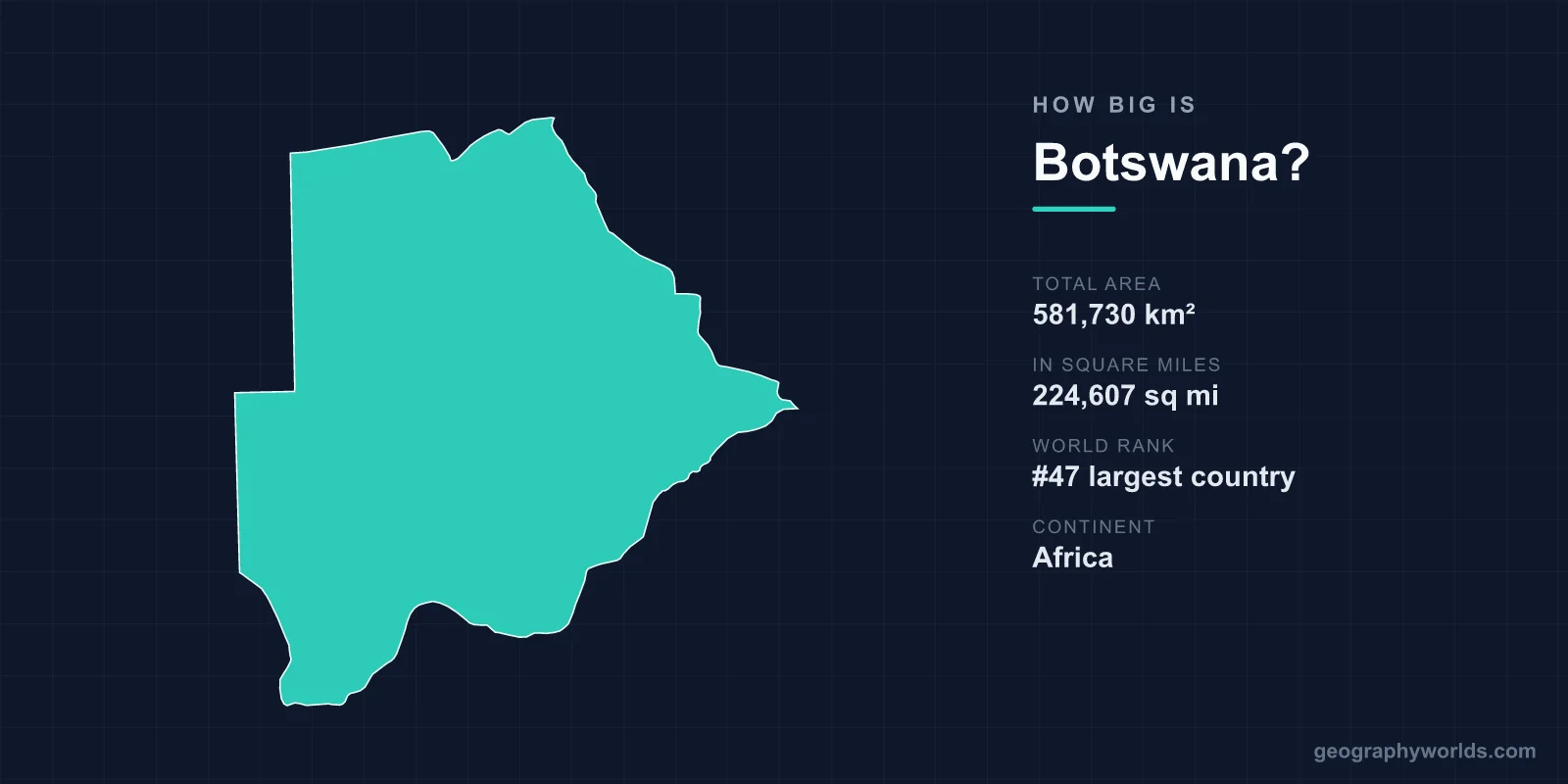
Botswana covers a total area of 581,730 km² (224,607 sq mi), making it the 47th largest country in the world — just slightly smaller than the U.S. state of Texas. This landlocked southern African nation accounts for roughly 0.39% of the Earth's total land area, yet it packs in some of the continent's most extraordinary landscapes, from the parched Kalahari to the flooded channels of the Okavango Delta.
Botswana's Size in Numbers
At 581,730 km², Botswana ranks 47th globally by land area, sitting comfortably in the upper-middle tier of the world's nearly 200 countries. The figure breaks down like this:
- Total area: 581,730 km² (224,607 sq mi)
- World rank: 47th largest country
- Continent: Africa
- Coastline: None — Botswana is landlocked
- Capital: Gaborone
- Share of world land: approximately 0.39%
Despite this generous footprint, Botswana is one of the most sparsely populated countries on Earth. With a population of roughly 2.4 million people spread across more than half a million square kilometres, vast stretches of the interior remain almost entirely uninhabited — a direct consequence of the arid terrain that dominates the country.
Geographic Dimensions and Terrain
Botswana is remarkably compact in shape, stretching about 900 km from north to south and a similar 900 km from east to west. This near-square outline gives it a more balanced spread than long, narrow countries of comparable area.
The land itself is overwhelmingly flat. Botswana sits on a high plateau, and gentle, rolling terrain characterises most of the country. The Kalahari Desert blankets around 70% of the national territory, a semi-arid expanse of sand and scrub that defines daily life across much of the interior. The highest point, Monalanong Hill, reaches just 1,494 m (4,902 ft) — modest by continental standards and a reminder that Botswana lacks the dramatic mountain ranges found elsewhere in Africa.
How Botswana Compares to Other Places
Size is easiest to grasp through comparison, and Botswana lends itself to several memorable ones:
- Texas: Botswana is slightly smaller than the Lone Star State (which spans about 695,000 km²).
- France: At 581,730 km², Botswana is roughly 91% the size of mainland France (640,679 km²).
- Japan: Botswana is considerably larger — about 154% the area of Japan (377,975 km²).
- Kenya: The two countries are close in size, with Botswana coming in just slightly smaller.
Among its immediate neighbours, Botswana is smaller than South Africa and Namibia but larger than Zimbabwe, placing it firmly in the middle of the southern African pack. For more context on the country, see the botswana country guide.
Major Geographic Features
What Botswana lacks in elevation it more than makes up for in distinctive landscapes. The northwest is home to the Okavango Delta, the world's largest inland delta and a UNESCO World Heritage Site. Each year the Okavango River fans out across the desert, flooding up to 15,000 km² of land and creating a lush oasis in the middle of the Kalahari — remarkably, the river never reaches the sea, instead evaporating and seeping into the sands.
To the northeast lie the Makgadikgadi Pans, among the largest salt flats on the planet and the remnant of a prehistoric super-lake that was once larger than Switzerland. The country also contains Chobe National Park, famous for hosting one of Africa's densest elephant populations, and the Tsodilo Hills, a second UNESCO site whose rock faces hold thousands of ancient paintings.
Botswana's climate is semi-arid, with hot summers and cool, dry winters. Rainfall is unreliable and concentrated between November and March, while Kalahari temperatures swing from near-freezing winter nights to highs above 40°C in summer.
Land Use and Conservation
One of the most striking facts about Botswana's territory is how much of it is set aside for wildlife. Nearly 40% of the country is devoted to national parks, game reserves, and protected wildlife management areas — one of the highest proportions of conservation land anywhere in the world. This vast network underpins Botswana's reputation as a premier safari destination and helps explain why so much of its large landmass remains wild and undeveloped.
Frequently Asked Questions
Is Botswana bigger than Texas?
No. Botswana covers 581,730 km², which makes it slightly smaller than the U.S. state of Texas (about 695,000 km²). The two are close enough that Texas is a popular point of comparison.
Where does Botswana rank in size?
Botswana is the 47th largest country in the world by total area, and one of the larger nations in southern Africa, though smaller than neighbouring South Africa and Namibia.
Does Botswana have a coastline?
No. Botswana is landlocked, sharing borders with South Africa, Namibia, Zimbabwe, and Zambia. It has no access to the ocean.
How much of Botswana is desert?
The Kalahari Desert covers roughly 70% of Botswana's land area. Despite its name, the Kalahari receives enough seasonal rain to support grasses and scattered trees, so it is technically a semi-desert rather than a true desert.
