
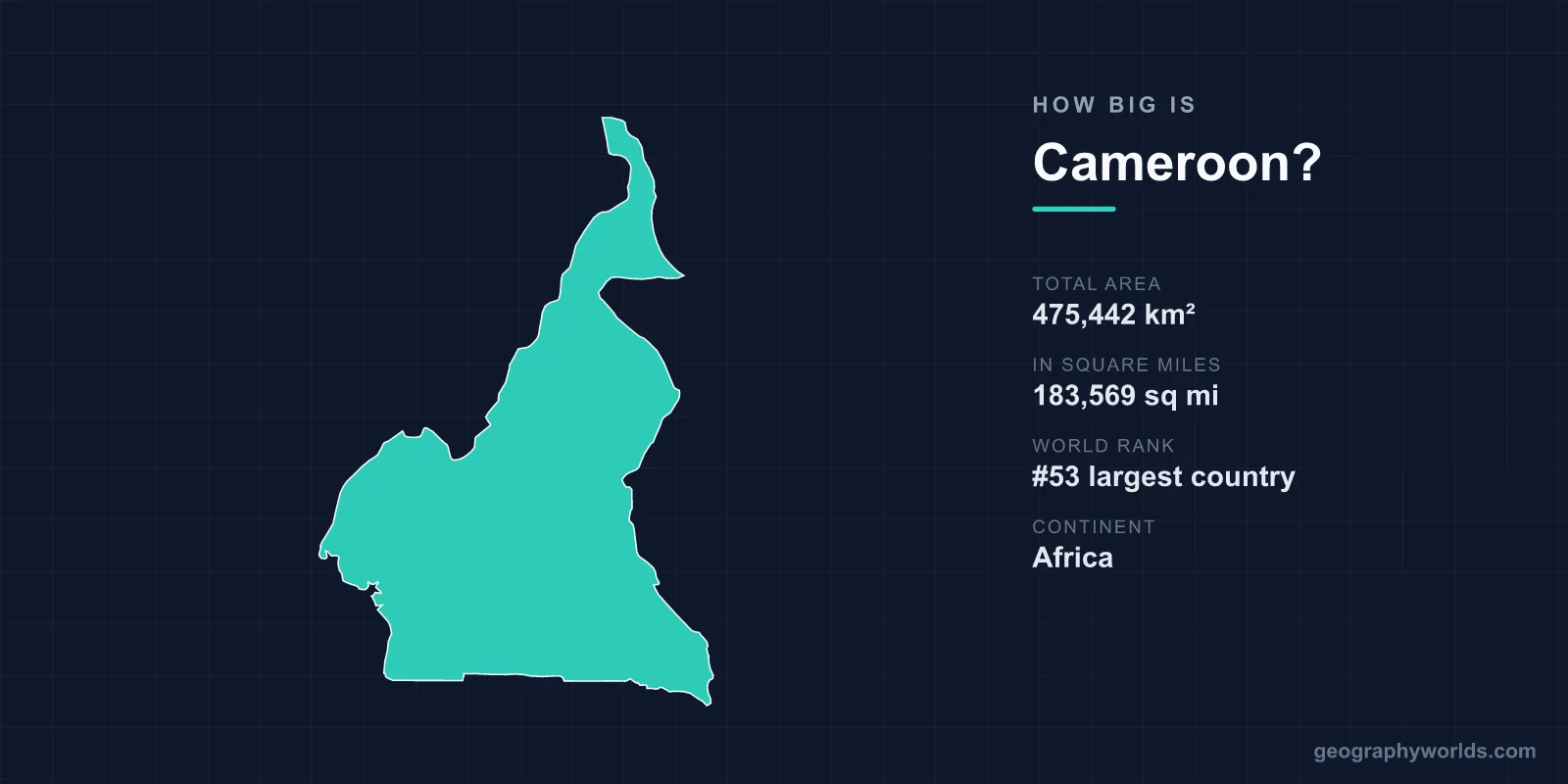
Cameroon covers a total area of 475,442 km² (183,569 sq mi), making it the 53rd largest country in the world — roughly the size of California, or about three-quarters the area of France. Located in Central Africa where the continent's western bulge meets its central mass, Cameroon packs an astonishing variety of landscapes into a country that ranks just outside the world's 50 largest nations.
Cameroon's Area in Numbers
Cameroon's 475,442 square kilometres represent about 0.32% of the Earth's total land area of roughly 148.94 million km². Of that total, the overwhelming majority is land, with a relatively small share given over to lakes and rivers. Here is the size at a glance:
- Total area: 475,442 km² (183,569 sq mi)
- World rank: 53rd largest country
- Continent: Africa (Central Africa)
- Capital: Yaoundé
- Coastline: 402 km along the Gulf of Guinea
- Highest point: Mount Cameroon, 4,040 m (13,255 ft)
Shaped a little like an elongated triangle, the country stretches roughly 1,200 km from north to south and about 800 km from east to west. That north–south span is what allows Cameroon to cross so many climate zones, from steamy equatorial rainforest near the Atlantic to dry Sahel scrubland on the shores of Lake Chad.
How Cameroon Compares to Other Places
Comparisons make the figure easier to picture. Cameroon is slightly larger than the US state of California (423,970 km²) and is close in size to Sweden or Spain. Set against its former colonial powers, Cameroon is about 74% the area of France (640,679 km²) and considerably larger than the United Kingdom or the combined Benelux countries.
Within Africa, Cameroon sits in the middle of the pack — far smaller than giants like Algeria, the Democratic Republic of the Congo, or its neighbour Chad, yet larger than nearby countries such as Gabon, Ghana, or Côte d'Ivoire. Compared with Japan (377,975 km²), Cameroon is about 26% larger. For a deeper dive into the country's regions, people, and travel highlights, see our cameroon country guide.
"Africa in Miniature"
Cameroon is often nicknamed "Africa in miniature" because, despite its modest world ranking, it contains nearly every major African landscape and climate within a single set of borders. In a journey from the coast to the far north you pass through tropical mangrove swamps, dense equatorial forest, volcanic mountains, grassy highland plateaus, wooded savanna, and finally the semi-arid Sahel.
This diversity is squeezed into a compact footprint. The southwestern coast around Mount Cameroon is one of the wettest places on Earth — the village of Debundscha receives over 10,000 mm of rain a year — while the far northern town of Maroua bakes in dry, dusty heat. Few countries pack such climatic extremes into 475,000 km².
Borders, Coastline, and Terrain
Cameroon shares land borders with six countries: Nigeria to the west, Chad to the northeast, the Central African Republic to the east, and the Republic of the Congo, Gabon, and Equatorial Guinea to the south. Its 402 km Atlantic coastline opens onto the Gulf of Guinea, giving the otherwise landlocked-feeling interior access to the sea through the major port of Douala.
The country's terrain rises from coastal lowlands to a central plateau and on to mountain ranges in the west. Mount Cameroon, at 4,040 m, is West Africa's highest peak and one of Africa's most active volcanoes, having last erupted in 2000. The volcanic Ring Road highlands and the Adamawa Plateau form the country's elevated spine, while flat savanna and the Lake Chad basin dominate the far north.
Why Cameroon's Size Matters
A medium-sized country geographically, Cameroon punches above its weight in biodiversity and cultural variety. Its territory holds around ten distinct ecological zones and protects wildlife strongholds such as Waza National Park, one of Central Africa's best places to see elephants, giraffes, and lions. The same north–south reach that delivers varied climates also produces a strikingly diverse population, with more than 250 ethnic groups and two official languages, English and French — a legacy of its colonial history under both Britain and France.
Frequently Asked Questions
What is the total area of Cameroon?
Cameroon has a total area of 475,442 km² (183,569 sq mi), which ranks it as the 53rd largest country in the world and places it among the mid-sized nations of Africa.
Is Cameroon bigger than California?
Yes, slightly. Cameroon's 475,442 km² is a little larger than California, which covers about 423,970 km². The two are close enough that California is the most common US-based comparison for Cameroon's size.
How does Cameroon's size compare to France?
Cameroon is about 74% the size of France. France covers roughly 640,679 km² to Cameroon's 475,442 km², so France is noticeably larger despite the historical colonial ties between the two countries.
What is the highest point in Cameroon?
The highest point is Mount Cameroon at 4,040 m (13,255 ft). It is the tallest peak in West Africa and an active volcano, famous for the annual Mount Cameroon Race of Hope that climbs and descends the mountain.
