
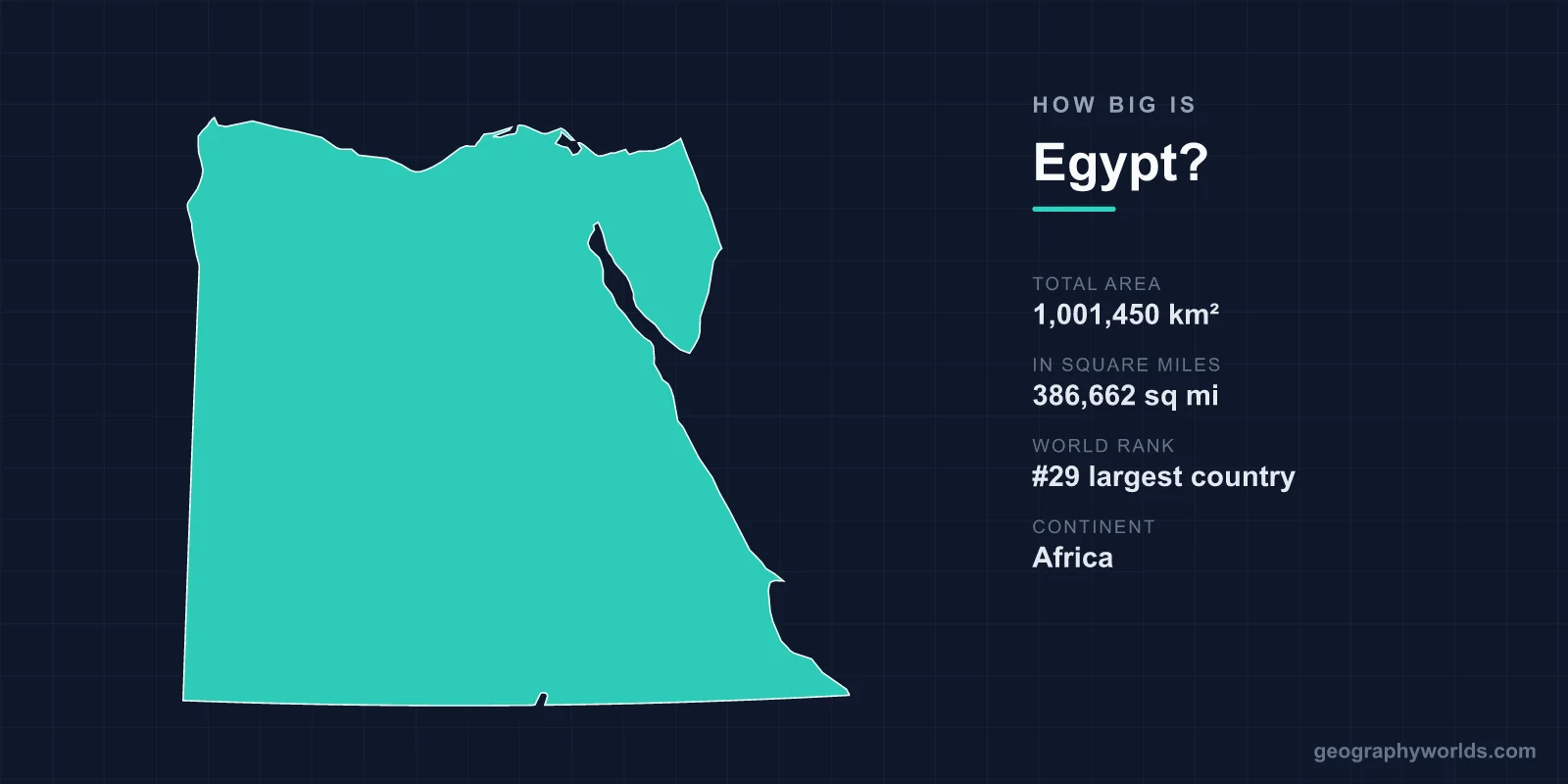
Egypt covers a total area of 1,001,450 km² (386,662 sq mi), making it the 29th largest country in the world — roughly the same size as France and Germany combined. That places Egypt among the largest nations on Earth, yet its true story is one of extreme contrast: a vast country where nearly all life crowds onto a thin green ribbon along the Nile.
Egypt's Area in Numbers
At just over one million square kilometres, Egypt accounts for about 0.67% of the Earth's total land surface of roughly 148.94 million km². It is the third-largest country in North Africa after Algeria and Libya, and the 13th largest in Africa overall. To translate the figure into everyday terms, Egypt's land area is equivalent to about 386,662 square miles.
- Total area: 1,001,450 km² (386,662 sq mi)
- World rank: 29th largest country
- Continent: Africa (with the Sinai Peninsula in Asia)
- Capital: Cairo
- Share of global land: approximately 0.67%
How Egypt's Size Compares
Comparisons make the scale easier to picture. Egypt is about 1.6 times larger than France (640,679 km²) and you could fit the United Kingdom inside it roughly four times over. It is close in size to France and Germany added together, and slightly larger than the U.S. states of Texas and California combined.
Despite ranking 29th globally, Egypt is dwarfed by its desert neighbours: Algeria, the largest country in Africa, is more than twice its size, and neighbouring Sudan and Libya are both larger too. What sets Egypt apart is not raw area but the concentration of its people and history into a tiny fraction of that land.
The Dimensions of the Land
Egypt stretches roughly 1,100 km from north to south and about 1,200 km from east to west, forming a broadly rectangular block in the northeastern corner of Africa. Its coastline runs some 2,450 km, split between the Mediterranean Sea to the north and the Red Sea to the east. The highest point is Mount Catherine (Gebel Katherina) in the Sinai, rising to 2,629 m (8,625 ft).
The terrain is dominated by desert. The Western (Libyan) Desert alone covers about two-thirds of the country, while the Eastern (Arabian) Desert occupies much of the land between the Nile and the Red Sea. The Sinai Peninsula, a rugged triangle of mountains and arid plateau, is the only part of Egypt that lies in Asia, making Egypt one of the few transcontinental nations.
A Big Country on a Thin Strip of Land
The most striking fact about Egypt's size is how little of it is actually used. Although the country spans more than a million square kilometres, only about 5–5.5% of that land is inhabited or cultivated. Around 95% of Egyptians live along the Nile River and across its Delta, clustering onto a green corridor that makes up roughly 5% of the national territory.
The Nile Delta, fanning out north of Cairo to the Mediterranean, is one of the world's largest river deltas at about 24,000 km². Beyond this fertile band, the desert receives almost no rainfall — Cairo averages under 25 mm a year — which is why the ancient Greek historian Herodotus famously called Egypt "the gift of the Nile." Without the river, the country would be little more than uninhabitable sand.
Landmarks That Define Egypt's Geography
Egypt's size encompasses some of the most recognisable places on the planet. The Giza Pyramids and the Great Sphinx sit on the desert edge just west of Cairo, the largest city in both Africa and the Arab world. The Great Pyramid of Giza is the last surviving structure of the Seven Wonders of the Ancient World.
Slicing through the isthmus between Africa and Asia, the Suez Canal links the Mediterranean and Red Seas and remains one of the busiest and most strategically vital shipping lanes on Earth. Other distinctive features include the surreal chalk pinnacles of the White Desert, the coral-rich Red Sea coast, and the lush oases scattered across the otherwise barren Western Desert. For more on the country's regions, climate, and culture, see our egypt country guide.
Frequently Asked Questions
Is Egypt bigger than France?
Yes. Egypt's area of 1,001,450 km² is roughly 1.6 times the size of France, which covers about 640,679 km². Egypt is closer in size to France and Germany combined.
What rank is Egypt by area in the world?
Egypt is the 29th largest country in the world by total area, and the 13th largest in Africa.
Why does so little of Egypt have people living in it?
Most of Egypt is harsh, near-rainless desert. About 95% of the population lives along the Nile River and in its Delta — only around 5% of the land — because the river provides the only reliable water for farming and settlement.
Is Egypt in Africa or Asia?
Egypt is primarily in northeastern Africa, but the Sinai Peninsula east of the Suez Canal lies in Asia, making Egypt a transcontinental country that bridges both continents.