
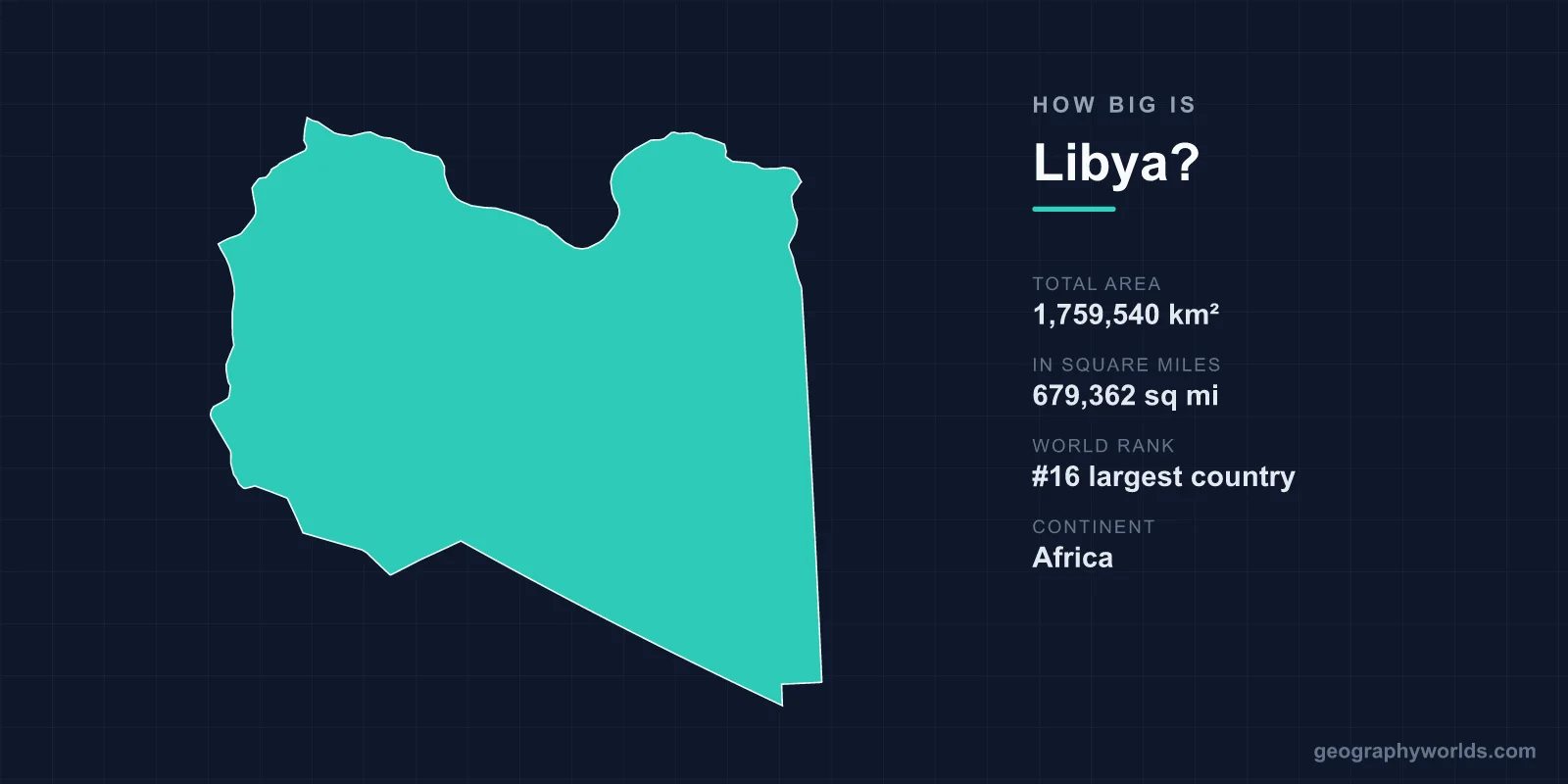
Libya covers a total area of 1,759,540 km² (679,362 sq mi), making it the 16th largest country in the world and the fourth largest in Africa. That vast expanse — roughly the size of the U.S. state of Alaska — stretches across the heart of North Africa, yet the overwhelming majority of it is empty Saharan desert where almost no one lives.
Libya's Area in Numbers
At 1,759,540 km², Libya accounts for about 1.18% of the Earth's total land surface of roughly 148.94 million km². To picture its scale, consider these figures:
- Total area: 1,759,540 km² (679,362 sq mi)
- World rank: 16th largest country on Earth
- Africa rank: 4th largest, after Algeria, the Democratic Republic of the Congo, and Sudan
- Capital: Tripoli, on the Mediterranean coast
- Coastline: about 1,770 km along the Mediterranean Sea
Despite ranking 16th by area, Libya has a relatively small population of around 7 million, which means most of that territory is sparsely inhabited or completely uninhabited. Population density is among the lowest in the world.
How Far Does Libya Stretch?
Libya is a genuinely large landmass in every direction. The country extends roughly 1,500 km from north to south and about 1,700 km from east to west, giving it a broad, blocky shape that dominates the central Mediterranean coast of Africa. Its 1,770 km coastline is the longest of any African nation fronting the Mediterranean.
The highest point is Bikku Bitti (Bette Peak) at 2,267 m (7,438 ft), located in the remote Tibesti Mountains along the southern border with Chad. From there the land falls away across hundreds of kilometres of plateaus, sand seas, and gravel plains before reaching the coast — a reminder that Libya's interior is as vertically and horizontally varied as it is dry.
A Country Made Mostly of Desert
What makes Libya's size so striking is how little of it is usable. More than 90% of the country is desert, part of the great Sahara that spreads across northern Africa. Less than 2% of Libya's land receives enough rainfall to support agriculture, and that thin fertile band hugs the Mediterranean coast.
This is why nearly the entire population — including the cities of Tripoli and Benghazi — clusters along the coastal strip. The interior is defined by features such as the Ubari Sand Sea, with its surprising oasis lakes hidden among towering dunes, the rugged volcanic Akakus and Tibesti Mountains, and the arid Fezzan region in the southwest. Summer temperatures inland regularly exceed 50°C, and the Libyan Sahara was once credited with the highest temperature ever recorded on Earth (58°C), a claim later disputed and reassigned.
To overcome its chronic water scarcity, Libya built the Great Man-Made River, the world's largest underground network of pipes and aqueducts. It pumps ancient fossil water from beneath the Sahara through thousands of kilometres of pipeline to supply the coastal cities — an engineering response to the simple fact that so much land comes with so little water.
Libya Compared to Other Places
Size comparisons make Libya's scale easier to grasp:
- vs. Alaska: Almost identical in area — Libya is about the size of the largest U.S. state.
- vs. the United Kingdom: Libya is roughly 7 times larger.
- vs. France: About 2.7 times larger than mainland France (640,679 km²).
- vs. Egypt: Libya is slightly larger than its eastern neighbour.
Libya shares land borders with six countries: Egypt and Sudan to the east, Chad and Niger to the south, and Algeria and Tunisia to the west. Its enormous footprint and central position make it a key crossroads between the Maghreb, the Sahel, and the Nile Valley. For a fuller picture of the nation's geography, history, and culture, see our libya country guide.
Frequently Asked Questions
What is the total area of Libya?
Libya has a total area of 1,759,540 km² (679,362 sq mi). This includes its vast Saharan interior and its narrow, populated Mediterranean coastal strip.
Where does Libya rank among the world's largest countries?
Libya is the 16th largest country in the world by area and the fourth largest in Africa, behind Algeria, the Democratic Republic of the Congo, and Sudan.
How does Libya compare to a U.S. state?
Libya is almost exactly the size of Alaska, the largest state in the United States. It is far larger than any state in the contiguous U.S.
Why does Libya have such a small population for its size?
Because over 90% of Libya is arid Saharan desert. Less than 2% of the land is suitable for agriculture, so the roughly 7 million residents live almost entirely along the Mediterranean coast, leaving the vast interior nearly empty.
