
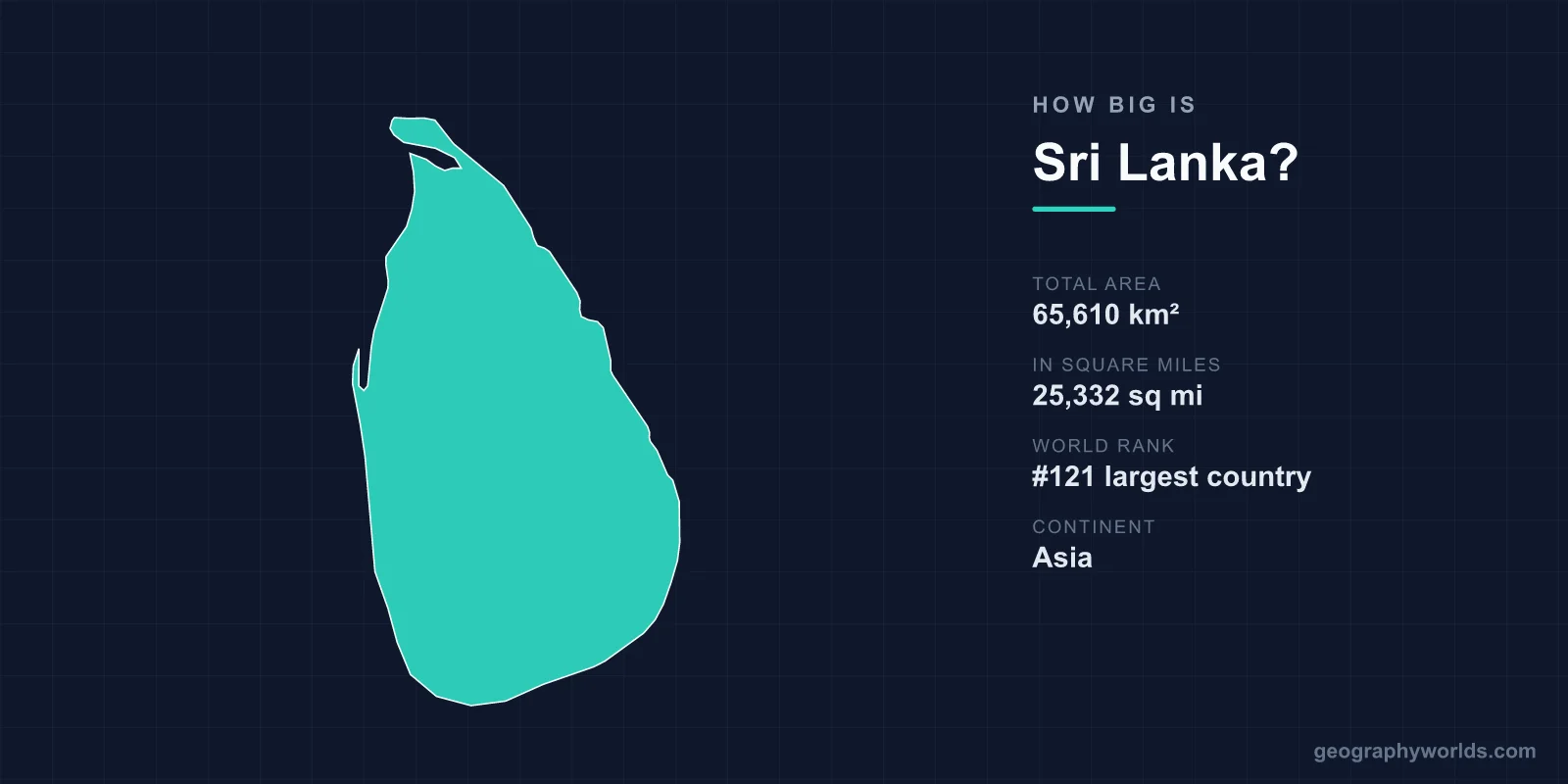
Sri Lanka covers a total area of 65,610 km² (25,332 sq mi), making it the 121st largest country in the world — roughly the size of the U.S. state of West Virginia or about 27% the size of the United Kingdom. Despite its modest footprint, this tear-drop shaped island in the Indian Ocean packs an extraordinary range of landscapes into a small space, from coastal lowlands to misty highland peaks.
The Numbers Behind Sri Lanka's Size
At 65,610 km², Sri Lanka accounts for only about 0.04% of the Earth's total land area of roughly 149 million km². That places it firmly among the world's smaller nations by area, ranked around 121st globally. Yet because it is densely packed and intensely varied, the island feels far larger to travellers than the map suggests.
- Total area: 65,610 km² (25,332 sq mi)
- World rank: approximately 121st largest country
- Share of global land: about 0.04%
- Continent: Asia (South Asia)
- Capital: Sri Jayawardenepura Kotte (commercial hub: Colombo)
- Coastline: roughly 1,340 km
For comparison, the entire island would fit inside the U.S. state of Texas more than ten times over, yet it supports a population of over 22 million people — making it relatively densely settled for its size.
How Far Does Sri Lanka Stretch?
Sri Lanka measures approximately 432 km from north to south at its longest and about 224 km from east to west at its widest. That compact span means you can theoretically drive from the northern Jaffna Peninsula to the southern beaches of Matara in a single long day, passing through dramatically different climate zones along the way.
The island sits just off the southeastern tip of India, separated from the subcontinent by the narrow Palk Strait and the Gulf of Mannar. A chain of limestone shoals known as Adam's Bridge once nearly connected the two landmasses. Its tear-drop or pear-like outline is one of the most instantly recognisable shapes on any world map.
A Mountainous Core and Coastal Plains
What makes Sri Lanka feel bigger than its area is its vertical variety. The terrain rises from flat, low-lying coastal plains — especially across the northern half of the island — to a rugged mountainous core in the south-central region. The Central Highlands climb steeply, with the highest point, Pidurutalagala, reaching 2,524 m (8,281 ft) above sea level.
This relief creates sharply contrasting climates within a short distance. The southwestern "wet zone" can receive up to 5,000 mm of rainfall a year, fed by two distinct monsoon seasons, while the north and east form a much drier zone. In the hill country, temperatures hover around a cool 15–20°C, a world away from the humid tropical coast. The same compact island therefore holds rainforest, savanna-like dry plains, and cool tea-growing uplands.
Big in Biodiversity, Not in Square Kilometres
Sri Lanka may be small, but few countries cram so much natural and cultural value into so little space. It is often described as having one of the highest rates of biological diversity per unit area in Asia, with around a quarter of its flowering plants found nowhere else on Earth. The Central Highlands are recognised as a UNESCO World Heritage Site, and the island as a whole holds an exceptional density of such sites — eight in total — relative to its size.
The same coastline that stretches some 1,340 km offers golden beaches, coral reefs, and lagoons, and the surrounding waters are among the best places on the planet to spot blue whales close to shore. Inland, the 5th-century rock fortress of Sigiriya rises around 200 m from the jungle, while Adam's Peak draws pilgrims of several faiths to its summit. For a country roughly the size of West Virginia, that is a remarkable concentration of landmarks. You can explore more in our sri lanka country guide.
Frequently Asked Questions
Is Sri Lanka bigger than the United Kingdom?
No. The United Kingdom covers about 243,610 km², so Sri Lanka, at 65,610 km², is roughly 27% of its size — a little over a quarter as large.
What U.S. state is Sri Lanka similar in size to?
Sri Lanka is about the size of West Virginia. It is also broadly comparable in area to a small to mid-sized U.S. state, far smaller than Texas or California.
How does Sri Lanka compare to South Korea?
South Korea covers around 100,210 km², so Sri Lanka is roughly 65% of its size — about two-thirds as large.
Why does Sri Lanka feel so varied for such a small country?
Its dramatic elevation range, from sea-level coasts to peaks above 2,500 m, combined with two monsoon systems, packs tropical beaches, dry plains, rainforests, and cool highlands into a single compact island.
