
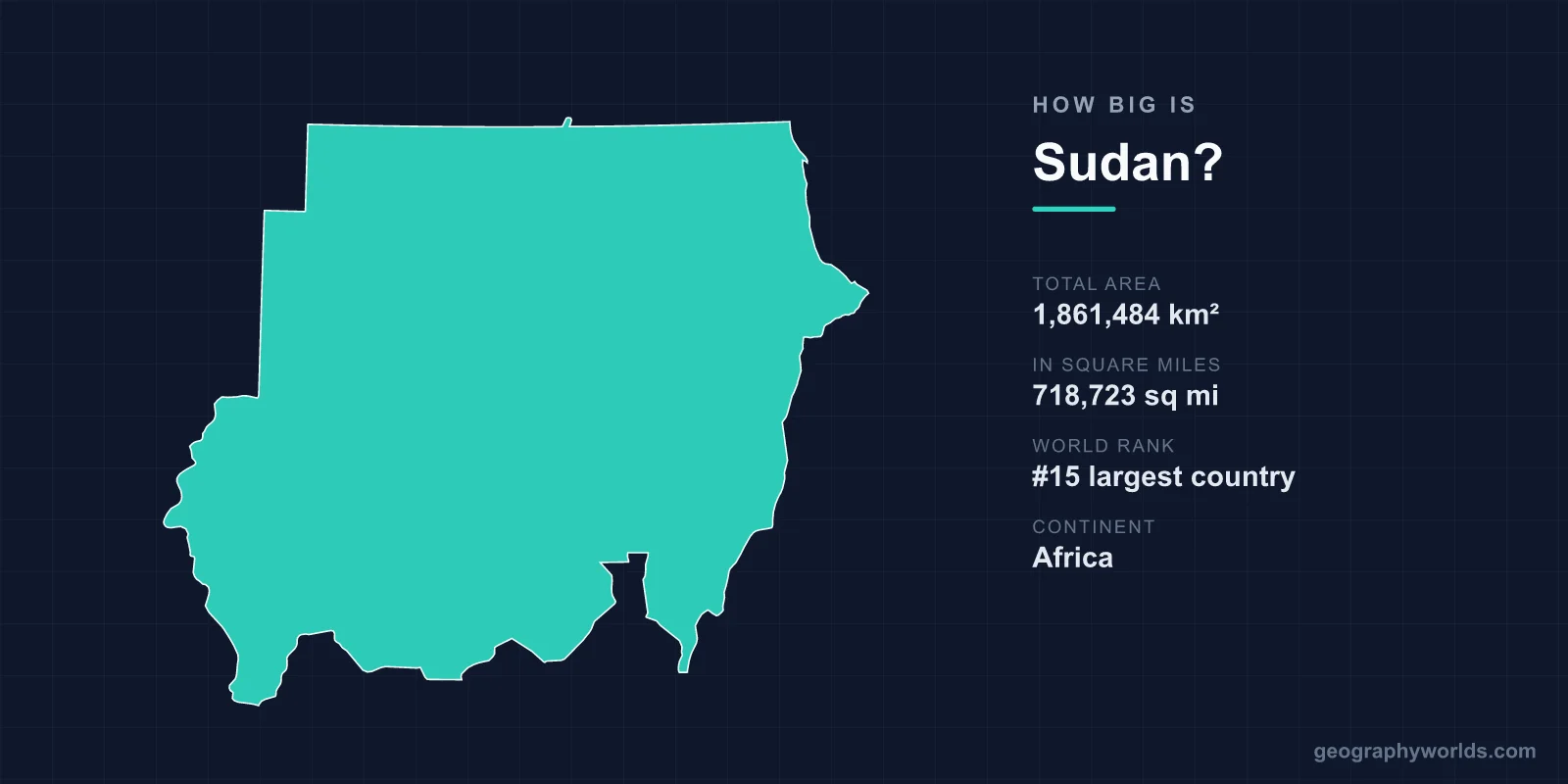
Sudan covers a total area of 1,861,484 km² (718,723 sq mi), making it the 15th largest country in the world and the third largest in Africa. That is roughly one-fifth the size of the United States and accounts for about 1.25% of the Earth's total land surface. Until South Sudan seceded in 2011, Sudan was the largest country on the entire African continent.
Sudan's Size in Numbers
At nearly 1.86 million square kilometres, Sudan is a genuinely vast country. Spread across the north-eastern shoulder of Africa, it stretches approximately 2,200 km from its northern desert border with Egypt down to its southern frontier, and roughly 1,900 km from east to west. Despite this enormous landmass, Sudan has a relatively modest coastline of about 853 km along the Red Sea.
- Total area: 1,861,484 km² (718,723 sq mi)
- World rank: 15th largest country
- Rank in Africa: 3rd largest (after Algeria and the Democratic Republic of the Congo)
- Share of Earth's land: approximately 1.25%
- Capital: Khartoum
- Continent: Africa
How Sudan Compares to Other Countries
Comparisons make Sudan's scale much easier to grasp. The country is about one-fifth the size of the United States, and you could fit the entire United Kingdom inside it roughly seven times over. Set against France (640,679 km²), Sudan is nearly three times larger. It also dwarfs Texas, the largest of the contiguous US states, comfortably swallowing it more than twice.
Within Africa, only Algeria and the Democratic Republic of the Congo exceed Sudan in area. Before 2011, when South Sudan became independent and took roughly 640,000 km² with it, Sudan held the title of Africa's biggest nation by a wide margin. Even after that loss of territory, it remains one of the continent's true giants and a strategic land bridge between sub-Saharan Africa, the Sahara, and the Arabian Peninsula.
The Land Within Sudan's Borders
Sudan's huge area encompasses a striking range of landscapes. The north is dominated by the Sahara and the Nubian Desert, among the hottest and driest places on Earth, where rainfall is almost nonexistent. Moving south, the arid desert gradually gives way to semi-arid steppe and then to tropical savanna near the southern border, a climate gradient that unfolds over more than 1,500 km.
Most of the terrain is flat plain, but several upland regions break the monotony. The Marrah Mountains rise in the western Darfur region, the Red Sea Hills line the eastern coast, and the country's highest point, Deriba Caldera, reaches 3,042 m (9,980 ft) within the Marrah range. The caldera is notable for containing both a freshwater and a saltwater lake in its volcanic crater.
Rivers, Deserts and the Nile
The Nile River system is the lifeline running through Sudan's vast interior. The Blue Nile, descending from the Ethiopian highlands, meets the White Nile, flowing up from the great lakes of central Africa, at the capital, Khartoum. There the two rivers merge to form the main Nile, and at the confluence visitors can often see the distinct blue and pale waters running side by side before they blend.
This narrow ribbon of fertile, irrigated land along the riverbanks supports the bulk of Sudan's population and agriculture, standing in sharp contrast to the empty desert that surrounds it. The Nubian Desert occupies much of the country's north-east, while the Red Sea coast in the far east offers some of the world's most pristine and least-disturbed coral reefs.
Sudan's size has also preserved an extraordinary archaeological legacy. The ancient pyramids of Meroë, built by the Kushite kingdom, are steeper and far more numerous than their Egyptian counterparts. In fact, Sudan is home to around 200 pyramids, more than Egypt itself, scattered across its northern desert. For more on the country's geography, history and culture, see our sudan country guide.
Frequently Asked Questions
Is Sudan bigger than Texas?
Yes. Sudan covers about 1,861,484 km², while Texas spans roughly 695,000 km². Sudan is more than two and a half times larger than Texas, the biggest state in the contiguous United States.
What rank is Sudan in size?
Sudan is the 15th largest country in the world by total area, and the third largest in Africa behind Algeria and the Democratic Republic of the Congo.
Why did Sudan get smaller?
Sudan lost about a quarter of its territory in July 2011, when South Sudan voted for independence and became a separate nation. Before that split, Sudan was the largest country in Africa.
How does Sudan compare to the United Kingdom?
Sudan is vastly larger. At roughly 1.86 million km², it could contain the United Kingdom (about 243,000 km²) approximately seven times over.
