
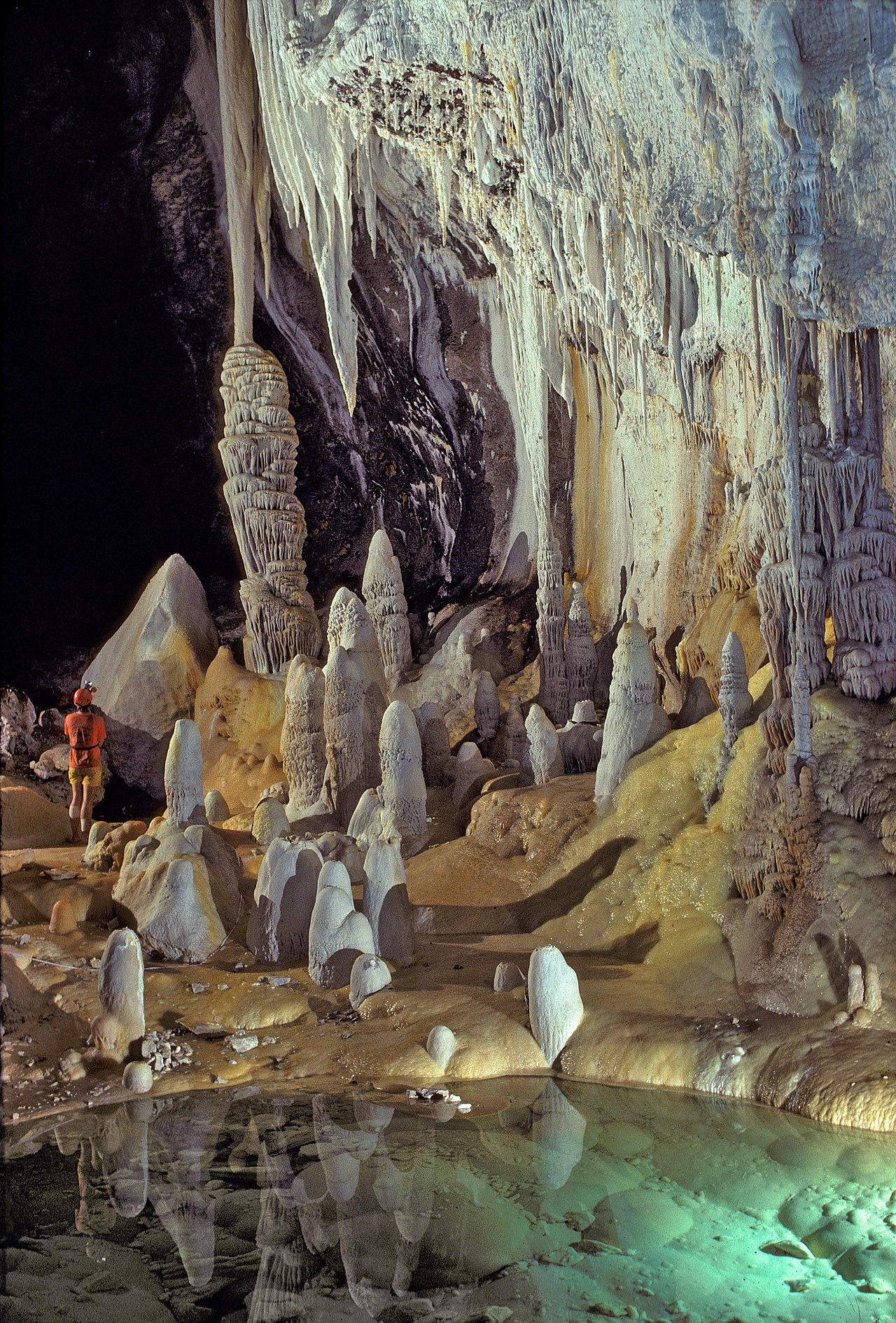
Caves are some of Earth's most mysterious places — underground worlds of darkness, strange formations, and unique ecosystems. The largest cave systems span hundreds of kilometers; the deepest reach over 2 kilometers below the surface. Some have been inhabited by humans for tens of thousands of years. They form through diverse geological processes, each producing distinctive cave types with their own characteristics.
The Short Answer
Caves form through several geological processes, with the most common being water dissolving soluble rocks like limestone. Other formation processes include: lava cooling and forming tubes, waves eroding sea cliffs, ice melting through glaciers, and tectonic activity opening fissures. Each process creates distinctive cave systems with their own structures and life forms.
Solution Caves (Limestone Caves)
The most common cave type. Form when slightly acidic water dissolves limestone:
- Rainwater absorbs CO₂ from atmosphere, becoming weak carbonic acid.
- Acid water seeps into limestone bedrock.
- Water dissolves calcium carbonate slowly over thousands of years.
- Networks of passages develop along joints and fractures.
- Cave systems extend over tens to hundreds of kilometers.
- The largest cave systems form this way.
Cave Formations (Speleothems)
The dramatic features inside limestone caves:
- Stalactites: Hanging from ceiling, formed by dripping water depositing minerals.
- Stalagmites: Growing from floor, where drips deposit minerals.
- Columns: When stalactites and stalagmites meet.
- Flowstone: Sheets of mineral deposited by flowing water.
- Helictites: Twisted, sideways-growing formations.
- Cave pearls: Smooth, round mineral deposits.
- Curtains: Thin sheets of mineral.
- Soda straws: Hollow tube stalactites.
How Stalactites and Stalagmites Form
The slow formation process:
- Water seeps through limestone, dissolving calcium carbonate.
- Saturated water drips into cave.
- Water loses CO₂ to cave atmosphere, becoming less acidic.
- Calcium carbonate precipitates out, depositing on cave surface.
- Over millennia, stalactites grow from ceilings (drip rate: 0.1-0.5 mm/year).
- Where drops fall, stalagmites grow upward.
- Eventually they may meet, forming columns.
Famous Limestone Caves
- Mammoth Cave (USA): Longest cave system in the world (676+ km mapped).
- Sistema Sac Actun (Mexico): Longest underwater cave (370+ km).
- Carlsbad Caverns (USA): Spectacular formations, bat colony.
- Postojna Cave (Slovenia): 24 km, famous for tourist trains.
- Waitomo Caves (NZ): Famous for glowworms.
- Reed Flute Cave (China): Beautifully lit formations.
- Cango Caves (South Africa): Among the oldest known cave systems.
- Han Sơn Đoòng (Vietnam): One of the largest passages in the world.
Lava Tube Caves
Form when lava cools:
- Active lava flow develops a hardened outer crust.
- Lava continues flowing inside through the insulated channel.
- When the eruption ends, the molten lava drains out.
- The hollow tube remains as a cave.
- Notable examples in Hawaii, Iceland, Italy, Mexico.
- Generally shorter than limestone caves but often quite straight.
Sea Caves
Form where waves erode coastal cliffs:
- Found in coastal areas with appropriate rock
- Wave erosion exploits weak zones in cliffs
- Generally short (less than 100 m)
- Some flooded at high tide, dry at low tide
- Famous: Fingal's Cave (Scotland), Blue Grotto (Capri)
Ice Caves
Form within glaciers or ice formations:
- Meltwater carves passages through ice
- Temporarily structures that may change yearly
- Notable: Vatnajökull (Iceland), Mendenhall Glacier (Alaska)
- Can have striking blue colors from ice
- Some persist for years before reshaping
Fissure Caves
Form when bedrock cracks:
- Tectonic activity opens fissures
- May involve fault movement
- Generally narrow and tall
- Found in various rock types
Anchialine Caves
Coastal caves with mixed fresh and salt water:
- Form where land meets sea
- Have unique ecosystems adapted to varying salinity
- Famous examples in Hawaii, Mexico, Bahamas
- Important for biological research
Cave Ecosystems
Caves host distinct life:
- Bats: Many cave systems home to large bat colonies.
- Cave-adapted animals: Eyeless, colorless creatures evolved for total darkness.
- Stygobites: Animals living entirely in groundwater of caves.
- Microbes: Cave microbiology is rich and largely unknown.
- Cave fish, salamanders, spiders, beetles with distinctive adaptations.
Cave Climate
Stable, distinctive climate:
- Temperature stays close to the regional mean annual temperature
- High humidity (often 95-100%)
- Complete darkness past the entrance zone
- Little seasonal variation
- Some have specific air flow patterns
Caving (Spelunking)
The exploration of caves:
- Technical skills required for serious caving
- Equipment includes ropes, lights, helmets, communication
- Some caves require diving
- Many systems have not yet been fully explored
- Recreational caving exists at many tourist caves
Cave Mapping
Surveying caves is challenging:
- 3D maps showing horizontal and vertical extent
- Detailed measurements of passages
- Specialized cave survey instruments
- Some systems hundreds of km mapped
- Always more to explore
Deepest Caves
- Veryovkina Cave (Georgia): 2,212 m deep.
- Krubera Cave (Georgia): 2,197 m deep.
- Sarma Cave (Georgia): 1,830 m deep.
- Lukina Jama (Croatia): 1,431 m deep.
- The deepest caves are mostly in the Caucasus region of Georgia.
Cave Archaeology
Caves have preserved human history:
- Lascaux (France): 17,000-year-old cave paintings.
- Altamira (Spain): Famous bison paintings.
- Chauvet (France): Oldest known cave art (30,000+ years).
- Various other locations: Worldwide cave art traditions.
- Sterkfontein (South Africa): Hominid fossils.
- Denisova Cave (Russia): Denisovan human remains.
Religious and Cultural Significance
Caves feature prominently in culture:
- Many religions have sacred caves
- Plato's "Allegory of the Cave" — foundational philosophy.
- Buddhist cave temples in India and China
- Christian hermit caves throughout history
- Various indigenous sacred caves worldwide
Karst Landscapes
Limestone caves are part of larger karst:
- Limestone bedrock dissolved by water
- Surface features: sinkholes, disappearing streams, springs
- Underground features: cave systems, underground rivers
- Major karst regions: Slovenia, China, Florida, Yucatan
Cave Preservation
Modern challenges to cave preservation:
- Tourism damage (oils from skin, lights causing algae growth)
- Air pollution affecting cave chemistry
- Groundwater contamination
- White-nose syndrome devastating bat populations
- Climate change affecting cave climate
Cave Diving
Underwater caves are explored by:
- Specialized cave divers
- Among the most dangerous diving activities
- Cenotes in Yucatan especially significant
- Some of the world's deepest caves are flooded
- Discoveries continue regularly
Key Facts
- Most caves form through water dissolving limestone.
- Stalactites grow downward from ceilings; stalagmites grow upward.
- Mammoth Cave system is the longest known (676+ km).
- Lava tubes, sea caves, and ice caves form differently.
- Caves host unique ecosystems adapted to total darkness.
Fun Facts
- Cave art at Chauvet is 30,000+ years old.
- Veryovkina Cave is 2,212 m deep — deepest in the world.
- Han Son Doong cave in Vietnam has a passage so large it could fit a 40-story building.
- Some cave-dwelling animals have lost their eyes through evolution.
- Cave temperature equals the local annual average temperature.
Cave Exploration Today
Despite the popularity of caving, much of the underground world remains unexplored. New caves are discovered regularly. Sistema Sac Actun in Mexico continues being mapped, with new sections found yearly. Vietnam's Son Doong was only confirmed in 2009 — among the largest known passages. Specialized teams use scuba diving, mountaineering, and surveying skills to push limits. Internet-connected expeditions document explorations in real time. Some scientists believe Earth's caves are an "underground ocean" with massive untapped water reserves. Geological surveys continue prospecting for new cave systems. Each discovery teaches us more about Earth's subsurface and the ecosystems it harbors.
Caves and Climate Change
Climate change affects caves in subtle but important ways. Cave temperatures track regional mean annual temperatures, so warming surface conditions warm caves over time. Some caves' formation rates depend on rainfall patterns. Cave-dwelling species face habitat changes. Stalactites and stalagmites form at specific moisture conditions; changes can disrupt growth. Glacier caves are particularly affected — many are melting rapidly. Climate records preserved in cave deposits (called speleothems) provide some of the most precise records of past climate. Caves both record and respond to climate change, making them important for climate research.
Cave Music and Acoustics
Caves have unique acoustic properties. Large chambers can produce reverberation lasting many seconds. Some chambers act as natural amphitheaters. The Carlsbad Caverns have hosted concerts. Stalactite formations sometimes produce sounds when struck — "stalactite music." Ancient peoples used caves' acoustic properties for ritual purposes; some prehistoric cave art is positioned where acoustic effects are strongest. Modern researchers study cave acoustics to understand how ancient humans used these spaces. Cave systems can produce wind sounds called "cave wind" — air moving through passages. The combination of darkness, isolation, and unique acoustics gives caves their mystical reputation.
Famous Cave Discoveries
Some of the most remarkable cave finds have occurred recently. The 1994 discovery of Chauvet Cave revealed 30,000+ year old art preserved in pristine condition. The 1999 finding of preserved Pleistocene cave bear remains in Slovenia. Lechuguilla Cave's 1986 discovery in New Mexico revealed previously unknown crystal formations. South Africa's Rising Star Cave (2013) yielded the new human species Homo naledi. Diego Garcia Cave's discovery of multiple Paleolithic artifacts. Each discovery rewrites understanding of human prehistory, paleontology, or cave science. Exploration continues — significant discoveries are made every year.
The Bottom Line
Caves form through diverse processes, most commonly water dissolving limestone over thousands of years. Other formation processes — lava cooling, wave erosion, ice melting, tectonic activity — produce distinct cave types. Each system has unique characteristics, from spectacular limestone formations to delicate lava tubes to flooded underwater systems. Caves provide windows into Earth's history, host specialized ecosystems, and have preserved invaluable archaeological remains. They remain among Earth's most fascinating and least-explored environments.