
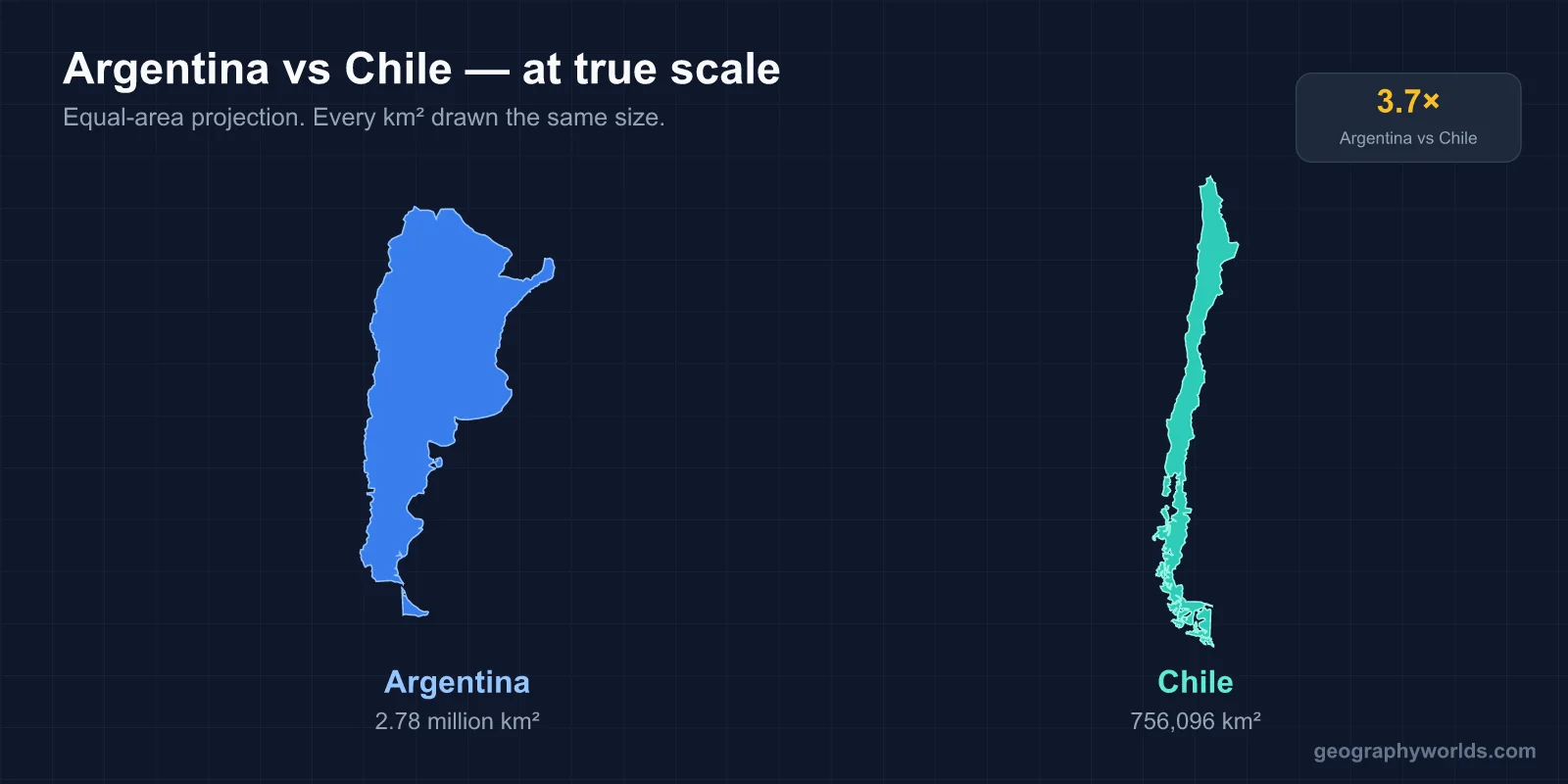
Yes. Argentina is much larger than Chile. Argentina covers 2,780,400 km², while Chile covers 756,096 km². Argentina is about 3.68 times the size of Chile — large enough to fit nearly four Chiles inside its borders. Argentina is the 8th-largest country in the world; Chile ranks 38th.
The Short Answer
Argentina and Chile share the longest international border in the Americas — about 5,308 km, running along the Andes Mountains from the Atacama Desert in the north to the Beagle Channel in the south. They're both Spanish-speaking South American Cone countries with close cultural ties. But geographically, Argentina dominates: nearly 4× larger by area, with about 2.4× more people.
Chile is one of the most uniquely shaped countries in the world — extraordinarily long and narrow. It stretches 4,270 km north-to-south but averages only about 175 km east-to-west. The Andes form Chile's entire eastern boundary; the Pacific Ocean is its western boundary. Argentina, by contrast, is a more conventionally shaped country, with mountains on the west, plains in the center, and the Atlantic on the east.

The Real Numbers
- Argentina total area: 2,780,400 km² (1,073,400 sq mi)
- Chile total area: 756,096 km² (291,933 sq mi)
- Difference: 2,024,304 km² — about the size of Saudi Arabia or Greenland
- Ratio: Argentina is about 3.68× the size of Chile
Argentina is the largest Spanish-speaking country in the world by area. Globally, it ranks 8th — just after Kazakhstan (2.72M km²) and just ahead of Algeria (2.38M km²). Chile is the 38th largest country, similar in size to Mozambique or Zambia.
Chile's Unique Shape
Chile is famously long and thin. Its 4,270 km length runs along the western coast of South America, while its average width is only 175 km. The longest stretch east-to-west is just 350 km. The country is so elongated that the climate at one end (the Atacama Desert in the north — driest place on Earth) is the polar opposite of the climate at the other end (Patagonia and Cape Horn — cold, wet, windy).
This shape is determined by the Andes Mountains, which form Chile's eastern boundary along its entire length. The Andes run north-south for over 7,000 km — the longest continental mountain range in the world. Chile occupies the narrow strip between the Andes and the Pacific Ocean. Argentina occupies the eastern side of the same Andes plus the vast Pampas plains beyond.
Population
Argentina has more people than Chile:
- Argentina population: ~46,400,000
- Chile population: ~19,500,000
- Argentina density: ~17 people per km²
- Chile density: ~26 people per km²
Argentina has about 2.4× more people than Chile. Chile is more densely populated (about 1.5× Argentina's density) — its small habitable zone (much of central Chile around Santiago is densely settled) packs more people per square kilometer than Argentina's spread-out plains.
The Argentine Pampas
The Pampas are vast fertile plains that cover much of central and eastern Argentina — about 750,000 km², roughly the size of Texas. The Pampas are the agricultural heartland of Argentina, producing wheat, corn, soybeans, and beef on an industrial scale. Argentina is one of the world's top exporters of agricultural products.
Chile has no equivalent large agricultural plain. Most of Chile's farming is in the Central Valley (Valle Central) between the coast and the Andes — a much smaller area focused on wine grapes, fruits, and vegetables. Chile is famous for its wine industry (especially Carmenère and Cabernet Sauvignon from regions like Maipo Valley and Colchagua Valley) and its fruit exports (cherries, grapes, blueberries to North America).
Economy
Both countries have significant economies, but their structures differ:
- Argentina GDP: ~$641 billion
- Chile GDP: ~$345 billion
- Argentina per capita GDP: ~$13,800
- Chile per capita GDP: ~$17,700
Argentina's economy is about 86% larger than Chile's in total terms, but on a per-capita basis, Chile is about 28% richer. Chile has had more stable economic management for decades — Argentina has experienced multiple sovereign debt crises (1989, 2001-2002, 2014, 2018-present) while Chile has been one of Latin America's most stable economies. Chile is the wealthiest country in South America by per-capita income.
Chile's economy is heavily dependent on copper — Chile produces about 28% of the world's copper, making it the world's largest copper producer. The state-owned mining company Codelco is one of the largest mining companies in the world. Argentina's economy is more diversified — agriculture, energy (oil, gas, renewables), services, manufacturing (cars, electronics), and finance.
Climate
Argentina has extraordinary climate range due to its size. The north (Salta, Jujuy) is subtropical and partly tropical. The Pampas (Buenos Aires region) is temperate. Patagonia (the southern third) is cool and dry. The Andean west has alpine conditions. Mendoza in west-central Argentina has Mediterranean climate. Antarctica is just across the Drake Passage to the south.
Chile's climate also has enormous variation. The Atacama Desert in the north is one of the driest places on Earth — some weather stations have never recorded rainfall in recorded history. Central Chile (Santiago, Valparaíso) has Mediterranean climate. Southern Chile (Patagonia, Tierra del Fuego) is cold, wet, and windy. Chile has glaciers in its far south. Both countries share the southern tip — Tierra del Fuego is divided between them.
Coastlines
Chile has a famous 6,435 km Pacific coastline — one of the longest in South America. Argentina has 4,989 km of Atlantic coastline. Both countries have significant coastal economies (fishing, ports, tourism), but Chile's coast is more dramatic — fjords, glaciers, and the rocky west coast culminate in Cape Horn at the continent's southern tip.
Argentina's coast is mostly flat sandy beaches along the Atlantic, with the major port of Buenos Aires on the Río de la Plata estuary. The famous Patagonia coastline features whale-watching beaches (Península Valdés) and other dramatic features.
Antarctic Claims
Both Argentina and Chile claim large overlapping sectors of Antarctica. Argentina claims about 1.46 million km² of "Argentine Antarctica"; Chile claims about 1.25 million km² of "Chilean Antarctic Territory." These claims overlap with each other and with the UK's claim. The Antarctic Treaty (1959) effectively freezes all such claims while it remains in force, but both countries operate Antarctic research stations and consider their southern territories an extension of their national domains.
Culture and Identity
Both countries have strong national identities shaped by mass European immigration in the late 19th and early 20th centuries. Argentina received about 6.6 million European immigrants between 1880 and 1930 — mostly Italians (about 60%) and Spaniards (about 30%), with smaller numbers of Germans, Russians, Poles, and Syrians/Lebanese. This shaped Argentina's distinctive cultural blend — Italian-influenced food (pizza, pasta, gelato), Spanish-language but with Italian-influenced accent (Rioplatense Spanish), and European-influenced architecture in Buenos Aires.
Chile received fewer European immigrants (about 800,000 total) and has a more mixed Indigenous-European heritage. The Mapuche people remain the largest Indigenous group in Chile, with significant cultural influence in the southern regions. Chilean Spanish has distinctive features (notably rapid speech and unique vocabulary) that make it sometimes hard for other Spanish speakers to understand. Both countries share major cultural exports: Argentine tango (especially from Buenos Aires); Chilean wine and poetry (Pablo Neruda and Gabriela Mistral are both Nobel Prize laureates from Chile).
Key Facts
- Argentina is about 3.68× the size of Chile.
- Argentina has 2.4× more people than Chile.
- Chile has 1.5× higher population density.
- Chile is wealthier per capita than Argentina (about 28% richer).
- The Argentina-Chile border (5,308 km) is the longest in the Americas.
Fun Facts
- Chile is one of only 3 countries in the world that is longer than it is wide by a factor of 10 or more.
- The southernmost continuously inhabited place in the world, Puerto Williams, is in Chile (population ~2,500).
- Argentina's Aconcagua (6,961 m) is the highest mountain in the Americas and outside Asia.
- Both countries fought for control of Patagonia in the late 1800s — the dispute was settled by border treaties in 1881.
- Argentina's wine production (15th in the world) is roughly equal to Chile's (9th in the world).
The Bottom Line
Argentina is much bigger than Chile — nearly 4× the area, with 2.4× the population. The two countries share a continent, a language, and the longest international border in the Americas, but they're geographically very different. Argentina is a conventional country shape with vast plains; Chile is a long, thin coastal strip squeezed between the Andes and the Pacific.
Despite the size gap, the two are roughly comparable as regional powers — both are G20 members, both have developed economies, both have major agricultural and industrial sectors. The Chilean economy is more stable and richer per capita; the Argentine economy is much larger in absolute terms but has been volatile. They're neighbors, rivals, and the two pillars of the Southern Cone.
Quiz South America!
Test your knowledge of Argentina, Chile, and other South American countries.
Play Geography Games →