
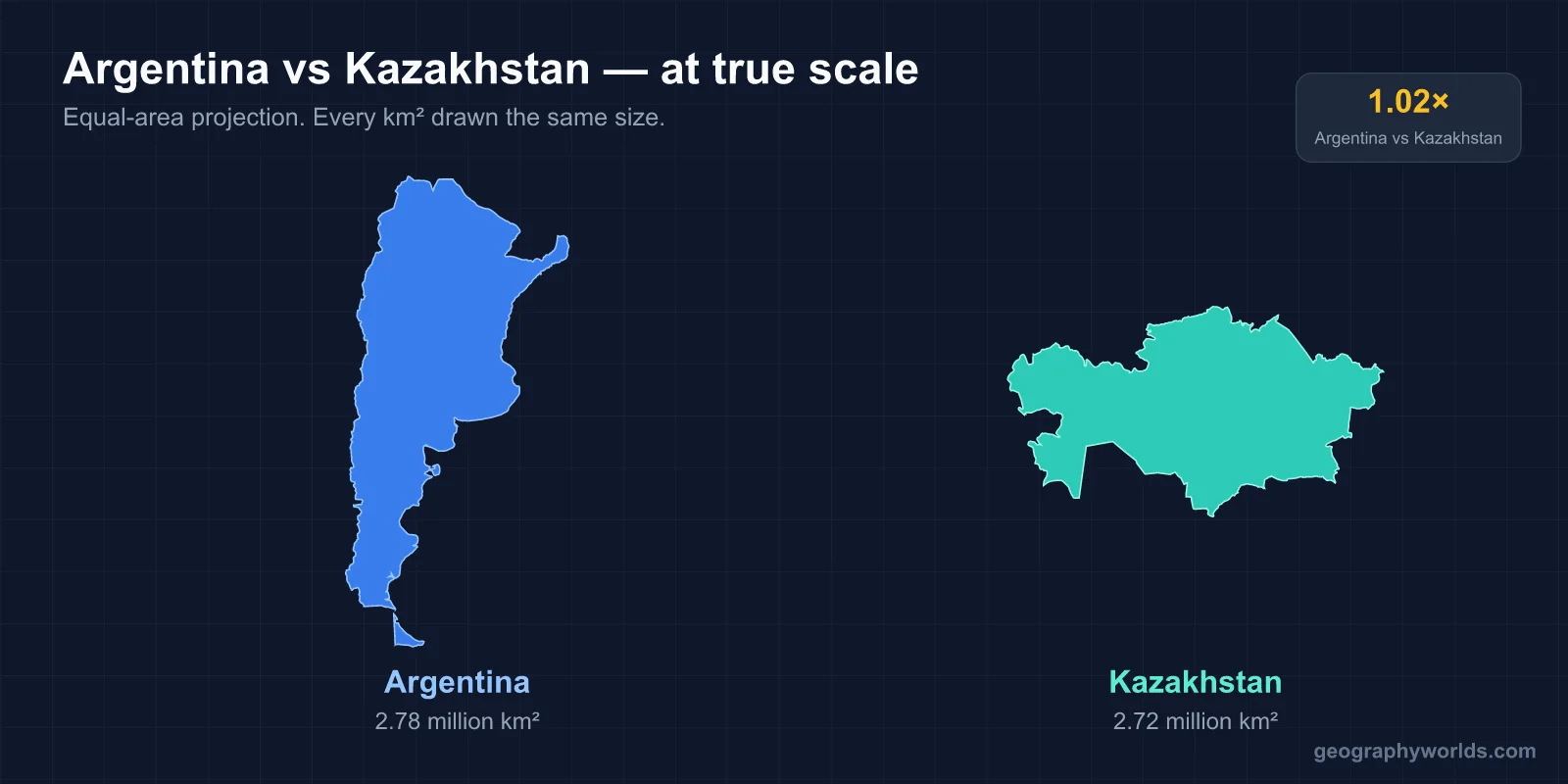
Yes, just barely. Argentina is slightly larger than Kazakhstan. Argentina covers 2,780,400 km², while Kazakhstan covers 2,724,900 km². Argentina is about 1.02 times the size of Kazakhstan — larger by 55,500 km², which is about the size of Croatia or Costa Rica. Both rank in the top 10 largest countries in the world.
The Short Answer
Argentina is the 8th-largest country in the world; Kazakhstan is the 9th. The gap between them (55,500 km²) is small enough that both can credibly claim to be in roughly the same size league. After Russia, Canada, the US, China, Brazil, Australia, and India, Argentina and Kazakhstan are the next two largest countries — Argentina edging Kazakhstan by a thin margin.
Despite similar sizes, the two countries are very different. Argentina is in South America with diverse climates from tropical (north) to subantarctic (south). Kazakhstan is in Central Asia, dominated by vast steppes and deserts. Argentina has 46 million people; Kazakhstan has 20 million — less than half.

The Real Numbers
- Argentina total area: 2,780,400 km² (1,073,400 sq mi)
- Kazakhstan total area: 2,724,900 km² (1,052,090 sq mi)
- Difference: 55,500 km² — about the size of Croatia or Costa Rica
- Ratio: Argentina is about 1.02× the size of Kazakhstan
Both rank in the top 10 worldwide. After them come Algeria (11th, 2.38M km²), Saudi Arabia (12th), and other large countries. The top 10 cluster gets progressively smaller — Russia is in a league of its own; Canada, the US, and China are clustered around 9.5-10 million km²; Brazil and Australia are around 7.7-8.5 million km²; India is 3.3M km²; Argentina and Kazakhstan are around 2.7-2.8M km².
Population
Argentina has more than 2× more people:
- Argentina population: ~46,400,000
- Kazakhstan population: ~20,000,000
- Argentina density: ~17 people per km²
- Kazakhstan density: ~7 people per km²
Argentina has about 2.3× more people than Kazakhstan, with about 2.4× higher density. Both countries have relatively low population densities — Argentina because of its vast Patagonian south, Kazakhstan because of its massive steppe interior.
Geography
Argentina spans about 3,700 km north-to-south, from the Iguazu Falls in the subtropical north to Tierra del Fuego in the subantarctic south. Major regions:
- The Andes: Forming the western border with Chile, including Aconcagua (6,961 m) — the highest peak in the Americas
- The Pampas: Vast fertile plains in central Argentina, the agricultural heartland
- Patagonia: The cool grasslands and glacier region in the south
- Gran Chaco: Hot lowland forest in the north
- Mesopotamia: Subtropical region between the Paraná and Uruguay rivers
Kazakhstan spans about 3,000 km east-to-west. Major regions:
- The Kazakh Steppe: Vast grasslands covering most of the country
- Aral Sea region: Once one of the world's largest lakes, now mostly dried up due to Soviet-era irrigation
- Caspian Sea coast: Western Kazakhstan
- Tien Shan Mountains: Along the southeastern border with Kyrgyzstan and China
- The Betpak-Dala Desert: Semi-arid central region
- Lake Balkhash: A large lake (one of the world's largest by area)
Climate
Argentina has remarkable climate range. The north (Salta, Jujuy) is subtropical and partly tropical. The Pampas (Buenos Aires region) is temperate. Patagonia is cool to cold. The Andean west has alpine conditions. Mendoza has Mediterranean climate. Argentina experiences all major climate types in a single country.
Kazakhstan has a continental climate dominated by the steppe — hot dry summers (35-40°C) and cold winters (-15 to -25°C in northern areas). The southern mountains have alpine climate. The country is generally arid to semi-arid, with most rainfall in the spring and early summer.
Economy
Both have significant economies but quite different structures:
- Argentina GDP: ~$641 billion
- Kazakhstan GDP: ~$260 billion
- Argentina per capita GDP: ~$13,800
- Kazakhstan per capita GDP: ~$13,000
Argentina's economy is about 2.5× larger than Kazakhstan's, but per-capita they're similar. Argentina has a diversified economy with agriculture (beef, soybeans, wheat), industry (cars, food processing), services, and tourism. Argentina has been plagued by economic instability — multiple sovereign debt crises (1989, 2001, 2014, 2018) and persistent high inflation.
Kazakhstan has an economy heavily dependent on oil, natural gas, and minerals. The country is the world's largest producer of uranium and has significant reserves of copper, zinc, gold, and chromium. Kazakhstan's capital, Astana (now called Nur-Sultan again), was built largely from oil revenue.
History
Argentina became independent from Spain in 1816 during the South American wars of independence. The country experienced waves of European immigration (especially Italian and Spanish) in the late 19th and early 20th centuries. Argentina was one of the world's richest countries per capita around 1900-1930 but has had economic difficulties since.
Kazakhstan was historically inhabited by nomadic Turkic peoples. The Russian Empire annexed the area in the 18th-19th centuries. Kazakhstan was a Soviet republic from 1936 to 1991. After the dissolution of the USSR, Kazakhstan became independent under President Nazarbayev, who ruled until 2019. The country has been navigating a complex relationship with Russia, China, and the West.
Languages and Culture
Argentina's official language is Spanish (with distinctive Argentine accent — Rioplatense Spanish). The country has strong Italian cultural influence due to mass immigration in the early 20th century. Catholicism is the dominant religion. Famous Argentine cultural exports include tango, asado (barbecue), Lionel Messi, and yerba mate.
Kazakhstan's official languages are Kazakh and Russian. About 65% of the population is Kazakh (Turkic Muslim), 18% Russian, and the remainder includes Ukrainians, Uzbeks, Uighurs, and others. Sunni Islam and Russian Orthodoxy are the main religions. Kazakhstan's cultural traditions blend Turkic, Mongol, and Soviet influences.
Key Facts
- Argentina is about 1.02× the size of Kazakhstan.
- Argentina has 2.3× more people than Kazakhstan.
- Argentina is in South America; Kazakhstan is in Central Asia.
- Both rank in the top 10 largest countries in the world.
- Argentina's economy is about 2.5× larger than Kazakhstan's.
Fun Facts
- Argentina's Aconcagua (6,961 m) is the highest mountain in the Americas, the highest outside Asia, and one of the Seven Summits.
- Kazakhstan's Baikonur Cosmodrome is the world's oldest and largest operational space launch facility — launching Sputnik in 1957 and Yuri Gagarin in 1961.
- The Aral Sea (between Kazakhstan and Uzbekistan) has lost about 90% of its volume since the 1960s due to Soviet irrigation projects — one of the world's worst environmental disasters.
- Argentina is the only country with Spanish as its official language that's in the Southern Hemisphere outside of Equatorial Guinea (in Africa).
- Kazakhstan's landmass means it has 5 time zones — but the country observes just 2 official time zones.
- Argentina's Iguazu Falls is wider than Niagara Falls and one of the New Seven Wonders of Nature.
- Kazakhstan's flag features a sun and an eagle — symbols common in Turkic culture and inherited from steppe traditions.
- Argentina's national dance is the tango, which originated in Buenos Aires' La Boca neighborhood in the late 19th century.
- Kazakhstan and Argentina both have national sports — Argentina's is football/soccer; Kazakhstan's national sport is kokpar (a horseback game involving a goat carcass).
International Position
Argentina is a G20 member, one of the largest economies in Latin America, and a major regional power in South America. The country has played significant roles in international diplomacy, especially through Mercosur (the South American trade bloc) and UN bodies. Argentina's territorial dispute with the UK over the Falkland Islands (a brief war in 1982) remains unresolved.
Kazakhstan is the most economically significant Central Asian country and a regional leader. The country has navigated complex relationships with Russia (its former imperial power), China (its largest trading partner), and Western countries. Kazakhstan was a founding member of the Shanghai Cooperation Organisation, and the Eurasian Economic Union with Russia and Belarus. The country is also a non-NATO partner with significant foreign policy independence.
The Bottom Line
Argentina is barely bigger than Kazakhstan — about 2% larger by area. Both are massive countries that rank in the top 10 globally. Argentina has more people, a more diversified economy, and a longer history of independence. Kazakhstan is rich in natural resources but with a sparser population and a more recent independent identity. The two countries occupy similar geographic scales on opposite sides of the world. Their similar areas illustrate that the world's largest countries are spread across all major continents — top-10 size is not concentrated in any single region. Both nations face the unique challenges and opportunities that come with vast territory: difficult administration of remote areas, abundant natural resources, and the need to balance regional differences within a single political framework. The size similarity may be coincidental, but the parallel challenges are not.