
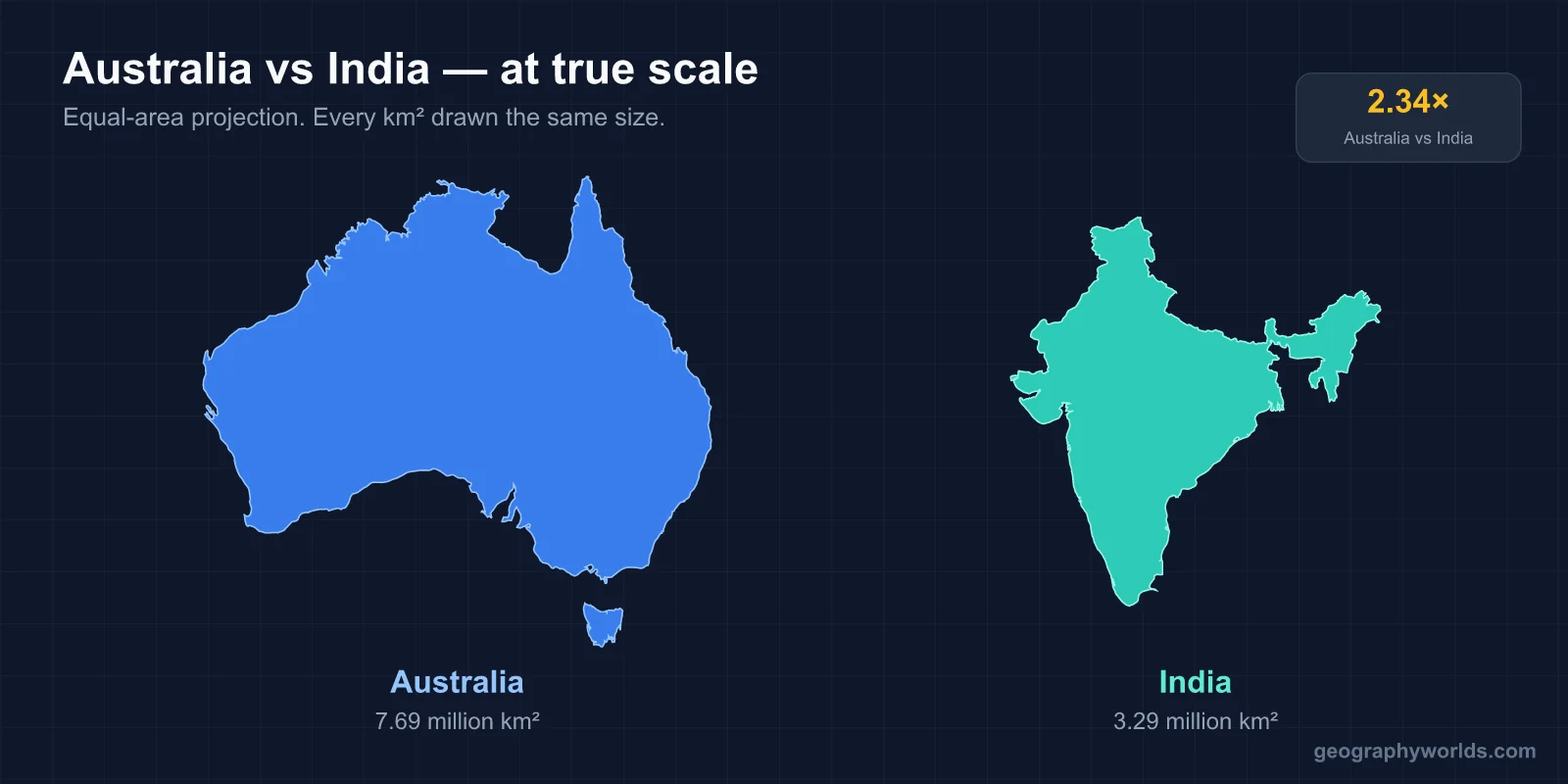
Australia is the world's only country to occupy an entire continent; India is the world's most populous country and a major subcontinent. Both are huge by any global standard. So how do they compare?
The Short Answer
Yes, Australia is much bigger than India. Australia covers 7,692,024 km². India covers 3,287,263 km². Australia is approximately 134% larger — more than twice the size of India.
Side-by-Side Numbers
- Australia area: 7,692,024 km² (2,969,907 sq mi)
- India area: 3,287,263 km² (1,269,219 sq mi)
- Difference: Australia is ~4,404,000 km² larger
- Ratio: Australia is ~2.34× the size of India
- Australia population: ~26 million
- India population: ~1.43 billion
Australia
Australia is unique in being simultaneously a country, a continent, and the world's largest island. It is the 6th largest country by area, behind Russia, Canada, the US, China, and Brazil. Population is just 26 million — extraordinarily small for the country's size — concentrated overwhelmingly along the eastern and southern coasts. Sydney (5.5 million), Melbourne (5.2 million), Brisbane, Perth, and Adelaide together hold most of the country's population.
Australia's geography is dominated by the vast interior Outback — deserts, semi-arid grasslands, and rocky plateaus stretching across most of the continent. The Great Dividing Range runs along the entire east coast. The Great Barrier Reef stretches 2,300 km along the northeastern coast. The far north has tropical rainforests; Tasmania to the south has temperate forests. Australia's highest peak is Mount Kosciuszko at 2,228 m — relatively low for a continent-sized country.
India
India occupies most of the Indian subcontinent in South Asia. It is bordered by Pakistan to the west, China and Nepal to the north, Bhutan to the northeast, and Bangladesh and Myanmar to the east. The Indian Ocean lies to the south. India is the world's most populous country (as of 2023, when it overtook China) with about 1.43 billion people, and the 7th largest country by land area.
India's geography is extraordinarily varied. The Himalayas form the northern border with the world's highest peaks. The Indo-Gangetic Plain is one of the most densely populated places on Earth. The Deccan Plateau dominates central and southern India. The Western and Eastern Ghats line the peninsula's coasts. The Thar Desert in the west, the Sundarbans mangrove forests in the east, the southern coast, and the Andaman and Nicobar Islands in the Bay of Bengal complete the picture.
Population Contrast
The contrast in population is staggering. India has 1.43 billion people; Australia has 26 million. India has about 55 times more people than Australia in only 43% of the area. India's population density is about 434 per km² — among the highest of any large country. Australia's is just 3.4 per km² — among the lowest of any large country. India and Australia represent two of the most extreme demographic configurations on Earth.
Climate
Both countries have varied climates spanning major climate zones. Australia's climate ranges from tropical monsoon in the north (Darwin, Cairns) to arid desert in the interior, to Mediterranean in the south (Perth, Adelaide), to temperate (Melbourne, Hobart) and humid subtropical (Sydney, Brisbane). Drought, bushfires, and tropical cyclones are major hazards. The 2019–2020 "Black Summer" bushfires burned over 18 million hectares — an area larger than England.
India spans tropical, subtropical, and high-altitude climates. The country has six major climate zones: alpine in the Himalayas, subtropical in the north, arid in the northwest (Rajasthan's Thar Desert), tropical wet-dry in central India, tropical wet on the southern coasts, and tropical monsoon in much of the country. The Indian monsoon delivers about 80% of annual rainfall to most of the country between June and September.
Economy
India has the larger economy. India's GDP is about $3.7 trillion — the 5th largest in the world. The economy is dominated by services (especially information technology and business process outsourcing), agriculture (employing about 40% of the workforce despite contributing only about 15% of GDP), pharmaceuticals, automotive manufacturing, textiles, and increasingly electronics. Australia has a GDP of about $1.7 trillion. Major industries include mining (iron ore, coal, lithium — Australia is one of the world's top mineral producers), agriculture, services, tourism, and education.
Diversity
India is extraordinarily diverse — 22 official languages, hundreds of dialects, four major religions originating there (Hinduism, Buddhism, Jainism, Sikhism) plus significant Muslim and Christian populations, and dozens of distinct ethnic groups. The country is sometimes called the "world's largest democracy" for managing this diversity through democratic institutions. Australia's diversity is shaped by immigration. About 30% of Australians were born overseas — the highest proportion of any large developed country except Israel. Modern Australia's population grew primarily through 19th and 20th century European immigration, plus large post-war influxes from Italy, Greece, the former Yugoslavia, Vietnam, China, India, and the Middle East.
Indian Diaspora in Australia
India and Australia are deeply connected by people and trade. About 800,000 people of Indian origin live in Australia, making them one of the largest immigrant communities. Indian students at Australian universities have been a major source of education revenue for years. India is Australia's 4th largest trading partner. The two countries signed a free trade agreement in 2022 and are part of the Quad security dialogue along with the US and Japan.
Wildlife and Ecosystems
Both countries have remarkable wildlife. Australia's isolation for 50+ million years has produced extraordinary endemic species — marsupials (kangaroos, koalas, wombats, possums), monotremes (the platypus and echidna are the only egg-laying mammals on Earth), unique birds (lyrebirds, kookaburras, cassowaries), and many reptiles. Roughly 87% of Australia's mammal species, 93% of its reptiles, and 94% of its frogs are found nowhere else. India has dramatically richer biodiversity by raw species count. Bengal tigers, Asian elephants, one-horned rhinos, Asiatic lions (only found in Gir Forest), snow leopards, sloth bears, and dholes are among India's iconic species. India is home to about 7.6% of all mammal species globally despite being only about 2.4% of the world's land surface.
Geographic Features
Both have extraordinary geographic features. Australia's features include Uluru (Ayers Rock — a sacred Aboriginal site and a global tourism icon), the Great Barrier Reef (the world's largest coral reef), the Outback (essentially the entire interior), the Kimberley (a remote region of dramatic landscapes), Tasmania, and the Daintree Rainforest (the world's oldest rainforest). India's features include the Himalayas, the Ganges River, the Sundarbans (the world's largest mangrove forest), the Western Ghats (a biodiversity hotspot), the Thar Desert, the Andaman and Nicobar Islands, and the Backwaters of Kerala.
Cultural Influence
Both have major cultural influence. India's cultural footprint is enormous — Bollywood (the Hindi film industry produces around 1,800 films per year), yoga, meditation, classical music, dance traditions, cuisine, and four major world religions. About 32 million people of Indian origin live abroad, the largest diaspora in the world. Australia's cultural influence is more recent but significant — Australian film, music, literature, and television have global audiences. Aboriginal Australian culture is one of the oldest continuous cultures on Earth, with art traditions going back tens of thousands of years.
Key Facts
- Australia is about 134% larger than India by area — more than twice the size.
- India has 55× more people than Australia.
- Both are members of the Commonwealth of Nations.
- India has 22 official languages; Australia has one (English) but high linguistic diversity.
- Both are major members of the Indo-Pacific economic and security architecture.
Fun Facts
- Australia has about 21 of the world's 25 most venomous snake species.
- India has 36 UNESCO World Heritage Sites; Australia has 20.
- Australia's Indigenous cultures are among the oldest on Earth.
- India's diverse climate enables three growing seasons per year in many regions.
- Both nations gained independence from Britain in the 20th century (Australia 1901, India 1947).
- Australia has only one country in its entire continent — itself.
- India is the world's top producer of milk and sugarcane.
- Both have major tea industries dating to British colonial agricultural policies.
- Australia's Western Australia state alone is larger than India by area.
- India's northern Himalayan border with China is one of the most disputed in the world.
- Both share the Indo-Australian tectonic plate.
- Cricket is the most-watched sport in both nations.
- Both have major roles in the global mining sector.
- The two countries share extensive maritime borders in the Indian Ocean.
- Both are major members of the Commonwealth of Nations.
The Bottom Line
Australia is much larger than India — more than twice the size. But India has 55 times more people. The two countries are now deeply economically interdependent, with growing strategic ties through the Quad and bilateral trade agreements. Both will continue to be major players in the Indo-Pacific region.
Quiz Indo-Pacific!
Test your knowledge of Australia, India, and the Indo-Pacific region.
Play Geography Games →