
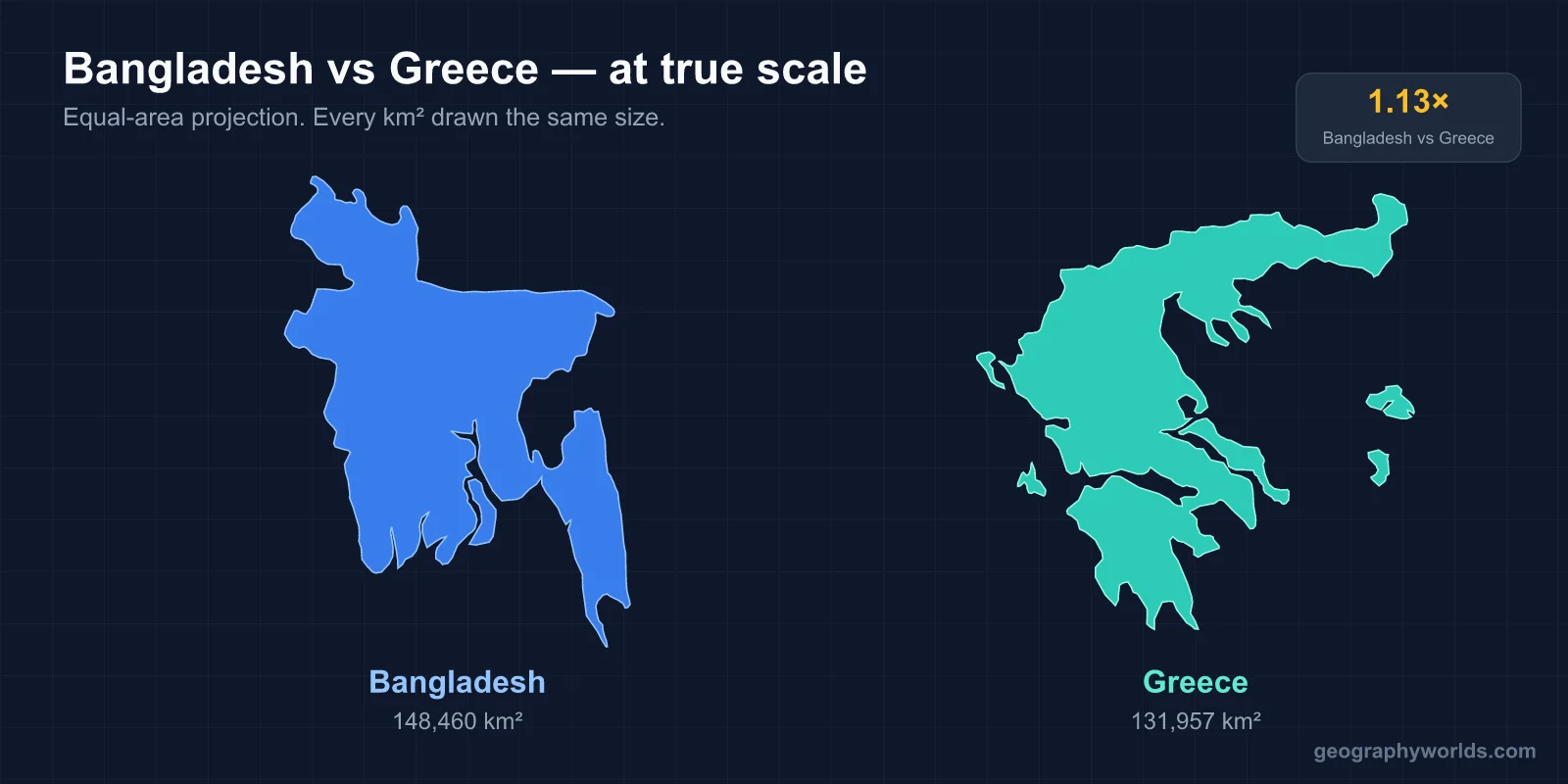
Yes. Bangladesh is slightly larger than Greece. Bangladesh covers 148,460 km², while Greece covers 131,957 km². Bangladesh is about 1.12 times the size of Greece — larger by 16,503 km², roughly the size of Kuwait. But Bangladesh has nearly 16 times more people than Greece (172 million vs 11 million).
The Short Answer
Bangladesh and Greece are both modest-sized countries — both ranking around 92nd-95th globally by area. But they're profoundly different: Bangladesh is one of the most densely populated countries on Earth (about 1,159 people per km² — among the highest in the world), while Greece is sparsely populated by European standards. Bangladesh has the world's 8th-largest population packed into a relatively small area; Greece has a population about the size of a single major city in Bangladesh.
The two countries are in completely different regions — Bangladesh in South Asia, Greece in southeastern Europe — and have radically different climates, cultures, and economies.

The Real Numbers
- Bangladesh total area: 148,460 km² (57,320 sq mi)
- Greece total area: 131,957 km² (50,949 sq mi)
- Difference: 16,503 km² — about the size of Kuwait
- Ratio: Bangladesh is about 1.12× the size of Greece
Population
Bangladesh has dramatically more people:
- Bangladesh population: ~172,000,000
- Greece population: ~10,400,000
- Bangladesh density: ~1,159 people per km²
- Greece density: ~79 people per km²
Bangladesh has about 16.5× more people than Greece. Bangladesh's population density (1,159 people/km²) is among the highest in the world — comparable to small city-states. Greece's density (79/km²) is below the European average.
Geography
Bangladesh is dominated by:
- The Ganges-Brahmaputra-Meghna Delta: The world's largest delta system, covering most of the country
- Bay of Bengal coast: 580 km of coastline, including the Sundarbans (largest mangrove forest in the world)
- Chittagong Hill Tracts: Hilly region in the southeast
- Major rivers: Ganges, Brahmaputra, Meghna, plus hundreds of smaller waterways
- Highest point: Saka Haphong (1,052 m) — surprisingly low for a country of Bangladesh's size
Greece has more mountainous and varied geography:
- Mainland Greece: Mountainous, with the Pindus Range running north to south
- Aegean Islands: About 6,000 islands (227 inhabited), including Crete, Rhodes, Mykonos, Santorini
- Mount Olympus: Greece's highest peak at 2,917 m, mythological home of the gods
- Three coastlines: Aegean (east), Ionian (west), and Mediterranean (south)
- Peloponnese Peninsula: Southern Greece
Climate
Bangladesh has tropical monsoon climate — hot summers (32-36°C), warm winters (10-25°C), and a heavy monsoon season (June-September) that brings most of the annual rainfall (1,500-2,500 mm). The country is highly vulnerable to flooding, cyclones, and storm surges from the Bay of Bengal.
Greece has Mediterranean climate dominant — hot dry summers (25-35°C), mild wet winters (5-15°C). The north has more continental influences, with colder winters. Greece is much drier and more temperate than Bangladesh.
Economy
Both have similar GDP totals despite the population difference:
- Bangladesh GDP: ~$460 billion
- Greece GDP: ~$248 billion
- Bangladesh per capita GDP: ~$2,700
- Greece per capita GDP: ~$23,900
Bangladesh's economy is about 85% larger than Greece's in absolute terms, but Greece is about 8.8× richer per capita. Bangladesh has been one of the fastest-growing economies in Asia, with GDP growth around 6-7% annually. The country is the world's 2nd-largest garment exporter (after China). Greece has a more developed but mature economy focused on shipping, tourism, agriculture, and services.
Industry
Bangladesh is a global manufacturing hub for textiles and ready-made garments — producing about 12% of global garment exports. Major brands (H&M, Walmart, Target, Zara) source heavily from Bangladesh. The country has also developed pharmaceutical and IT sectors.
Greece is famous for shipping — Greek shipowners control about 17% of the world's merchant fleet by tonnage, making Greece a leader in global maritime trade. Tourism is also crucial — Greece receives about 33 million international tourists annually. Other major sectors include agriculture (olive oil, wine, dairy), pharmaceuticals, and food processing.
Religion and Culture
Bangladesh is about 91% Muslim (mostly Sunni), with significant Hindu (8%), Buddhist, and Christian minorities. Bengali is the national language and a major cultural identity marker. Bengali poetry, literature, music (especially Rabindra Sangeet by Rabindranath Tagore), and cuisine are globally recognized.
Greece is about 90% Greek Orthodox Christian — the religion has been central to Greek identity since Roman times. Greek is the language of one of the world's longest continuous literary traditions. Ancient Greek civilization (philosophy, democracy, theater, sport) profoundly shaped Western culture. Modern Greek culture remains influential through cuisine, music, and academia.
History
Bangladesh is a relatively new country — gaining independence from Pakistan in 1971 after a brutal war. Before that, the region had been part of British India, the Mughal Empire, and earlier Bengali sultanates. Bengali culture stretches back over 3,000 years.
Greece has one of the world's oldest continuous civilizations — about 3,500 years of recorded Greek history. Ancient Greece produced democracy, classical philosophy, theater, and Olympic Games. After Byzantine and Ottoman rule, Greece gained independence in 1830 and became a modern nation-state.
Key Facts
- Bangladesh is about 1.12× the size of Greece.
- Bangladesh has 16.5× more people than Greece.
- Bangladesh is one of the most densely populated countries on Earth.
- Bangladesh's economy is 85% larger; Greece is 8.8× richer per capita.
- Both have significant histories — Greek over 3,500 years, Bengali over 3,000 years.
Fun Facts
- Bangladesh has more rivers (about 700) than any country in the world.
- Greece has the longest coastline in Europe (excluding islands) — about 13,676 km counting all islands.
- Bangladesh is the world's 8th-most populous country.
- Greece controls about 17% of the world's merchant shipping fleet.
- The Sundarbans mangrove forest in Bangladesh is home to the Royal Bengal Tiger.
Climate Vulnerability
Bangladesh is one of the world's most climate-vulnerable countries. The country's low elevation (much is just 1-3 m above sea level), combined with massive river deltas and cyclone risk, means even modest sea-level rise could displace tens of millions of Bangladeshis. The 1970 Bhola cyclone killed about 500,000 people — one of the deadliest natural disasters in history. The country has invested heavily in cyclone shelters, embankments, and warning systems.
Greece faces different but significant climate challenges. The Mediterranean climate is becoming hotter and drier, increasing wildfire risk. The summer of 2023 saw major wildfires across Greece. Water scarcity is becoming a concern in parts of the country. Sea-level rise threatens Greek coastal communities and archaeological sites.
Tourism
Both have major tourism but Greece is much more developed in this sector. Greece receives about 33 million international tourists annually — about 3× its population. The country is one of the world's top tourism destinations, with the Greek islands (Santorini, Mykonos, Crete, Rhodes) and ancient sites (Athens, Acropolis, Delphi) drawing visitors. Tourism contributes about 25% of Greek GDP.
Bangladesh receives relatively few international tourists — about 1 million annually. The country has significant potential — the Sundarbans mangrove forest, the longest natural sea beach in the world (Cox's Bazar, 120 km), historic sites, and rich culture. But infrastructure and security perceptions have limited tourism growth.
The Bottom Line
Bangladesh is slightly larger than Greece by area, but Bangladesh has 16.5× more people. Greece is dramatically richer per capita and has one of the world's oldest civilizations. Bangladesh has a much larger economy in absolute terms and is one of Asia's fastest-growing economies. The comparison highlights how dramatically population can vary between two similarly-sized countries — Bangladesh fits 172 million people in roughly the same space where Greece fits 10 million. The geographic similarities (comparable land area) coexist with vast differences in everything else: climate, culture, religion, language, economic structure, and political history. The two countries represent completely different patterns of human development on similarly-sized pieces of Earth's surface. Bangladesh's rapidly growing manufacturing economy and Greece's mature service-and-shipping economy face different challenges but both must navigate the global transition toward sustainability and digitization. Both also benefit from significant diaspora communities — Bangladeshi workers in the Middle East and elsewhere, Greeks across Europe and North America — that contribute to remittances and cultural influence. The size question is the simplest comparison; the deeper question of how 16× as many people live on nearly the same amount of land reveals more about the human geography of these two very different countries. Both nations have shaped global history in their own ways and will continue to play significant roles in their respective regions. Their geographic similarity is just an interesting coincidence; their human stories are completely different. Both, however, are essential to understanding modern Asia and modern Europe respectively. Both continue to play important roles in their regions and on the world stage.