
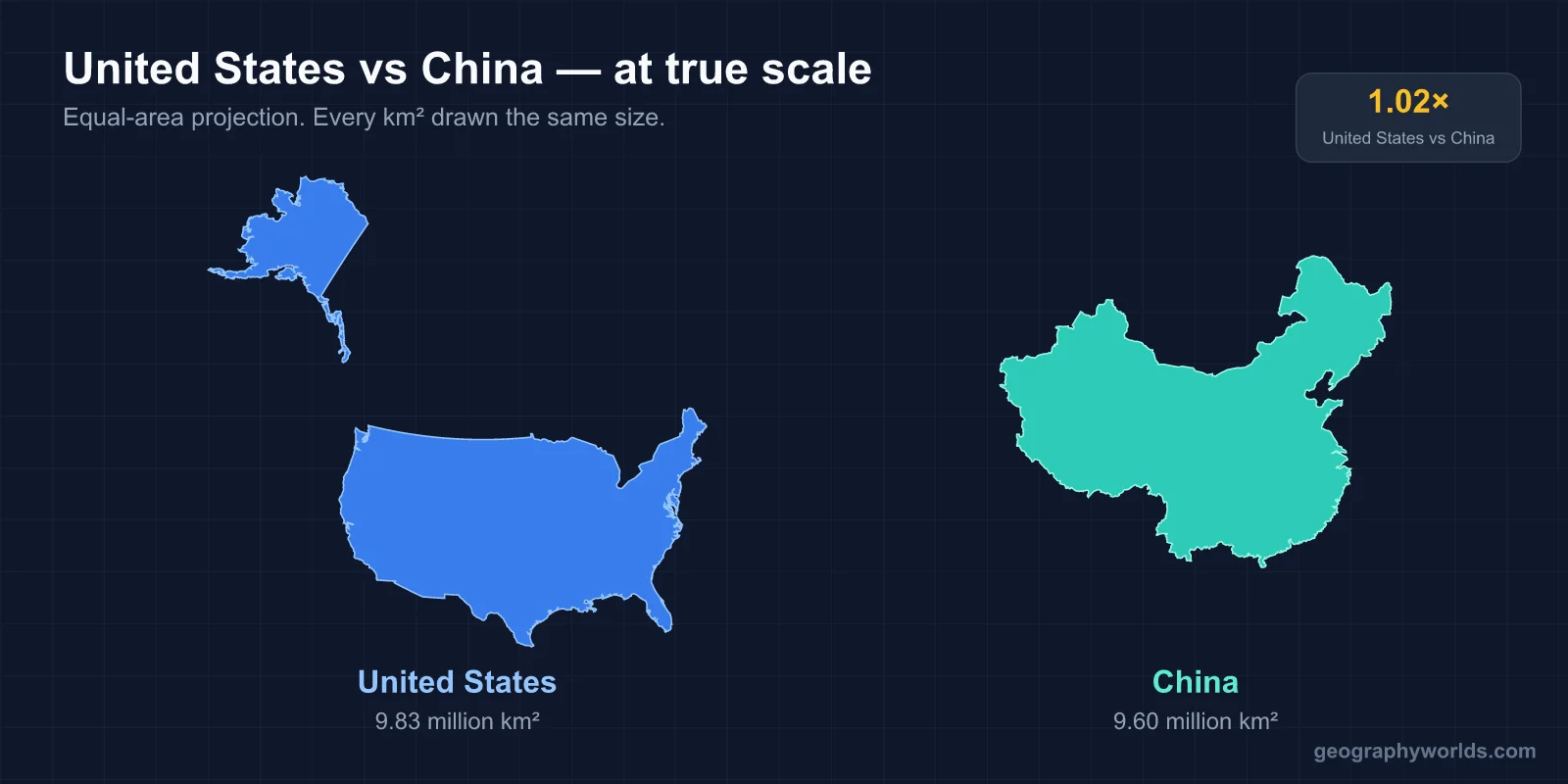
No, just barely. The United States covers 9,833,520 km², while China covers approximately 9,596,961 km². The US is about 2.5% larger than China — a difference of roughly 236,559 km², about the size of Romania. The two countries are so close in size that different sources rank them differently depending on whether disputed territories are counted.
The Short Answer
The US and China are the world's 3rd and 4th largest countries — or 4th and 3rd, depending on the source. The CIA World Factbook lists the US as 3rd at 9.83 million km², just ahead of China at 9.60 million km². The United Nations lists China as 3rd at 9.60 million km² and the US as 4th. The difference is small enough — about 2.5% — that the exact ranking shifts based on methodology.
What's clear: both are continental-scale countries that exceed Brazil, Australia, and India by significant margins. Only Russia (17.1 million km²) and Canada (9.98 million km²) are unambiguously larger than both. The China-vs-US comparison sits right at the edge where measurement choices matter.

The Real Numbers
- United States total area: 9,833,520 km² (3,796,742 sq mi)
- China total area: 9,596,961 km² (3,705,407 sq mi)
- Difference: 236,559 km² — about the size of Romania or the United Kingdom
- Ratio: US is about 1.025× the size of China
The figures above exclude disputed territories. If you include Aksai Chin (administered by China but claimed by India), Arunachal Pradesh (administered by India but claimed by China), Taiwan (de facto independent but claimed by China), and disputed border areas, the numbers shift slightly. Most sources put the gap between the US and China at 200,000 to 400,000 km² depending on which disputed areas are included.
Why Some Sources Rank China Bigger
Several factors contribute to the dispute:
- US water vs land totals: The US figure (9.83M km²) includes large internal water bodies (the Great Lakes within US territory, major rivers). China's figure typically excludes inland water surface areas.
- Disputed territories: China claims Taiwan, parts of Kashmir (Aksai Chin), and other areas. Including these would push China's area higher.
- EEZ vs land area: Both countries have substantial Exclusive Economic Zones in surrounding waters, but these aren't usually counted as "country area."
- Historical claims: China's nine-dash line in the South China Sea adds claimed maritime territory not recognized internationally.
The CIA World Factbook uses a consistent methodology that puts the US slightly ahead. Most other major sources agree, with the US ranking 3rd and China 4th. But the close finish means both countries can credibly claim "3rd largest" depending on the audience.
Population: China Dominates
While the size comparison is close, the population gap is vast:
- China population: ~1,410,000,000
- US population: ~333,000,000
- China density: ~147 people per km²
- US density: ~36 people per km²
China has about 4.2× more people than the US, packed into 2.5% less land. China's population density is about 4× higher than the US's. But this average hides huge regional differences — eastern China is very densely populated, while western China (Tibet, Xinjiang) is nearly empty.
Population Distribution
About 94% of China's population lives east of the so-called "Hu Line" — an imaginary boundary running from northeast (Heilongjiang) to southwest (Yunnan). The eastern half of China is densely populated, urban, and agricultural. The western half is mostly mountains, deserts, and steppes — sparse population, low GDP, but ethnically diverse.
The US population distribution is more even but still has its own patterns. The Northeast Corridor (Boston-Washington), the Great Lakes region, California, the Southeast, and Texas are heavily populated. The Mountain West and the Plains are much sparser. The US doesn't have a single "empty quarter" like western China, but its population isn't evenly distributed either.
Economy: A Close Comparison
By nominal GDP, the US economy is the world's largest:
- US GDP (nominal): ~$26.9 trillion
- China GDP (nominal): ~$17.7 trillion
- US per capita GDP: ~$80,000
- China per capita GDP: ~$12,800
But by PPP (purchasing power parity, which accounts for price differences), China's economy is actually larger than the US's — about $30 trillion (PPP) vs $26.9 trillion (PPP). So which has the "bigger" economy depends on the measurement. On consumption volume and goods produced, China leads. On dollar-denominated activity at market exchange rates, the US leads.
Geographic Diversity
Both countries span enormous geographic variety. China contains the Himalayas (the world's highest mountains), the Taklamakan and Gobi deserts, the fertile North China Plain, the Yangtze and Yellow river basins, tropical Hainan Island, and the high Tibetan Plateau (the largest plateau on Earth). China spans about 31 degrees of latitude (from 18°N at Hainan to 53°N in Heilongjiang).
The US spans roughly 49 degrees of latitude (from 18°N in Hawaii to 71°N in Alaska's North Slope). It contains the Rockies, the Appalachians, the Great Plains, the Mississippi-Missouri river system, deserts (Mojave, Sonoran, Great Basin), the Great Lakes, the Gulf Coast, and the Alaskan and Hawaiian extremes. Both countries are exceptionally diverse in landscape.
Climate Comparison
China's climate ranges from tropical in the south (Hainan, Yunnan) to subarctic in the north (Heilongjiang, Inner Mongolia). It has a strong monsoon influence in the east, severe continental climate in the interior, and high-altitude cold in Tibet. China has been hit by major floods, droughts, and typhoons throughout its history.
The US climate range is even greater — from tropical Hawaii and Florida to arctic Alaska, with deserts, prairies, temperate forests, and Mediterranean zones in between. The US has hurricanes, tornadoes, blizzards, wildfires, and earthquakes across various regions. Climate diversity in the US slightly exceeds China's, primarily because of Alaska and Hawaii.
Coastlines
The US has roughly 19,924 km of coastline (counting Alaska's deeply indented coast). China has roughly 14,500 km of coastline along the Pacific. Both countries have major shipping ports, naval power, and coastal economies. The US has Atlantic, Pacific, Gulf of Mexico, and Arctic coastlines — touching three oceans. China has only Pacific coastline. So while the coastline lengths are comparable, the US has more diverse marine access.
Time Zones — A Stark Contrast
China officially uses a single time zone — Beijing Standard Time (UTC+8) — across its entire 5,200 km east-to-west expanse. This means that in western Xinjiang, sunrise can occur as late as 10 AM in winter and sunset as late as 10 PM in summer, because the official time is set for Beijing 4,000 km east. The single-time-zone policy is a legacy of Mao-era unification efforts and continues despite the geographic awkwardness it creates.
The US has 6 official time zones (Pacific, Mountain, Central, Eastern, Alaska, Hawaii-Aleutian), aligning local time with the position of the sun. Crossing from New York to LA means changing clocks 3 times to keep noon roughly at noon. The two approaches reflect very different national philosophies about geographic uniformity versus practical solar alignment.
Key Facts
- The US is about 2.5% larger than China by area.
- China has 4.2× more people than the US.
- China's population density is 4× higher than the US's.
- By nominal GDP, the US is larger; by PPP, China is larger.
- Different sources rank these two countries 3rd-4th and 4th-3rd depending on methodology.
Fun Facts
- If you took just the contiguous US (without Alaska or Hawaii), China would be bigger.
- China has more time zones officially (1 — all of China uses Beijing time), while the US has 6.
- The Great Wall of China is about 21,196 km long — longer than the diameter of the moon (3,475 km) or even Earth (12,742 km).
- The US has more lakes than China by a wide margin.
- China's Three Gorges Dam is the world's largest power plant by capacity (22,500 MW).
- China shares borders with 14 countries (the most of any country, tied with Russia); the US shares borders with only 2.
- China's Forbidden City in Beijing is about 720,000 m² — roughly the size of the US National Mall in Washington DC.
The Bottom Line
The US is slightly bigger than China — by about 2.5%, or the size of Romania. The two countries are so close in area that the ranking can flip depending on which sources you trust and which territories you include. Both are continental-scale superpowers with massive populations, diverse geography, and global economic and political influence.
For the foreseeable future, the US and China will remain the 3rd and 4th largest countries on Earth, regardless of which comes first. The economic and political rivalry between them shapes 21st-century geopolitics. The size question is settled at the margin — the more interesting question is how each uses its land, people, and resources.