
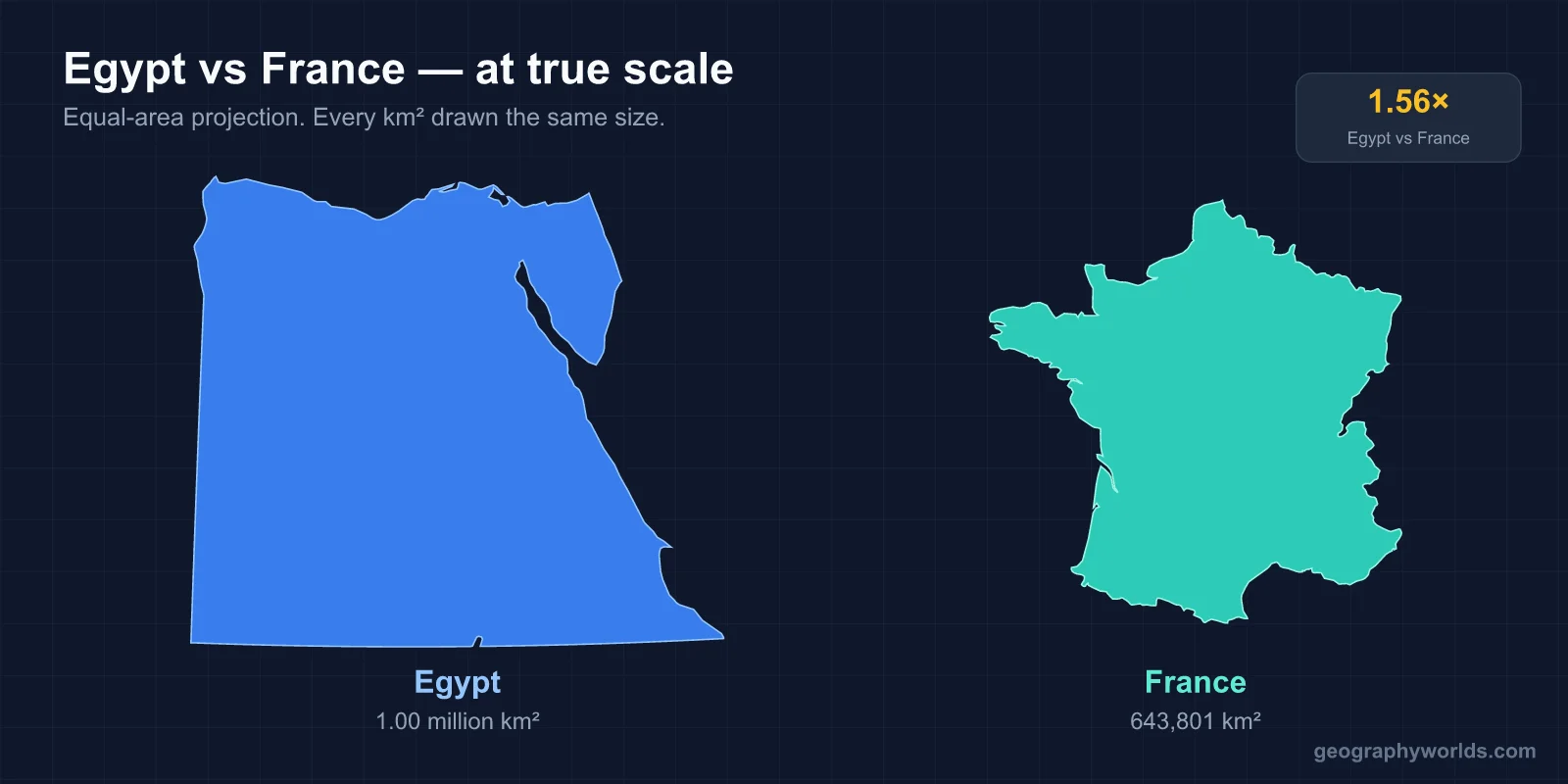
Yes. Egypt is larger than France. Egypt covers 1,001,450 km², while metropolitan France covers 643,801 km². Egypt is about 1.55 times the size of France — larger by 357,649 km², which is about the area of Germany. But most of Egypt is empty desert; the inhabited zone along the Nile is much smaller than France.
The Short Answer
Egypt is the 30th-largest country in the world and one of the largest in North Africa. France is the 42nd-largest country (in its metropolitan European territory). Egypt wins the head-to-head size comparison clearly. But the comparison becomes more nuanced when you consider that 95-97% of Egypt's population lives along the Nile River and its delta — a strip of habitable land covering only about 40,000 km² (less than 4% of Egypt's total area).
So while Egypt is geographically much larger, the actually-inhabited Egypt is dramatically smaller than France. The two countries have similar populations but radically different population distributions.
The Real Numbers
- Egypt total area: 1,001,450 km² (386,662 sq mi)
- France (metropolitan) total area: 643,801 km² (248,573 sq mi)
- Difference: 357,649 km² — about the size of Germany
- Ratio: Egypt is about 1.55× the size of France
Note: this comparison uses metropolitan France. If you include French overseas territories (French Guiana, Reunion, Martinique, etc.), France grows to about 763,000 km² — making Egypt only 1.31× larger than total France.
Population
Egypt has more people than France:
- Egypt population: ~110,000,000
- France population: ~68,000,000
- Egypt density (national): ~110 people per km²
- France density: ~106 people per km²
Egypt has about 62% more people than France. The national population densities look similar, but the reality is very different. France's population is distributed across most of its territory; Egypt's population is concentrated in less than 5% of its land. In the inhabited zone along the Nile, Egyptian population density approaches 1,500 people per km² — about 14× France's overall density.
Geography
Egypt is dominated by desert:
- Western Desert: Part of the Sahara, covering about 2/3 of Egypt
- Eastern Desert: Between the Nile and the Red Sea
- Sinai Peninsula: Triangular landmass between Africa and Asia
- The Nile Valley: A green strip of farmland from south to north
- The Nile Delta: Fan-shaped fertile delta on the Mediterranean
- Lake Nasser: Massive reservoir behind the Aswan High Dam
France has remarkable geographic diversity:
- Alps: Southeastern mountains, including Mont Blanc (4,808 m)
- Pyrenees: Spanish border mountains
- Massif Central: Plateau in the south-central region
- Brittany: Coastal peninsula in the northwest
- Mediterranean coast: Côte d'Azur, Provence
- Atlantic coast: Aquitaine, Bay of Biscay
- Major rivers: Seine, Rhône, Loire, Garonne, Rhine
Climate
Egypt has hot desert climate dominant. Summers are extremely hot (40-45°C in most of the country). Winters are mild (10-20°C average). Rainfall is minimal — most of Egypt receives less than 25 mm annually. The Mediterranean coast (Alexandria, Marsa Matruh) gets slightly more rain and has a milder climate.
France has temperate climate dominant. Northern France has oceanic climate (mild, wet). Central and eastern France have continental influence (colder winters, warmer summers). Southern France has Mediterranean climate (hot dry summers, mild wet winters). The Alps have alpine climate. France has all four seasons distinctly across most of its territory.
Economy
France's economy is much larger:
- France GDP: ~$3.1 trillion
- Egypt GDP: ~$398 billion
- France per capita GDP: ~$46,000
- Egypt per capita GDP: ~$3,600
France's economy is about 8× larger than Egypt's. Per capita, France is about 13× richer on average. France is the 7th-largest economy in the world; Egypt is the 41st. France has a highly diversified, developed economy — manufacturing (Airbus, Renault, automotive supplies), luxury goods (LVMH, L'Oréal, Kering), finance, technology, agriculture, and tourism.
Egypt's economy is heavily based on tourism, Suez Canal revenues, remittances from Egyptians abroad, agriculture (Nile delta), oil and gas, manufacturing, and services. The country is a middle-income economy with significant poverty and unemployment challenges.
History and Civilization
Egypt has one of the longest continuous civilizations on Earth — over 5,000 years. Ancient Egypt produced the pyramids, hieroglyphic writing, advanced engineering, and a sophisticated religious-political system. After 30 dynasties, Egypt was conquered by Persians, Greeks (Alexander the Great), Romans, Arabs, Ottomans, and the British before becoming fully independent in 1952. The Suez Canal opened in 1869, creating a critical trade route between the Mediterranean and Indian Ocean.
France has been one of the most influential European countries for over 1,200 years. The Frankish Kingdom unified much of Western Europe in the 8th century. France was a major colonial power (especially in Africa and Indochina), the birthplace of the modern democratic revolution (1789), and a center of Enlightenment thought. Modern France is a founding member of the EU and one of the UN Security Council's permanent five.
The Suez Canal vs the English Channel
Egypt controls the Suez Canal, one of the world's most important waterways. The canal connects the Mediterranean and Red Seas, enabling ships to travel between Europe and Asia without sailing around Africa. About 12% of world trade by tonnage passes through Suez. Canal fees generated about $9 billion for Egypt in 2023.
France borders the English Channel — the busy waterway between France and the UK. About 500 ships pass through the Dover Strait daily. The Channel Tunnel (Eurotunnel), opened in 1994, connects Calais (France) to Folkestone (England) via a 50-km undersea rail tunnel. France's position controls one of the world's key maritime corridors, similar in significance to Egypt's Suez.
Key Facts
- Egypt is about 1.55× the size of France.
- Egypt has 62% more people than France.
- France's GDP is 8× larger than Egypt's.
- 95-97% of Egypt's population lives along the Nile.
- Both control strategic maritime corridors (Suez and English Channel/Eurotunnel).
Fun Facts
- Egypt's population would fit comfortably in the Nile Delta alone (about 24,000 km²).
- France's LVMH luxury conglomerate is worth more than Egypt's entire annual GDP.
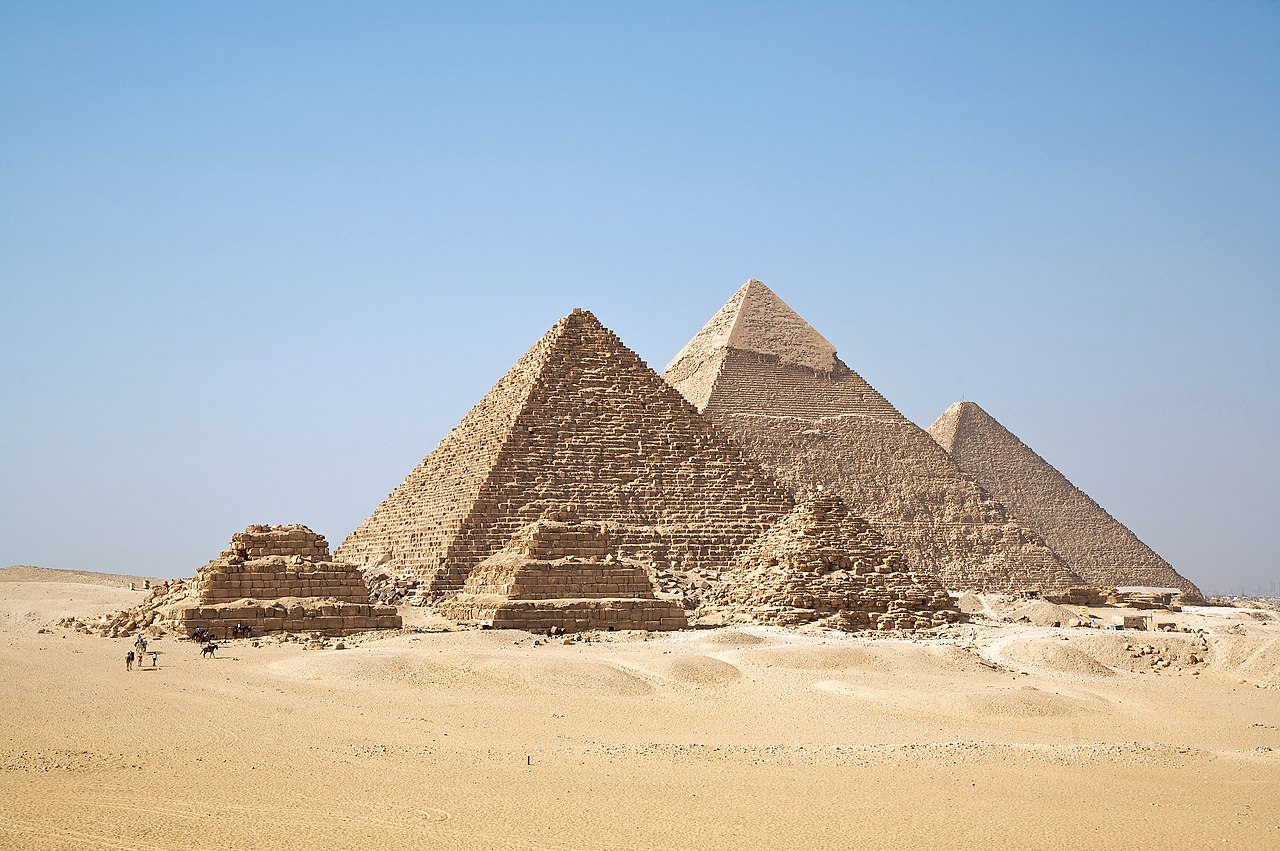
- The Great Pyramid of Giza was the tallest human-made structure for over 3,800 years — until the Eiffel Tower was built in 1889.
- France has 58 UNESCO World Heritage Sites (5th in the world); Egypt has 7 (still significant).
- The Suez Canal's 2021 blockage by the Ever Given container ship cost about $9 billion per day in disrupted trade.
- Egypt's population is the largest in the Arab world and the third-largest in Africa (after Nigeria and Ethiopia).
- France has more time zones than any country in the world (12 total) when including all overseas territories.
- The Egyptian Pound has been Egypt's currency since 1834; the Euro has been France's currency since 1999, replacing the franc.
Languages and Religion
Egypt's official language is Arabic, with Egyptian Arabic being the most widely spoken Arabic dialect in the world due to Egyptian films and music spreading throughout the Arab world. About 90% of Egyptians are Sunni Muslim, with a significant Coptic Christian minority (about 10%) — one of the oldest Christian communities in the world.
France's official language is French — spoken by about 300 million people worldwide due to French colonial history. France is officially secular (laïcité), but is historically Catholic — about 60% of French people identify with Christianity, with smaller Muslim (about 8%), Jewish, and Buddhist populations. The country has a long tradition of religious freedom alongside strong secularism in public life.
Tourism Industries
France is the world's most-visited country, receiving about 90 million international tourists annually — more than any other country. Paris alone attracts about 30 million visitors per year. Major attractions: Eiffel Tower, Louvre Museum, Versailles, the French Riviera, Mont Saint-Michel, the Loire Valley castles. Tourism contributes about 8% of French GDP.
Egypt receives about 13 million international tourists annually. Major attractions: Pyramids of Giza, Sphinx, Luxor (Karnak, Valley of the Kings), Abu Simbel, the Red Sea coast (Hurghada, Sharm El Sheikh), Cairo (Egyptian Museum). Tourism is critical to Egypt's economy — about 12% of GDP and a major source of foreign currency.
The Bottom Line
Egypt is bigger than France by area (55% larger) but only because most of Egypt is uninhabited desert. France's populated, developed area dwarfs Egypt's inhabited Nile zone. France has a much larger economy, higher per-capita income, and broader land use. Egypt has more people and one of the world's oldest civilizations. The two countries represent dramatically different patterns of geography and human use. Egypt's narrow Nile strip is one of the most densely populated places on Earth, while France distributes its 68 million people across nearly all its land area — two opposite models of how to fill a country.
Quiz Mediterranean Geography!
Test your knowledge of Egypt, France, and the region.
Play Geography Games →