
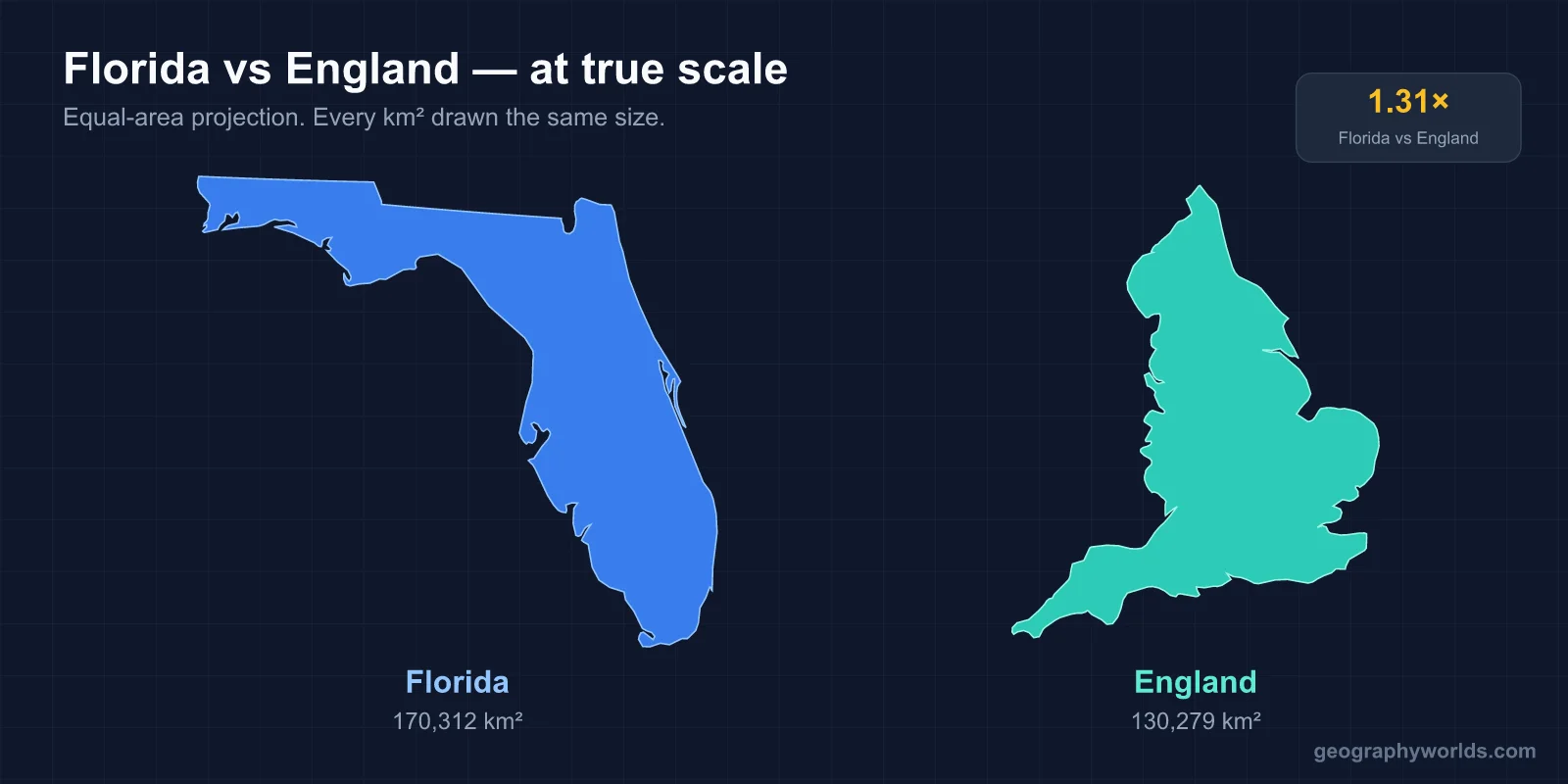
Yes. Florida is larger than England. Florida covers 170,312 km², while England covers 130,279 km². Florida is about 1.31 times the size of England — larger by 40,033 km², which is roughly the size of the Netherlands or Switzerland. But England has about 2.5 times more people than Florida.
The Short Answer
Florida (a US state) and England (a constituent country of the UK) are commonly compared because of their similar shapes (Florida is a peninsula; England is most of an island), similar economic importance, and similar tourist appeal. Both are major sub-national entities — Florida ranks 22nd among US states by area; England is the largest of the UK's four constituent countries.
Florida is bigger by area, but England has substantially more people (56 million vs Florida's 22 million). The two regions represent different scales of urbanization — England is one of the most densely populated places in the world, while Florida has lots of space (especially in the panhandle and central Florida) that isn't heavily developed.

The Real Numbers
- Florida total area: 170,312 km² (65,758 sq mi)
- England total area: 130,279 km² (50,301 sq mi)
- Difference: 40,033 km² — about the size of the Netherlands or Switzerland
- Ratio: Florida is about 1.31× the size of England
For context, if Florida were a country, it would rank about 95th in the world by area. England, if it were a country (it's part of the UK), would rank about 110th. Both are mid-sized regions globally.
Population
England dominates:
- England population: ~56,500,000
- Florida population: ~22,600,000
- England density: ~434 people per km²
- Florida density: ~133 people per km²
England has about 2.5× more people than Florida, packed into 24% less land. England's population density (434/km²) is among the highest in the world — about 3.3× Florida's density. England is genuinely densely settled; Florida has lots of empty space, particularly in the central forests and the panhandle's rural areas.
Geographic Setting
Florida is a peninsula extending south from the southeastern United States, with the Gulf of Mexico to the west and the Atlantic Ocean to the east. The state's southernmost point (Key West) is at about 24.5°N latitude — making it the southernmost continental US state. Florida is mostly flat (the highest point is just 105 m) with extensive wetlands (the Everglades), beaches, and pine forests.
England occupies the southern two-thirds of the island of Great Britain. It's bordered by Wales to the west, Scotland to the north, and the English Channel and North Sea to the south and east. England has more topographic variety than Florida — the Pennine Mountains in the north, the Lake District, the Cotswolds, the South Downs, and varied coastlines.
Climate
Florida has subtropical to tropical climate. Summers are hot and humid (28-33°C with high humidity). Winters are mild — South Florida (Miami) rarely sees freezing temperatures, while North Florida occasionally does. Hurricane season runs from June to November, with major storms occasionally hitting the state (especially the Gulf coast and the Florida Keys).
England has a temperate oceanic climate — mild, wet, and famously variable. Summers average 17-22°C with occasional heat waves. Winters average 4-7°C with rare deep cold. Rainfall is moderate and distributed across the year. Snow is rare in southern England (London), more common in the north and uplands.
Economy
Both regions have major economies:
- England GDP: ~$2.8 trillion
- Florida GDP: ~$1.3 trillion
- England per capita GDP: ~$49,000
- Florida per capita GDP: ~$57,000
England's economy is about 2.2× larger than Florida's in absolute terms, but Florida has higher per-capita GDP (about 16% richer per person). England is the UK's economic engine — London alone generates about 22% of UK GDP. Florida's economy is diversified — tourism, agriculture, finance, healthcare, defense, and aerospace are major sectors.
Tourism
Both are major tourist destinations. Florida receives about 130-140 million visitors annually (including domestic tourists). Major attractions: Walt Disney World, Universal Studios, Miami Beach, the Florida Keys, the Everglades, Kennedy Space Center, Daytona Beach, beaches throughout the state.
England receives about 38 million international tourists annually, plus much domestic tourism. Major attractions: London (the Tower, Buckingham Palace, Big Ben, Westminster Abbey, the British Museum), Stonehenge, Bath, the Cotswolds, the Lake District, York, Liverpool, Cornwall.
History
Florida has a varied colonial history. The state was claimed by Spain in 1513 (Ponce de León), held by various European powers, and eventually became part of the US in 1819. Florida joined the Union in 1845 as the 27th state. The state seceded during the Civil War and was readmitted afterward. Modern Florida's population boomed after WWII with the rise of air conditioning, tourism, and retirement migration.
England has a much longer recorded history — over 2,000 years of continuous habitation as a defined polity. From Anglo-Saxon kingdoms (5th-11th centuries) to the Norman Conquest (1066), the Plantagenets, Tudors, Stuarts, and the modern UK, England has been one of the most influential regions in world history. The British Empire at its peak controlled about 25% of the world's population and land area.
Notable Differences
Florida is famous for:
- Theme parks (Disney, Universal)
- Citrus production (oranges, grapefruit)
- Retirement community demographics
- NASA's Kennedy Space Center
- Cuban-American influence (especially Miami)
- Hurricanes (Andrew 1992, Katrina-influenced 2005 era, Irma 2017, Ian 2022)
- Everglades National Park (subtropical wilderness)
England is famous for:
- Royal family and monarchy
- Premier League football (the world's most popular sports league)
- Shakespeare, Dickens, Austen, and English literary tradition
- The Beatles, Rolling Stones, and British rock
- The City of London (global financial center)
- Pub culture and traditional British food
- Oxford and Cambridge universities
Key Facts
- Florida is about 1.31× the size of England.
- England has 2.5× more people than Florida.
- England's economy is 2.2× larger than Florida's in absolute terms.
- Florida has higher per-capita GDP than England.
- Both have major tourism industries and similar coastal/temperate climates (though Florida is subtropical).
Fun Facts
- Florida has more coastline than any other state except Alaska — about 1,350 miles of coastline.
- England has more bookstores per square kilometer than Florida.
- The Spanish founded St. Augustine, Florida in 1565 — the oldest continuously inhabited European settlement in the US.
- England's pub-to-population ratio is one of the highest in the world.
- Florida produces about 70% of the US orange supply.
- If England were a US state, it would be the most populous (more than California's 39 million).
- Florida's panhandle is 320 km long but only 80 km wide — a uniquely shaped portion of the state.
- The London metropolitan area alone (~14 million people) has more residents than Florida's entire metro areas combined (Miami, Tampa, Orlando, Jacksonville).
Healthcare and Public Services
England has the National Health Service (NHS), one of the world's most famous public healthcare systems, founded in 1948. The NHS provides healthcare to all UK residents largely free at point of use, funded by taxation. England (and the UK) consistently ranks high in healthcare access and outcomes by international standards.
Florida has the US healthcare system — a mix of private insurance, employer-based coverage, and government programs (Medicare for seniors, Medicaid for low-income residents). Healthcare costs are dramatically higher in Florida than in England, and millions of Floridians lack health insurance. The contrast between the two systems is one of the most stark policy differences between Florida and England.
Sports and Recreation
England is football-mad. The Premier League is the world's most-watched sports league. The country produced football, cricket, and rugby — all major global sports today. England hosts iconic events like Wimbledon (tennis), the FA Cup final, and the Lord's cricket ground (Test matches).
Florida's sports culture is more diverse. The state hosts NFL teams (Tampa Bay Buccaneers, Miami Dolphins, Jacksonville Jaguars), NBA teams (Miami Heat, Orlando Magic), NHL teams (Florida Panthers, Tampa Bay Lightning), MLB teams (Tampa Bay Rays, Miami Marlins), and major motorsports (Daytona 500). Outdoor recreation — fishing, boating, beach sports, golf — is also a defining feature of Florida.
The Bottom Line
Florida is bigger than England by area (about 31% larger), but England has 2.5× more people and a 2.2× larger economy. The two regions represent very different scales of urbanization and history. Florida is a relatively recently developed area with massive tourism and retirement industries; England is one of the oldest continuously developed political entities in the world. Despite their dramatic differences in history and density, both are economic powerhouses by global standards and contribute disproportionately to their respective national economies. Comparing them illustrates how size and population scale differently — Florida's extra area is filled with sparsely populated wetlands and forests, while England packs people densely across nearly all of its land.