
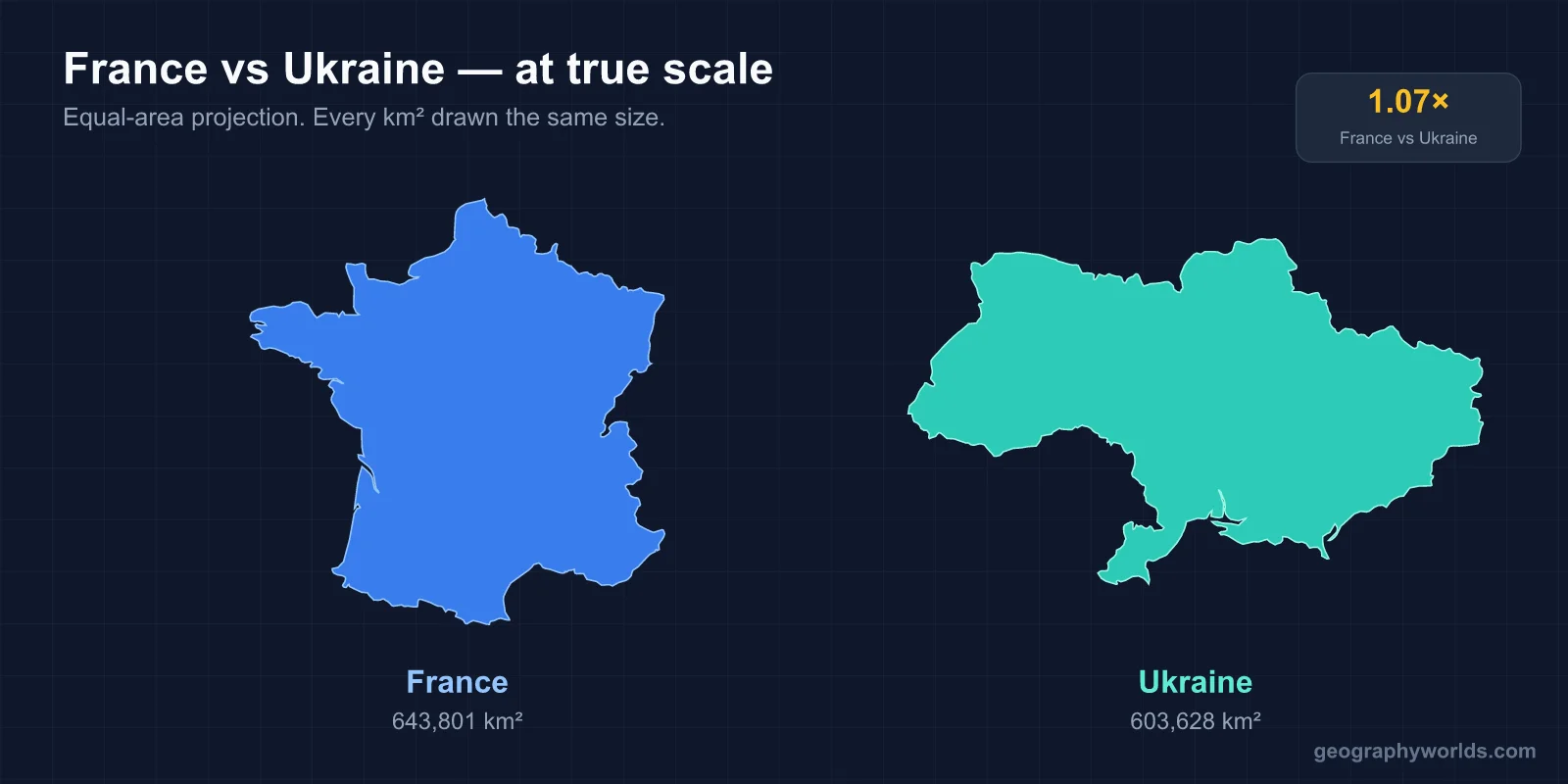
Yes, just barely. France is slightly larger than Ukraine. France covers 643,801 km², while Ukraine covers 603,628 km². France is about 1.07 times the size of Ukraine — larger by 40,173 km², about the size of Switzerland. But Ukraine is the second-largest country entirely within Europe (after European Russia, which is part of Russia, the largest country).
The Short Answer
France and Ukraine are two of Europe's largest countries. France is the 3rd largest in Europe (after Russia and Ukraine, with metropolitan France only). Ukraine is the 2nd largest country entirely within Europe (Russia is larger but extends across both Europe and Asia). Both are major European nations with deep historical legacies and significant contemporary geopolitical importance.
The size comparison is interesting because Ukraine has been at the center of European politics since Russia's full-scale invasion in 2022. France has been a major European power for over 1,000 years. Both are members of major international organizations (France in NATO, EU, G7; Ukraine seeking deeper EU integration and NATO membership).

The Real Numbers
- France (metropolitan) total area: 643,801 km² (248,573 sq mi)
- Ukraine total area: 603,628 km² (233,063 sq mi)
- Difference: 40,173 km² — about the size of Switzerland
- Ratio: France is about 1.07× the size of Ukraine
Note: Ukraine's area includes Crimea (occupied by Russia since 2014) and other territories currently under Russian military occupation. Ukraine's internationally recognized borders include these territories.
Population
France has more people than Ukraine:
- France population: ~68,000,000
- Ukraine population: ~37,000,000 (pre-war), now significantly reduced due to war refugees
- France density: ~106 people per km²
- Ukraine density: ~61 people per km² (pre-war)
France has about 84% more people than Ukraine (using pre-war figures). The Ukraine war has caused massive displacement — about 7 million Ukrainians have fled abroad (mainly to other European countries) and millions more are internally displaced. The current population on Ukrainian-controlled territory is significantly lower than pre-war figures.
Geography
France has remarkable geographic diversity:
- The Alps: Including Mont Blanc (4,808 m), highest peak in Western Europe
- Pyrenees: Border with Spain
- Massif Central: Plateau in south-central France
- Loire Valley: Famous wine and chateaux region
- Mediterranean and Atlantic coasts: Plus English Channel
- Major rivers: Seine, Rhône, Loire, Garonne
Ukraine has its own diverse geography:
- Carpathian Mountains: Western Ukraine, including Hoverla (2,061 m), the highest peak
- Crimean Peninsula: Currently occupied by Russia
- The Steppe: Most of central and southern Ukraine — fertile black soil region
- Black Sea coast: About 2,782 km of coastline
- Sea of Azov coast: Northern arm of the Black Sea
- Major rivers: Dnipro (most important), Dnister, Southern Bug
Climate
France has temperate climate — oceanic in the west, continental in the east, Mediterranean in the south, alpine in the mountains. The country has all four seasons distinctly across most of its territory.
Ukraine has primarily continental climate — colder than France with hotter summers. Winters bring significant snow across most of the country. The Black Sea coast has milder climate. Ukraine's climate is more similar to that of Russia and Belarus than to most of Western Europe.
Economy
France has a dramatically larger economy:
- France GDP: ~$3.1 trillion
- Ukraine GDP: ~$200 billion (pre-war was about $200 billion; war has significantly impacted the economy)
- France per capita GDP: ~$46,000
- Ukraine per capita GDP: ~$5,000
France's economy is about 15× larger than Ukraine's in absolute terms, and about 9× richer per capita. France is the 7th-largest economy in the world. Ukraine's economy has been devastated by Russian invasion — about 25% of GDP was lost in 2022 alone. Recovery and reconstruction will take decades and require massive international investment.
History
France has been a unified state since 843 AD (Treaty of Verdun). The country has been a kingdom, a republic, an empire, and a modern democratic republic. France was a major European colonial power, and French culture has shaped Western civilization profoundly (Enlightenment, French Revolution, modern democracy).
Ukraine's modern history is complex. The Kyivan Rus (9th-13th centuries) is considered the precursor to modern Ukraine, Russia, and Belarus. Ukraine has been ruled by various powers — Mongols, Lithuania, Poland, the Ottoman Empire, Tsarist Russia, the Soviet Union. Ukraine declared independence in 1991 after the Soviet Union's dissolution. The country has been at war with Russia since 2014 (when Russia invaded and annexed Crimea), with full-scale war beginning in February 2022.
Cultural Significance
France has produced an extraordinary cultural legacy — Voltaire, Rousseau, Descartes, Hugo, Proust, Sartre, Camus in philosophy and literature; Monet, Manet, Cézanne, Renoir in art; Bizet, Debussy, Ravel in music. French cuisine has been recognized as UNESCO Intangible Cultural Heritage. France remains a global cultural and intellectual leader.
Ukraine has its own rich cultural heritage. Famous Ukrainians include writer Taras Shevchenko (national poet), composer Mykola Lysenko, novelist Mikhail Bulgakov (born in Kyiv), filmmaker Sergei Bondarchuk, and many others. Ukrainian folk music, dance, and embroidery traditions are distinctive and globally recognized. The vyshyvanka (embroidered shirt) has become a symbol of Ukrainian national identity.
Languages
France's official language is French — one of the world's most prestigious languages with about 300 million speakers globally. Regional languages (Breton, Occitan, Catalan, Basque, Corsican, Alsatian) have varying levels of recognition.
Ukraine's official language is Ukrainian (an East Slavic language related to Russian and Belarusian). Russian is widely spoken, particularly in eastern Ukraine and Crimea. Since the 2014 Russian invasion and especially since 2022, there has been a strong shift toward Ukrainian usage. Other regional languages include Hungarian, Romanian, Polish, and others in border regions.
Key Facts
- France is just 7% larger than Ukraine.
- Ukraine is the 2nd-largest country entirely within Europe (after European Russia).
- France has 84% more people than Ukraine (pre-war).
- France's economy is 15× larger than Ukraine's.
- Ukraine has been at war with Russia since 2014 (full-scale war since 2022).
Fun Facts
- Both countries have UNESCO-recognized cultural traditions — French cuisine and Ukrainian Borshch (UNESCO Intangible Cultural Heritage 2022).
- France has 58 UNESCO World Heritage Sites; Ukraine has 8.
- The Ukrainian "Holodomor" (man-made famine, 1932-33) killed millions during Soviet rule.
- France has the highest minimum legal vacation days in the EU (5 weeks).
- Ukraine is home to one of Europe's largest preserved historic city centers — Lviv.
Agriculture
Both countries are agricultural powerhouses but in very different categories. France is the EU's largest agricultural producer by value, dominating in wine (the largest exporter by value globally, producing about 45 million hectoliters per year), wheat, dairy, beef, and luxury foods. Ukraine, before the 2022 invasion, was one of the world's largest exporters of sunflower oil, corn, wheat, barley, and rapeseed. Its chernozem ("black earth") soils are some of the most fertile on the planet — roughly a quarter of the world's most fertile soil lies in Ukraine. The war has badly disrupted Ukraine's exports, contributing to global food price spikes and food insecurity in Africa and the Middle East.
Geography Within Each Country
France's geography is famously varied for a country its size: the Alps in the southeast (Mont Blanc, 4,810 m), the Pyrenees on the Spanish border, the Massif Central plateau, the Mediterranean coast, the Atlantic coast, and the Channel coast in the north. Ukraine is overwhelmingly flat — the steppe and forest-steppe dominate. The Carpathian Mountains in the west are the only major highlands; Hoverla at 2,061 m is the highest point. The Dnieper River flows for over 2,200 km through Ukraine, dividing the country roughly in half. The southern coast on the Black Sea, including Crimea (currently under Russian occupation), is a strategically critical region.
Languages and People
France has one official language — French — spoken by virtually all 67 million residents, with regional languages like Breton, Occitan, Alsatian, and Basque surviving as minority tongues. The country has been a magnet for immigration from former colonies in North and West Africa, and Paris is one of the most diverse capitals in Europe. Ukraine is largely bilingual between Ukrainian and Russian, with Ukrainian being the sole official language. Use of Russian has declined sharply since 2014 and again since 2022 as a matter of national identity. Other languages spoken include Crimean Tatar, Polish, Hungarian, and Romanian along various borders. Both countries share strong Orthodox Christian heritage in Ukraine and Roman Catholic heritage in France, though both are now largely secular societies.
The Bottom Line
France is barely larger than Ukraine — about 7% larger. France has dramatically more people, a much larger economy, and a longer continuous unified history. Ukraine has been Europe's largest country entirely within the continent (excluding European Russia) but has been at war for years. Both will continue to play critical roles in shaping Europe — France as a leader of the EU and a major Western power, Ukraine as the front line of European democracy and a potential future EU member. The size similarity is just a coincidence; their political and economic trajectories are very different.