
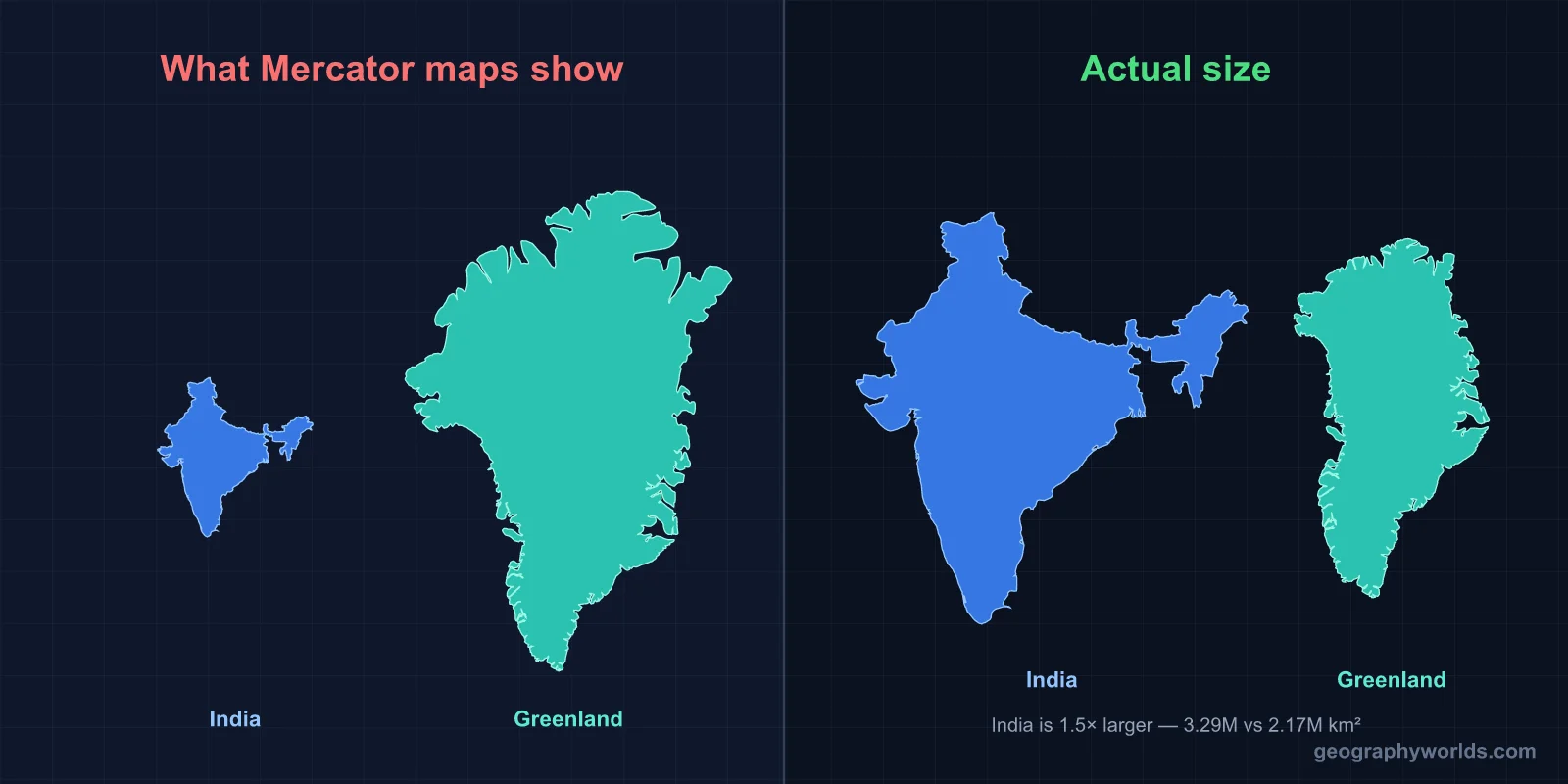
Greenland looks enormous on most world maps — sometimes as big as Africa, often bigger than the entire United States or India. But this is largely a cartographic trick. Greenland is actually smaller than India. The Mercator projection that dominates most maps grossly distorts areas near the poles. So which is actually bigger?
The Short Answer
No, India is bigger than Greenland. India covers 3,287,263 km². Greenland covers 2,166,086 km². India is approximately 52% larger than Greenland. This surprises many people who grew up with Mercator projection maps.
Side-by-Side Numbers
- Greenland area: 2,166,086 km² (836,330 sq mi)
- India area: 3,287,263 km² (1,269,219 sq mi)
- Difference: India is ~1,121,000 km² larger
- Ratio: India is ~1.52× the size of Greenland
- Greenland population: ~56,000
- India population: ~1.43 billion
The Mercator Distortion
The Mercator projection, developed by Flemish cartographer Gerardus Mercator in 1569, was designed to make sea navigation easier. It preserves angles (loxodromes appear as straight lines), which is great for navigation. But it dramatically distorts area at high latitudes, with countries near the poles appearing far larger than they really are. On Mercator, Greenland looks roughly the size of Africa — but Africa is actually 14 times bigger. Russia looks like it covers a huge fraction of the world's land — but it's actually about 11%.
India, which sits between about 8°N and 35°N latitude, is shown at near its true size on Mercator. Greenland, between 60°N and 84°N, is shown at roughly 14 times its actual size at the high end of the country. The Mercator projection is gradually being replaced in education and media by equal-area projections (Gall-Peters, Robinson, Equal Earth) that show countries at their true relative sizes.
Greenland
Greenland is the world's largest island, an autonomous territory of the Kingdom of Denmark located in the North Atlantic and Arctic Oceans between Iceland and Canada. About 80% of Greenland is covered by an ice sheet — the second-largest body of ice on Earth — up to 3 km thick. The ice-free coastal regions support about 56,000 people, almost all of whom are Inuit or of mixed Inuit-Danish ancestry.
Greenland is highly autonomous within the Kingdom of Denmark, with its own government, parliament (the Inatsisartut), and significant control over its own affairs. Denmark retains responsibility for foreign affairs and defense. Nuuk, the capital, has about 19,000 residents. The territory is strategically important due to its Arctic position, mineral wealth, and proximity to North America.
India
India occupies most of the Indian subcontinent in South Asia. It is bordered by Pakistan to the west, China and Nepal to the north, Bhutan to the northeast, and Bangladesh and Myanmar to the east. The Indian Ocean lies to the south. India is the world's most populous country (as of 2023, when it overtook China) with about 1.43 billion people, and the 7th largest country by land area.
India's geography is extraordinarily varied. The Himalayas form the northern border. The Indo-Gangetic Plain is one of the most densely populated places on Earth. The Deccan Plateau dominates central and southern India. The Western and Eastern Ghats line the peninsula's coasts. The Thar Desert in the west, the Sundarbans mangrove forests in the east, the southern coast, and the Andaman and Nicobar Islands in the Bay of Bengal complete the picture.
Population Contrast
The demographic contrast could not be more extreme. India has 1.43 billion people; Greenland has 56,000. India has roughly 25,500 times more people than Greenland in only 1.52 times the area. India's population density is about 434 per km²; Greenland's is 0.026 per km². Greenland is one of the most sparsely populated territories on Earth; India is one of the most densely populated large countries.
Climate
The climate gap mirrors everything else. Greenland's climate is Arctic to subarctic. The far north has true polar conditions with permanent ice and minimal summer warming. The southern tip has a subarctic climate with relatively mild summers. The ice-free coastal regions support some vegetation, traditional Inuit communities, fishing, and limited agriculture.
India spans every major tropical and subtropical climate. The country has six major climate zones: alpine in the Himalayas, subtropical in the north, arid in the northwest, tropical wet-dry in central India, tropical wet on the southern coasts, and tropical monsoon in much of the country. The Indian monsoon delivers about 80% of annual rainfall to most of the country between June and September.
Economy
India has the world's 5th largest economy by GDP at about $3.7 trillion (PPP: $13.1 trillion). It is one of the fastest-growing major economies, with strengths in information technology, pharmaceuticals, automotive manufacturing, textiles, and increasingly electronics. India's services sector accounts for over 50% of GDP. Greenland has a much smaller economy at about $3.2 billion. The economy is dominated by fishing (about 90% of exports), with growing interest in mining (rare earth elements, uranium, lead, zinc) and tourism.
History
India's civilization stretches back at least 5,000 years to the Indus Valley Civilization (3300–1300 BCE), one of the world's earliest urban civilizations. The Mauryan, Gupta, Mughal, and Maratha empires shaped much of South Asia. The British Raj (1858–1947) brought colonial rule. India gained independence on August 15, 1947, simultaneously with the bloody Partition that created Pakistan. Today India is the world's largest democracy.
Greenland's history is much shorter. The Inuit reached the island around 4,500 years ago via migrations from northeastern Canada. Vikings led by Erik the Red established settlements around 985 CE, with up to several thousand Norse Greenlanders at peak; these settlements mysteriously vanished by the 15th century. Denmark colonized Greenland in 1721, and the territory has been moving toward greater autonomy ever since.
Cultural Footprint
India has one of the largest cultural footprints in the world. Bollywood produces around 1,800 films per year. Indian cuisine has spread globally — curry is essentially a national dish of Britain, and Indian restaurants exist in every major city worldwide. Yoga, meditation, classical music (Hindustani and Carnatic), and dance traditions (Bharatanatyam, Kathak) have global influence. India is the birthplace of four major world religions: Hinduism, Buddhism, Jainism, and Sikhism. Greenland's cultural footprint is smaller but distinctive. Inuit traditions (kayak design, drum dancing, throat singing, traditional hunting practices) shape the territory's identity. Modern Greenlandic culture blends Inuit roots with Danish influence and increasing global connections.
Strategic Importance
Both have significant strategic geography. India is a rising global power, the world's most populous country, a nuclear power, a major exporter of services and increasingly manufacturing, and a critical player in Indo-Pacific geopolitics. Greenland sits at a crossroads of the Arctic, with key military and surveillance value (the US Pituffik Space Base has operated there since 1951). As Arctic ice retreats, new shipping lanes and resource extraction opportunities open up.
Resources and Economy Bridges
Despite their dramatic size and population differences, there are growing economic links. India has been deepening relations with Denmark and Greenland in areas of green energy and Arctic research. Indian rare-earth mineral demands could potentially be served by future Greenlandic mining operations, given India's ambitious electronics and electric vehicle plans. Greenlandic delegations have visited India for trade discussions multiple times in recent years. The two are unlikely partners but represent the kind of complex economic geography that defines 21st-century globalization.
Key Facts
- India is about 52% larger than Greenland by area.
- India has 25,500× more people than Greenland.
- The Mercator projection makes Greenland look much larger than it actually is.
- Greenland is the world's largest island; India is the world's most populous country.
- Both are politically associated with major non-American powers (Denmark; with India as fully sovereign).
Fun Facts
- Greenland looks roughly the size of Africa on Mercator, but Africa is 14× larger than Greenland.
- India has 22 official languages and over 1,600 dialects.
- If Greenland's ice sheet melted, global sea levels would rise about 7.2 m.
- India's coastline is over 7,500 km long.
- Greenland is part of North America geographically but Europe politically.
- India is roughly the size of all of Western Europe combined.
- Greenland's ice sheet is so heavy that it has depressed the underlying bedrock by hundreds of meters.
- India's Mumbai metro alone has 22 million people — almost half of Greenland's entire population... times 8,000.
The Bottom Line
India is significantly larger than Greenland — about 52% larger. The Mercator projection used on most world maps makes Greenland appear much bigger than it really is, which leads to widespread misconception. Both are remarkable in their own ways — India as a civilizational and demographic powerhouse, Greenland as a vast, ice-covered Arctic territory with growing strategic importance.
Quiz Map Distortions!
Test your knowledge of Greenland, India, and the true sizes of countries.
Play Geography Games →