
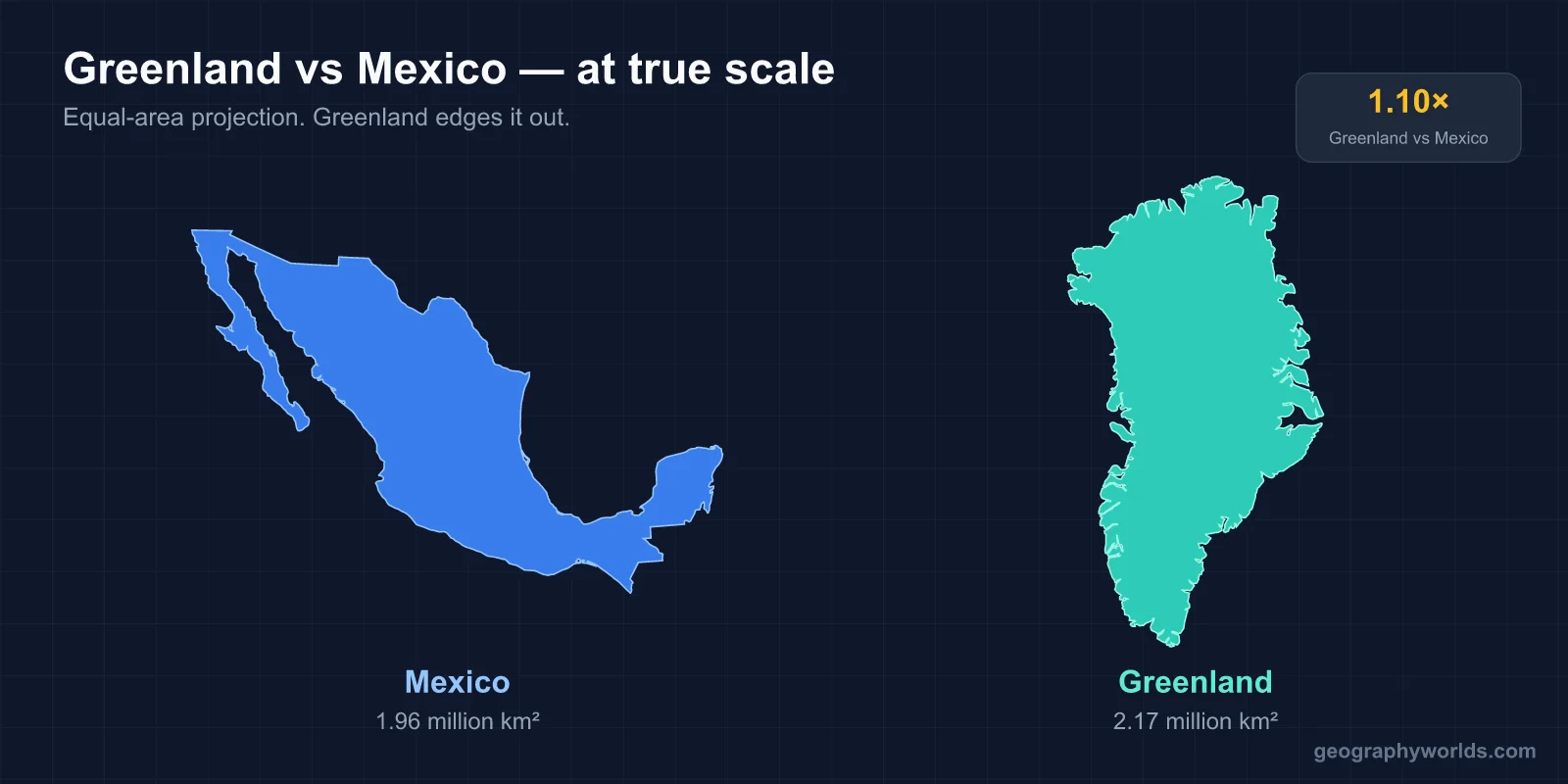
Greenland is the world's largest island; Mexico is one of the largest countries in North America. They share a continent (in the geographical sense — both sit on the North American plate), and they're close enough in size that the comparison is genuinely interesting. So which is bigger?
The Short Answer
Yes, Greenland is bigger than Mexico — barely. Greenland covers 2,166,086 km². Mexico covers 1,964,375 km². Greenland is approximately 10.3% larger than Mexico.
Side-by-Side Numbers
- Greenland area: 2,166,086 km² (836,330 sq mi)
- Mexico area: 1,964,375 km² (758,449 sq mi)
- Difference: Greenland is ~202,000 km² larger
- Ratio: Greenland is ~1.10× the size of Mexico
- Greenland population: ~56,000
- Mexico population: ~131 million
Greenland
Greenland is the world's largest island, an autonomous territory of the Kingdom of Denmark located in the North Atlantic and Arctic Oceans between Iceland and Canada. About 80% of Greenland is covered by an ice sheet — the second-largest body of ice on Earth — up to 3 km thick. The ice-free coastal regions support about 56,000 people, almost all of whom are Inuit (the indigenous Greenlanders) or of mixed Inuit-Danish ancestry.
Greenland is highly autonomous within the Kingdom of Denmark, with its own government, parliament (the Inatsisartut), and significant control over its own affairs. Denmark retains responsibility for foreign affairs and defense. Nuuk, the capital, has about 19,000 residents. The territory is strategically important due to its Arctic position, mineral wealth (rare earth elements, gold, uranium), and proximity to North America. The United States has expressed interest in buying Greenland multiple times, most recently in 2019 and again in 2024–2025.
Mexico
Mexico is a country in southern North America, bordered by the United States to the north, Belize and Guatemala to the south, the Pacific Ocean to the west, and the Gulf of Mexico and Caribbean Sea to the east. It is the 13th largest country in the world by area and the 10th most populous, with about 131 million people. Mexico is the largest Spanish-speaking country in the world by population. Mexico City, the capital, is one of the world's largest metropolitan areas with about 22 million people.
Mexico's geography is varied. The Sierra Madre Occidental and Sierra Madre Oriental mountain ranges run along the western and eastern sides of the country. The Central Mexican Plateau (which contains Mexico City) sits between them. Northern Mexico is mostly arid (the Chihuahuan and Sonoran deserts), while southern Mexico is more tropical and humid. The Yucatán Peninsula juts northeast into the Gulf of Mexico. Major rivers include the Rio Grande (forming much of the US border), the Usumacinta, and the Grijalva.
Population Contrast
The population gap is staggering. Mexico has 131 million people; Greenland has 56,000. Mexico has roughly 2,340 times more people than Greenland in roughly the same area. Mexico's population density is about 67 per km²; Greenland's is about 0.026 per km² — one of the lowest of any inhabited territory on Earth. Most of Greenland is uninhabitable due to ice cover; most of Mexico is densely populated, with central Mexico being one of the more densely settled regions of the Americas.
Climate
Greenland's climate is Arctic to subarctic. The far north has true polar conditions with permanent ice and minimal summer warming. The southern tip has a subarctic climate with relatively mild summers. The ice-free coastal regions support some vegetation, traditional Inuit communities, fishing, and limited agriculture (potatoes, root vegetables, sheep farming in the south).
Mexico spans tropical to temperate climates. Northern Mexico has hot deserts and semi-arid steppe. The Central Plateau, despite being south of the deserts, has mild climates due to elevation — Mexico City sits at 2,240 m and has spring-like temperatures year-round. Southern Mexico is tropical, with significant rainfall and lush vegetation. The country experiences hurricanes on both coasts, with the Pacific coast typically getting more intense storms.
Economic Comparison
Mexico is one of the world's major economies, with a GDP of about $1.8 trillion (15th largest in the world). It is a member of the G20, a major manufacturing hub (especially in autos, electronics, and aerospace), a top tourism destination (about 45 million international visitors per year), and the source of the largest immigrant population in the United States. Mexico's economy is closely integrated with the US and Canadian economies through the USMCA trade agreement.
Greenland's economy is dramatically smaller — about $3.2 billion GDP. The economy is dominated by fishing (especially halibut, prawns, and crab), which accounts for about 90% of exports. Tourism is growing, with about 100,000 international visitors per year. Mineral exploration has been increasing, with significant interest in rare earth elements, lead, zinc, and uranium. Denmark provides an annual block grant to support Greenland's budget — about $500 million per year, which represents over half of Greenland's public spending.
Strategic Geography
Both have significant strategic geography. Greenland sits at a crossroads of the Arctic, with key military and surveillance value. The US Thule Air Base (now Pituffik Space Base) has operated there since 1951. As Arctic ice retreats, new shipping lanes and resource extraction opportunities open up — making Greenland increasingly contested between Denmark, the US, China, and other Arctic powers. Mexico is strategically critical to the US for trade, migration policy, drug enforcement, and security. The 3,145 km US-Mexico border is one of the most-crossed international boundaries in the world, with about 400 million crossings annually.
History
Mexico has one of the longest documented histories in the Americas. Mesoamerican civilizations — the Olmecs, Mayans, Toltecs, Mixtecs, Zapotecs, Aztecs, and many others — built sophisticated cultures over thousands of years. The Spanish conquest of the Aztec Empire (1519–1521) under Hernán Cortés brought the region under European control for 300 years until Mexican independence in 1821. The 19th and 20th centuries saw the Mexican-American War (1846–1848, which transferred half of Mexico's territory to the US), the Mexican Revolution (1910–1920), and modernization under various governments.
Greenland's history is shorter but equally distinctive. The Inuit reached the island around 4,500 years ago via migrations from northeastern Canada. Vikings led by Erik the Red established settlements around 985 CE, with up to several thousand Norse Greenlanders at peak; these settlements mysteriously vanished by the 15th century, possibly due to climate change and cultural isolation. Denmark colonized Greenland in 1721, and the territory remained under Danish control until gaining home rule in 1979 and full self-governance in 2009.
Cultural Heritage
Mexico has one of the most influential cultures globally. Mexican food (tacos, mole, tequila, mezcal, chocolate which originated there), Mexican music (mariachi, rancheras, banda), Mexican cinema (Alejandro González Iñárritu, Alfonso Cuarón, Guillermo del Toro have all won Best Director Oscars in recent decades), and Mexican visual arts (Diego Rivera, Frida Kahlo) have spread worldwide. Mexico has 35 UNESCO World Heritage Sites, second only to Italy globally. Greenland has its own rich cultural heritage centered on Inuit traditions — including hunting, fishing, kayak design, storytelling, and music. Modern Greenlandic culture blends Inuit roots with Danish influence and increasing global connections. The territory has produced internationally recognized artists, filmmakers, and musicians.
Climate Change Frontline
Both face significant climate change challenges but in very different ways. Greenland's ice sheet is losing approximately 270 gigatons of ice per year, contributing significantly to global sea-level rise. Coastal communities in Greenland are seeing changes in sea ice that affect traditional hunting and fishing economies. Mexico faces a different set of climate threats — more frequent and severe hurricanes on both coasts, droughts in the north, water shortages affecting Mexico City and other major urban areas, and threats to agriculture from changing rainfall patterns. The North American Free Trade Agreement (USMCA) framework has included some climate provisions, but coordinated North American climate policy remains uneven.
Key Facts
- Greenland is about 10% larger than Mexico by area.
- Mexico has 2,340× more people than Greenland.
- Both sit on the North American tectonic plate.
- Greenland is the world's largest island; Mexico is the 13th largest country.
- Mexico is the largest Spanish-speaking country.
Fun Facts
- Greenland is part of the North American continent geographically but Europe politically.
- Mexico City is one of the highest-elevation major cities in the world.
- The northern tip of Greenland is closer to the North Pole than to its own capital.
- Mexico has the largest pyramid by volume in the world (the Great Pyramid of Cholula).
- Greenland's ice sheet contains enough water to raise global sea levels 7.2 m if melted.
The Bottom Line
Greenland is bigger than Mexico — by about 10%. The two share a continent geographically but exist in completely different realities: Greenland is mostly empty ice with a small Inuit population; Mexico is one of the world's most dynamic economies, with a vast and diverse population. Both will continue to play significant roles in North American and global affairs — Greenland increasingly so as the Arctic opens up to commerce and contestation.
Quiz North America!
Test your knowledge of Greenland, Mexico, and North American geography.
Play Geography Games →