
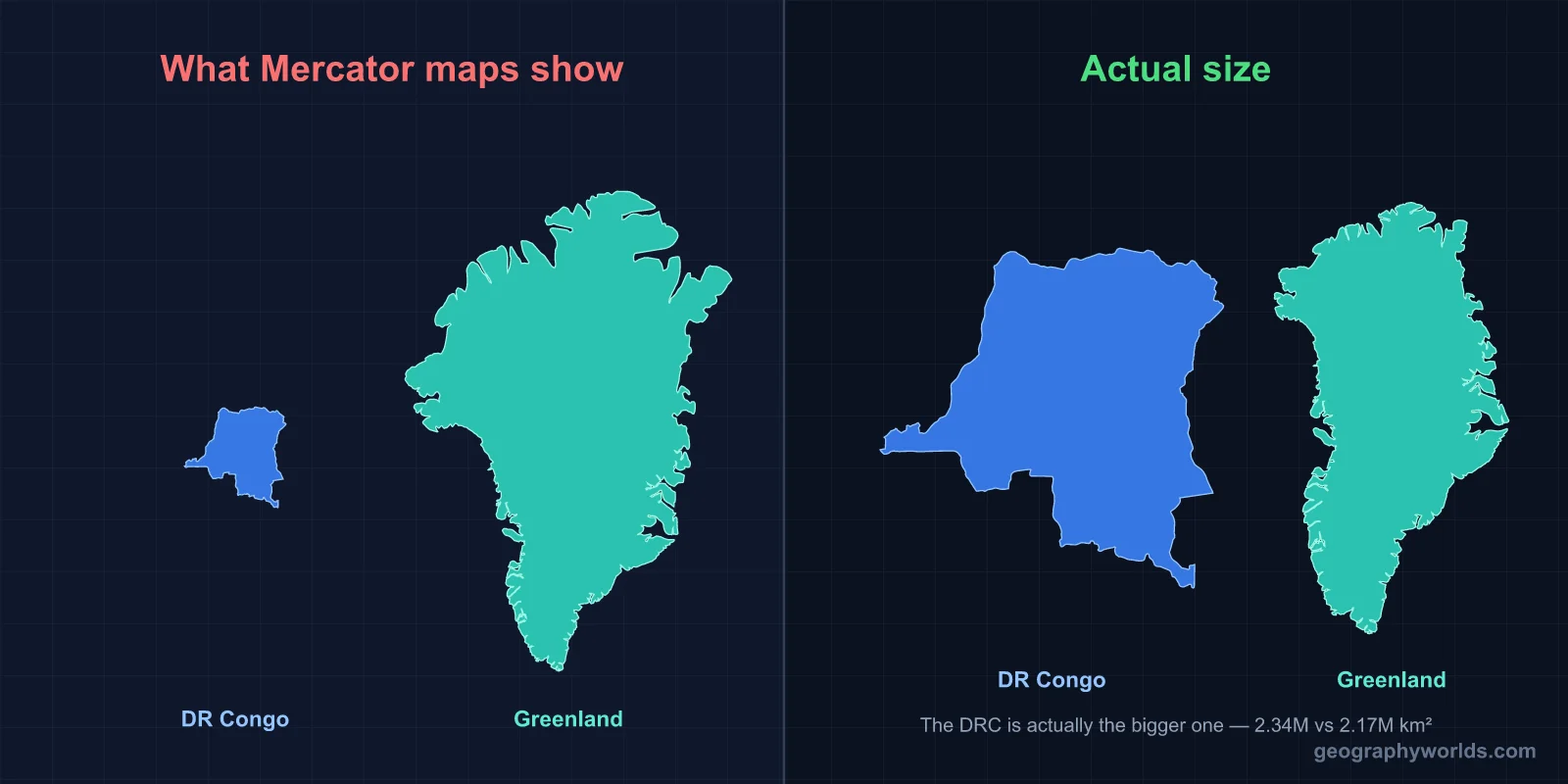
Greenland is the world's largest island; the Democratic Republic of the Congo (DRC) is the second-largest country in Africa and one of the most resource-rich nations on Earth. Both are immense by any measure. So which is bigger?
The Short Answer
No, the DRC is bigger than Greenland — but only by about 8%. The DRC covers about 2,344,858 km². Greenland covers 2,166,086 km². The DRC is approximately 178,000 km² larger. The two are remarkably close in size despite their wildly different climates and populations.
Side-by-Side Numbers
- DRC area: 2,344,858 km² (905,355 sq mi)
- Greenland area: 2,166,086 km² (836,330 sq mi)
- Difference: DRC is ~178,000 km² larger
- Ratio: DRC is ~1.08× the size of Greenland
- DRC population: ~102 million
- Greenland population: ~56,000
Greenland
Greenland is the world's largest island, an autonomous territory of the Kingdom of Denmark located in the North Atlantic and Arctic Oceans between Iceland and Canada. About 80% of Greenland is covered by an ice sheet — the second-largest body of ice on Earth — up to 3 km thick. The ice-free coastal regions support about 56,000 people, almost all of whom are Inuit or of mixed Inuit-Danish ancestry.
Greenland is highly autonomous within the Kingdom of Denmark, with its own government, parliament (the Inatsisartut), and significant control over its own affairs. Denmark retains responsibility for foreign affairs and defense. Nuuk, the capital, has about 19,000 residents. The territory is strategically important due to its Arctic position, mineral wealth (rare earth elements, gold, uranium), and proximity to North America.
The Democratic Republic of the Congo
The DRC is in Central Africa and is the second-largest country in Africa after Algeria. It is bordered by 9 other countries (Republic of the Congo, Central African Republic, South Sudan, Uganda, Rwanda, Burundi, Tanzania, Zambia, Angola) and has a very short coastline (about 37 km) on the Atlantic at the mouth of the Congo River. The DRC is the 11th largest country in the world by area.
The country is dominated by the Congo Basin — the world's second-largest rainforest after the Amazon. The Congo River, the second-longest in Africa and the world's deepest river (over 220 m in places), flows through the country before emptying into the Atlantic. The DRC has enormous mineral wealth — it holds about 70% of the world's cobalt reserves, plus major deposits of copper, gold, diamonds, coltan, and rare earth elements. Kinshasa, the capital, has about 17 million people, making it one of the largest cities in Africa.
Population Contrast
The population gap is staggering. The DRC has about 102 million people; Greenland has 56,000. The DRC has roughly 1,820 times more people than Greenland in only 8% more land. The DRC's population density is about 44 per km²; Greenland's is about 0.026 per km² — one of the lowest of any inhabited territory on Earth. Most of Greenland is uninhabitable due to ice; most of the DRC supports tropical agriculture and rainforest communities.
Climate
Greenland's climate is Arctic to subarctic. The far north has true polar conditions with permanent ice and minimal summer warming. The southern tip has a subarctic climate with relatively mild summers. The ice-free coastal regions support some vegetation, traditional Inuit communities, fishing, and limited agriculture (potatoes, root vegetables, sheep farming in the south).
The DRC has a tropical climate dominated by the Congo Basin rainforest. The equator runs through the country, so seasonal variations are minimal. Annual rainfall in the rainforest exceeds 2,000 mm in most areas, supporting dense forest cover. The highlands of the east (along the Albertine Rift) are cooler and host different ecosystems. The DRC is home to gorillas (eastern and western lowland), forest elephants, okapi (the country's national animal, found only in the DRC), bonobos, chimpanzees, and a vast range of birds, reptiles, and insects.
Economy
Both economies are dominated by natural resources but in very different categories. Greenland's economy is small — about $3.2 billion GDP — and dominated by fishing (especially halibut, prawns, and crab), which accounts for about 90% of exports. Tourism is growing, with about 100,000 international visitors per year. Mineral exploration has been increasing, with significant interest in rare earth elements, lead, zinc, and uranium. Denmark provides an annual block grant of about $500 million.
The DRC has a GDP of about $66 billion — small relative to its size but growing. The economy is dominated by mining — the country produces about 70% of the world's cobalt (essential for batteries in electric vehicles and electronics) and is a major copper producer. Despite its enormous mineral wealth, the DRC remains one of the poorest countries in the world by GDP per capita due to a combination of factors: legacy of brutal Belgian colonization (1885–1960, when King Leopold II personally owned the territory and oversaw atrocities that killed millions), continued resource extraction by foreign companies, ongoing conflict in eastern provinces, and weak governance.
Resource Wealth
Both regions are sitting on enormous mineral wealth. Greenland is at the center of the new global competition for rare earth elements and Arctic minerals. As the ice sheet retreats due to climate change, mineral exploration becomes more feasible, attracting interest from Denmark, the US, China, the EU, and others. Specific resources include rare earth elements, uranium, zinc, lead, and potentially oil and gas (though oil exploration was banned by the Greenlandic government in 2021). The DRC's mineral wealth is well-documented and globally critical. Beyond cobalt and copper, the country has major deposits of gold, diamonds, tin, tungsten, coltan (used in capacitors for electronics), and increasingly lithium. The "battery minerals" the world needs for the green transition are disproportionately found in the DRC.
Strategic Importance
Both have growing strategic importance. Greenland sits at a crossroads of the Arctic, with key military and surveillance value. The US Thule Air Base (now Pituffik Space Base) has operated there since 1951. As Arctic ice retreats, new shipping lanes and resource extraction opportunities open up — making Greenland increasingly contested between Denmark, the US, China, and other Arctic powers. The DRC is critical to the global energy transition because of its mineral wealth. The country has significant geopolitical importance for the EU, US, and China, all of which are trying to secure mineral supply chains. Eastern DRC continues to experience conflict involving rebel groups, Rwandan military activity, and humanitarian crises.
Climate Change
Both regions are on the front line of climate change in different ways. Greenland is losing ice mass at an accelerating rate — about 270 gigatons per year on average. The Greenland Ice Sheet's contribution to global sea-level rise has been a major focus of climate science for decades. If the entire ice sheet melted, global sea levels would rise about 7.2 m, with catastrophic effects on coastal cities worldwide. The Congo Basin rainforest is one of the world's largest carbon sinks, storing an estimated 60 billion tons of carbon. Deforestation, while less than in the Amazon, is accelerating due to agriculture, logging, and mining pressures. The DRC's political instability complicates conservation efforts.
History
The DRC has one of the most tragic colonial histories in Africa. King Leopold II of Belgium personally owned the territory from 1885 to 1908 as the "Congo Free State," extracting rubber and ivory while perpetrating violence and forced labor that killed an estimated 8–10 million Congolese. The territory became the Belgian Congo (a more conventional colony) in 1908 and gained independence in 1960. Patrice Lumumba, the first prime minister, was assassinated within months. Decades of conflict and Mobutu's kleptocratic rule followed. The First and Second Congo Wars (1996–2003) involved 9 African nations and killed millions, the deadliest conflicts since World War II. Greenland's modern history is much shorter and far less violent. Norse settlers from Iceland and Norway colonized Greenland starting in the 980s under Erik the Red, but mysteriously disappeared by the 1400s. Denmark recolonized in 1721 and Greenland has been moving toward greater autonomy ever since, gaining home rule in 1979 and full self-government in 2009.
Key Facts
- The DRC is about 8% larger than Greenland by area.
- The DRC has 1,820× more people than Greenland.
- The DRC produces about 70% of the world's cobalt.
- Greenland is the world's largest island.
- Both face significant climate change pressures.
Fun Facts
- The Congo River is the world's deepest river (over 220 m in places).
- Greenland's population is about 56,000 — fewer than most US small cities.
- The DRC has the world's highest concentration of cobalt.
- The Greenland Ice Sheet contains enough water to raise global sea levels 7.2 m.
- Both regions are major centers of geopolitical attention.
The Bottom Line
The DRC is bigger than Greenland — but only by about 8%. The two regions could not be more different demographically and climatically: a vast tropical African nation of 102 million people versus an Arctic ice-covered island of just 56,000. Both sit on enormous mineral wealth that the world increasingly needs, and both will continue to be central to global resource competition and climate change concerns in the decades ahead.
Quiz Resource-Rich Regions!
Test your knowledge of Greenland, the DRC, and the world's biggest places.
Play Geography Games →