
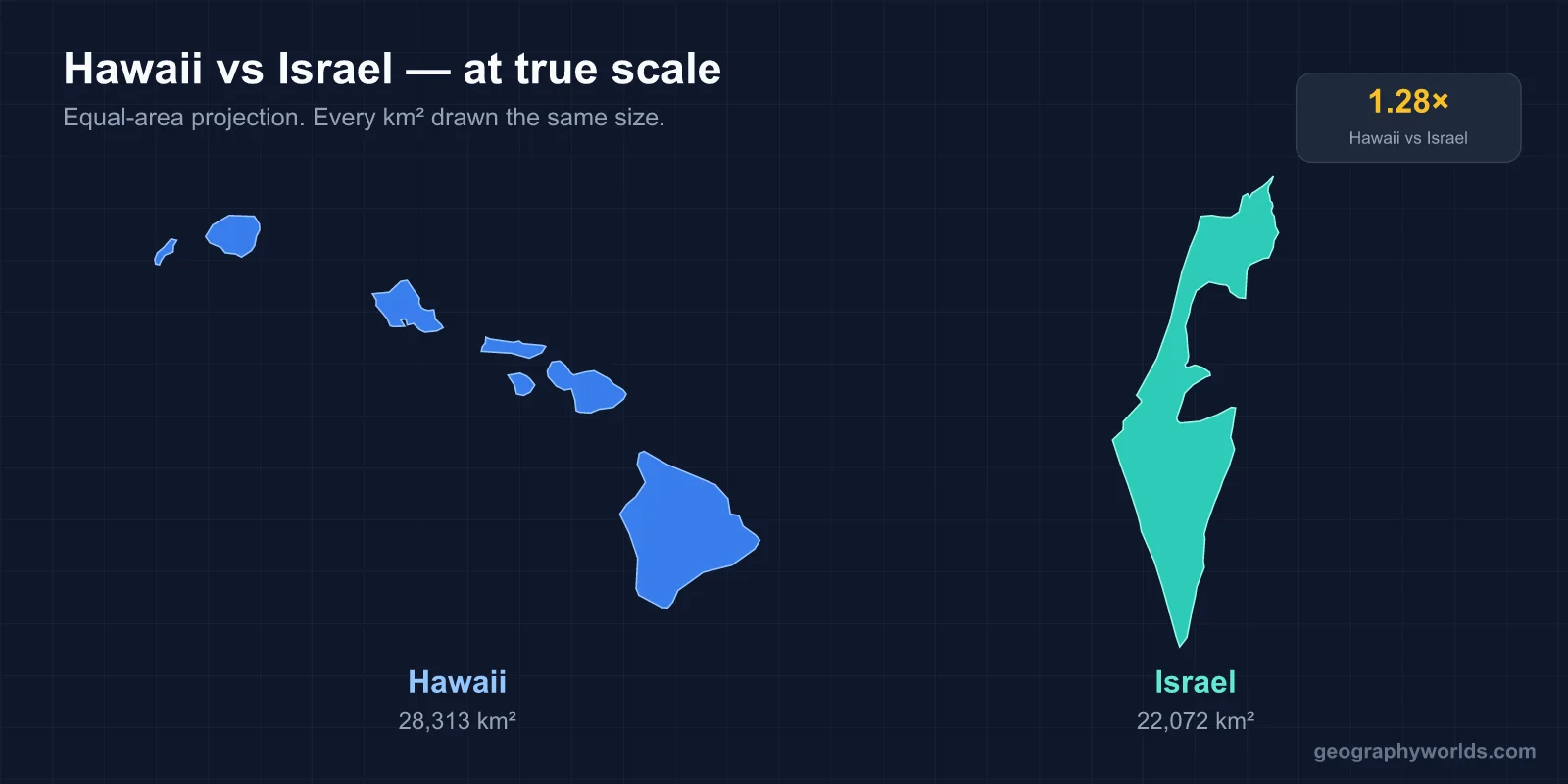
Yes. Hawaii is larger than Israel. Hawaii covers 28,313 km², while Israel covers 22,072 km². Hawaii is about 1.28 times the size of Israel — larger by 6,241 km², which is about the size of Brunei or Luxembourg. But Israel has more than 7 times more people than Hawaii (9.7 million vs 1.4 million).
The Short Answer
Hawaii is the 47th-largest US state and one of two states (with Alaska) not on the North American mainland. Israel is a small but globally significant country in the Middle East. The two are comparable in size — both around 20,000-30,000 km² — but have completely different geographies, climates, demographics, and historical contexts.
Hawaii consists of 137 volcanic islands in the Pacific Ocean, 5 of which are major. Israel is a Mediterranean country in Western Asia, bordering Lebanon, Syria, Jordan, Egypt, and the Palestinian territories.

The Real Numbers
- Hawaii total area: 28,313 km² (10,931 sq mi)
- Israel total area: 22,072 km² (8,522 sq mi)
- Difference: 6,241 km² — about the size of Brunei
- Ratio: Hawaii is about 1.28× the size of Israel
Population
Israel has dramatically more people:
- Israel population: ~9,700,000
- Hawaii population: ~1,400,000
- Israel density: ~440 people per km²
- Hawaii density: ~49 people per km²
Israel has about 7× more people than Hawaii. Israeli density is about 9× higher. Israel is one of the most densely populated countries with significant land; Hawaii is sparsely populated for a US state, with most of its population on Oahu.
Geography
Hawaii is an island chain of volcanic origin:
- Hawaii (Big Island): Largest island, 10,432 km², home to Mauna Kea (4,207 m above sea level)
- Maui: 1,884 km² — popular tourist destination
- Oahu: 1,545 km² — home to Honolulu and most of Hawaii's population
- Kauai: 1,430 km² — the "Garden Isle"
- Molokai, Lanai, Niihau, Kahoolawe: Smaller main islands
- Northwestern Hawaiian Islands: Small atolls and reefs
Israel has remarkable geographic diversity in a small package:
- Mediterranean coast: 273 km of coastline
- Galilee region: Northern hills and the Sea of Galilee
- Jordan Valley and Dead Sea: Lowest point on Earth's surface at -430 m
- Negev Desert: Southern desert covering 60% of Israel
- Mount Hermon area: In the far north, Israel's highest point at 2,236 m
- Red Sea coast: Short coastline at Eilat
Climate
Hawaii has tropical climate. Temperatures stay relatively consistent year-round (22-28°C), but vary significantly by elevation. Coastal areas are warm; the summits of Mauna Kea and Mauna Loa can drop below freezing and even have snow. Rainfall varies dramatically — windward sides receive heavy rain while leeward sides are dry.
Israel has Mediterranean to desert climate. The coast (Tel Aviv) has hot dry summers and mild wet winters. Jerusalem has cooler temperatures due to elevation. The Negev Desert is hot and dry. The Dead Sea region is one of the hottest places in the country with summer temperatures over 40°C.
Economy
Israel has a dramatically larger economy:
- Israel GDP: ~$525 billion
- Hawaii GDP: ~$108 billion
- Israel per capita GDP: ~$54,000
- Hawaii per capita GDP: ~$77,000
Israel's economy is about 4.9× larger than Hawaii's in absolute terms, but Hawaii is about 43% richer per capita. Israel is famous as a "Startup Nation" — the country has more startups per capita than nearly any other country. Major Israeli companies and industries include technology (Wix, Mobileye, Check Point), pharmaceuticals (Teva), defense, agriculture (Israel pioneered drip irrigation), and tourism.
Hawaii's economy depends heavily on tourism (~25% of GDP), defense (military bases), agriculture (sugar, pineapple, macadamia nuts, coffee), and services. Tourism brings about 10 million visitors annually.
Religion and Culture
Israel is the world's only Jewish-majority country — about 74% Jewish, 18% Muslim, 2% Christian, 2% Druze, and other religious minorities. Hebrew is the dominant language, with Arabic as a second official language. Israel was founded in 1948 as a homeland for the Jewish people. The country contains many of Judaism, Christianity, and Islam's most sacred sites — especially in Jerusalem.
Hawaii has a diverse population with no single ethnic majority. About 25% Asian, 25% white, 10% Native Hawaiian or Pacific Islander, with significant mixed-race population. Major religions include Christianity, Buddhism, and Native Hawaiian spiritual traditions. English is the dominant language, but Native Hawaiian (ʻŌlelo Hawaiʻi) is also an official language.
History
Hawaii was settled by Polynesians around 300-600 AD. The Hawaiian kingdom was unified by King Kamehameha I in 1810. American settlers and businesses gained increasing influence; in 1893, the Hawaiian monarchy was overthrown by American interests. Hawaii became a US territory in 1898 and the 50th US state in 1959.
Israel was established as a state in 1948 after the United Nations partition of British Mandate Palestine. The country has experienced multiple wars with neighboring Arab states (1948, 1956, 1967, 1973) and ongoing conflict with Palestinians. Despite security challenges, Israel has built a developed economy and one of the most innovative tech sectors in the world.
Key Facts
- Hawaii is about 1.28× the size of Israel.
- Israel has 7× more people than Hawaii.
- Israel is one of the most densely populated countries; Hawaii is less densely populated.
- Israel's economy is 4.9× larger than Hawaii's.
- Hawaii is a US state; Israel is a sovereign country.
Fun Facts
- Hawaii has 11 of the 13 climate zones in the world — only the truly arctic and the Sahara-like hot desert are missing.
- Israel's Dead Sea is the lowest point on Earth's surface (-430 m).
- Mauna Kea in Hawaii is technically the tallest mountain on Earth from base (ocean floor) to summit (10,210 m total).
- Israel has more museums per capita than any country in the world.
- Hawaii is the most isolated population center on Earth — over 4,000 km from any continent.
Innovation and Technology
Israel is one of the most innovative countries in the world. The country has the highest R&D spending as a percentage of GDP among OECD countries. Major Israeli tech and pharmaceutical companies include Teva, Mobileye (autonomous driving), Check Point Software, Wix, Waze, and many startups. Tel Aviv is one of the world's top startup hubs.
Hawaii's economy is more concentrated in tourism, defense, and agriculture. However, Hawaii is home to important astronomical research at Mauna Kea (one of the best observation sites in the world) and the University of Hawaii system. Hawaii also hosts significant US military presence — Pearl Harbor remains a major naval base.
Travel and Connections
Hawaii is one of the most isolated population centers on Earth. The state is over 4,000 km from the nearest continent. Travel to Hawaii typically involves long flights — about 5 hours from California, 8 hours from Tokyo, 10 hours from Sydney. Despite this, Hawaii attracts about 10 million international and domestic tourists annually.
Israel is well-connected by air and land. Ben Gurion Airport is a major Middle Eastern hub. Israel's land borders with Egypt and Jordan are largely closed but functional. Diplomatic relations and travel restrictions with Arab neighbors have eased in recent years (Abraham Accords). Israel receives about 4-5 million international tourists annually, focused on religious, historical, and beach tourism.
The Bottom Line
Hawaii is bigger than Israel by area (28% larger), but Israel has 7× more people and a much larger economy. Both punch above their weight in global attention — Hawaii as one of the world's most famous vacation destinations, Israel as a major center of technology and Middle East geopolitics. Both have unique cultures shaped by geographic isolation (Hawaii's Pacific position, Israel's diaspora-based founding), and both have outsized cultural influence relative to their physical size. Both also face unique challenges — Hawaii with sustainability concerns over tourism, native Hawaiian rights, and rising sea levels; Israel with ongoing conflicts, water scarcity, and demographic challenges. Their stories continue to be told globally, even though both are relatively small in geographic terms. The two places represent something deeper about how identity, history, and culture often matter more than land area in shaping global influence. Both Hawaii and Israel show that small places can have outsized roles in world affairs when culture, religion, technology, or strategic position give them special significance. The next time you look at a map and think about which places "matter," remember that area is just one measure — and often not the most important one. Hawaii and Israel are reminders that big things can happen in small places. Both will continue to shape global culture, politics, and economics far beyond what their geographic footprints might suggest. The Hawaii-Israel comparison is also a reminder of the diversity of human experience — two remarkable places shaped by very different histories yet both essential to their respective regions.