
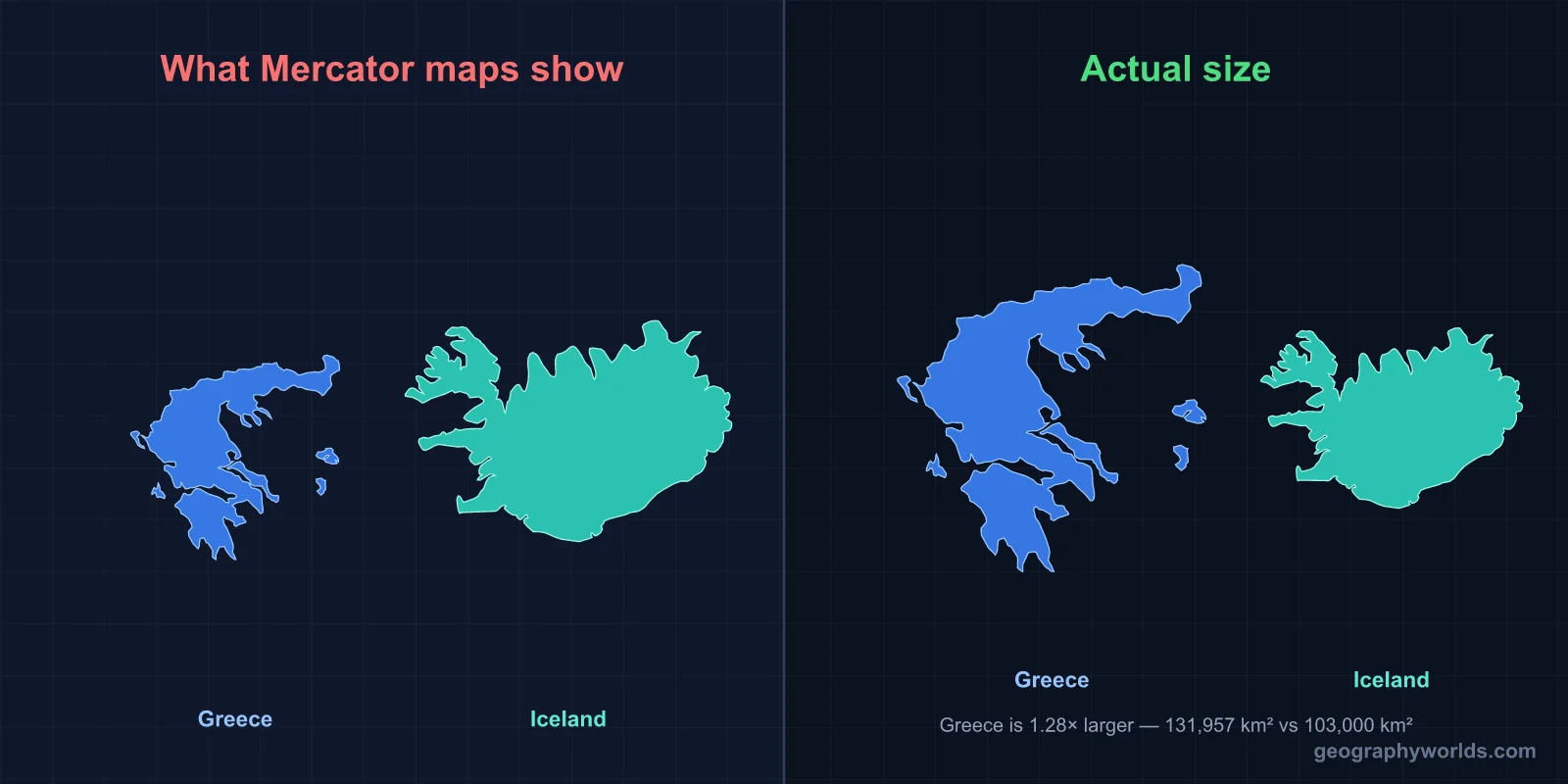
Iceland and Greece sit at opposite climatic ends of Europe — Iceland just south of the Arctic Circle, Greece in the southeastern Mediterranean. Both are island-rich nations with major cultural influence relative to their populations. So which is bigger?
The Short Answer
No, Greece is bigger than Iceland. Greece covers 131,957 km². Iceland covers 103,000 km². Greece is approximately 28% larger than Iceland.
Side-by-Side Numbers
- Iceland area: 103,000 km² (39,769 sq mi)
- Greece area: 131,957 km² (50,949 sq mi)
- Difference: Greece is ~29,000 km² larger
- Ratio: Greece is ~1.28× the size of Iceland
- Iceland population: ~395,000
- Greece population: ~10.4 million
Iceland
Iceland is a North Atlantic island nation, located just south of the Arctic Circle between Greenland and Norway. The country sits atop the Mid-Atlantic Ridge — the boundary between the North American and Eurasian tectonic plates — making it one of the most geologically active places on Earth. Iceland has approximately 130 volcanoes, including over 30 active volcanic systems, geysers, hot springs, and vast lava fields. About 11% of the island is covered by glaciers.
Iceland's capital, Reykjavík, is home to about 140,000 people in the city and 230,000 in the metro area — more than half of the country's population. The country was settled by Norse Vikings in the late 9th century, with significant Celtic influence from enslaved peoples brought from Ireland and Scotland. It became fully independent from Denmark in 1944.
Greece
Greece is in southeastern Europe at the southern tip of the Balkan Peninsula. It borders Albania, North Macedonia, Bulgaria, and Turkey on the mainland, with extensive coastlines along the Aegean Sea (east), the Ionian Sea (west), and the Mediterranean Sea (south). Greece consists of a mainland and over 6,000 islands and islets, of which about 200 are inhabited. The country has one of the longest coastlines in the world relative to its land area — about 13,676 km, including all islands.
Greece is mostly mountainous. The Pindus Mountains run down the spine of mainland Greece; Mount Olympus (2,917 m), the mythological home of the Greek gods, is the highest peak. The country's most famous islands include Crete (the largest), Rhodes, Corfu, Santorini, and Mykonos. Athens, the capital, has about 3.1 million in its metro area.
Population Contrast
The population gap is dramatic. Greece has about 10.4 million people; Iceland has about 395,000. Greece has 26 times more people in 28% more area. Population density: Greece about 79 per km², Iceland about 4 per km². Iceland is one of the most sparsely populated countries in Europe; Greece is moderately populated.
Climate
The two have radically different climates. Iceland is just south of the Arctic Circle. Summers are mild (10–15°C), winters are surprisingly mild for the latitude (mostly just below freezing) thanks to the Gulf Stream, but the country is wet, windy, and changeable. Iceland gets nearly 24 hours of daylight in mid-summer and only 4 hours in mid-winter. The interior highlands have a polar climate.
Greece has a Mediterranean climate. Summers are hot and dry — coastal regions stay between 28–35°C, with low rainfall. Winters are mild and wetter. The mainland's mountainous interior has continental influences with cold winters. The Aegean islands are warmer and drier; the Ionian islands wetter. Snow falls in the mountains in winter, and ski resorts operate in northern Greece.
Economy
Both economies are smaller than their cultural impact suggests. Iceland has a GDP of about $30 billion. Major industries include fishing (still about 30% of exports), aluminum smelting (using cheap geothermal and hydroelectric power), tourism (which has exploded since the 2010s), and increasingly tech and biotech. Greek GDP is about $245 billion. Major industries include tourism (the largest contributor to GDP), shipping (Greek shipowners control about 20% of the world's shipping tonnage), agriculture (olive oil, wine, fruit), and increasingly technology and renewable energy.
Volcanic and Tectonic Activity
Both sit on geological hot spots. Iceland is one of the most geologically active places on Earth. The Mid-Atlantic Ridge runs directly through the island, splitting it between the North American and Eurasian plates. The country averages about one volcanic eruption every five years. Major recent eruptions include Eyjafjallajökull (2010, which famously shut down European air travel for a week), Holuhraun (2014), and Fagradalsfjall (2021–2023). Greece is geologically active too — the country sits at the boundary between the African and Eurasian plates and is one of the most earthquake-prone regions in Europe. The Hellenic Trench off Greece's south coast produces frequent earthquakes. Santorini is a famous volcanic island, with the massive Minoan eruption (around 1600 BCE) being one of the largest in human history.
History and Civilization
Greece is the birthplace of Western civilization. Ancient Greek city-states — Athens, Sparta, Corinth, Thebes — produced foundational works of philosophy (Socrates, Plato, Aristotle), drama (Aeschylus, Sophocles, Euripides), poetry (Homer), mathematics (Euclid, Archimedes), and political theory (the Athenian democracy). Greece was part of the Roman, Byzantine, and Ottoman Empires for centuries before gaining independence from the Ottomans in 1830. Iceland's history is shorter but distinctive. Norse Vikings settled the island starting around 870 CE. The Icelandic Alþingi — the world's oldest continuously-functioning parliament — was founded around 930 CE at Þingvellir. Iceland was under Norwegian rule from 1262 and then Danish rule from 1380 until full independence in 1944. Icelandic literature (the medieval sagas) is among the great works of world literature.
Tourism
Both are major tourism destinations relative to their populations. Iceland's tourism boom in the 2010s saw visitor numbers explode from about 500,000 in 2010 to 2.3 million in 2018 (about 6× the country's population). Top attractions include the Blue Lagoon, the Golden Circle (Geysir, Gullfoss, Þingvellir), glaciers, waterfalls, the South Coast, and Reykjavík. Greece welcomes about 32 million international visitors per year. Top destinations include the Acropolis in Athens, Delphi, Olympia, Mycenae, the Aegean islands (Santorini, Mykonos, Crete, Rhodes), and the Ionian islands.
Cuisine
Both have distinctive food cultures. Icelandic cuisine reflects the country's climate and history — heavy on fish (cod, haddock, herring), lamb, dairy products (skyr — a yogurt-like product is internationally exported), and traditional preserved foods (fermented shark, smoked lamb, dried fish). Greek cuisine is one of the foundational Mediterranean diets — olive oil, fresh vegetables, fish, lamb, cheese (feta), and herbs. Famous dishes include moussaka, souvlaki, tzatziki, dolmades, baklava, and Greek salad. Greek wine traditions go back thousands of years.
Energy
Iceland is a global leader in renewable energy. About 100% of its electricity comes from renewables — primarily hydroelectric (70%) and geothermal (30%). Geothermal also provides about 90% of the country's heating. The combination of cheap green energy has made Iceland an unlikely hub for energy-intensive industries like aluminum smelting, server farms, and data centers. Greece has been scaling up renewables rapidly — solar and wind energy now account for over 40% of electricity, and the country has committed to phasing out lignite coal by 2028. Greece has significant offshore wind potential in the Aegean.
Diaspora
Both countries have substantial diasporas relative to their populations. The Greek diaspora numbers about 5 million worldwide — a 1:2 ratio to the home country population. Major communities exist in the US (especially New York and Chicago), Australia (Melbourne has more Greeks than any city outside Athens), Canada, and Germany. The Icelandic diaspora is smaller in absolute numbers (about 200,000–300,000 globally) but enormous relative to Iceland's population of 395,000. The largest community of Icelandic descent is in Manitoba, Canada (a major destination for 19th-century Icelandic emigration).
Key Facts
- Greece is about 28% larger than Iceland by area.
- Greece has 26× more people than Iceland.
- Iceland is one of the most volcanically active places on Earth.
- Greece has over 6,000 islands; Iceland is one main island with smaller surrounding islands.
- Both have ancient parliamentary traditions (Iceland's Alþingi, Athens's democracy).
Fun Facts
- Iceland has more sheep than people.
- Greece has more archaeological sites than any other country relative to its size.
- Iceland's parliament is the world's oldest continuously-functioning legislature.
- Mount Olympus is the mythological home of the Greek gods.
- Both countries have major Indian Ocean and Atlantic/Mediterranean shipping connections.
- Iceland is the only NATO member without a standing military.
- Greece has been a NATO member since 1952.
- Both have shipping fleets disproportionate to their populations.
- Iceland gained full independence in 1944; Greece in 1830.
- Both are major destinations for cruise ship tourism.
The Bottom Line
Greece is bigger than Iceland — by about 28%. Both are small-to-medium-sized European countries with major cultural impact: Greece as the birthplace of Western civilization, Iceland as a uniquely positioned island nation with outsized influence in literature, energy, and tourism. Both punch well above their physical size on the global stage.
Quiz European Nations!
Test your knowledge of Iceland, Greece, and great European countries.
Play Geography Games →